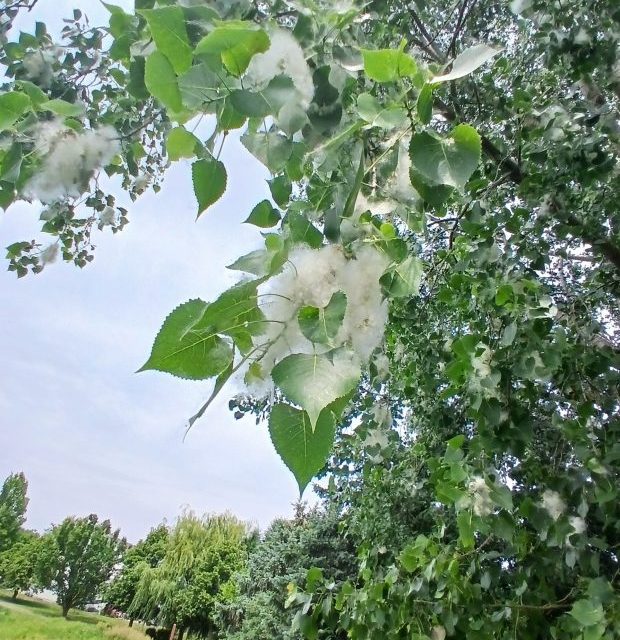
Growing up, you might have seen tiny cotton-like fluffs drifting in the wind during June. These fluffs are the seeds of the eastern cottonwood tree. As children, the fluttering seeds often appear like a snowstorm, gathering in piles along sidewalks. The cottonwood’s ‘snowfall’ still enchants neighborhoods today.
Recently, I explored two forest preserves in Lake County to identify more signs of these fascinating trees. Eastern cottonwoods are easily recognized by their 3- to 7-inch-long, triangular leaves with small, rounded edges and a pointed tip.
The eastern cottonwood, part of the poplar family, is known for rapid growth. It can reach over 100 feet and live for more than 100 years. Illinois boasts a giant cottonwood in Ogle County, towering at 122 feet and potentially 200 years old. A different species, the smaller swamp cottonwood, resides only in Illinois’s southern areas.
Cottonwoods prefer moist locations, often thriving along rivers and lakes. Young cottonwoods feature greenish-gray bark, while mature trees develop furrowed gray bark. Their leaves are attached to long stems that make them flutter in the breeze, much like the quaking aspen.
The eastern cottonwood’s fluff marks the beginning of summer in northeastern Illinois, as locals like Bill Richmond recall from childhood memories.
The tree’s seeds emerge after the cottonwood reaches about 10 years, with peak seed production at age 30. Only female trees yield cotton. In spring, flowers on catkins of these trees bloom, with male catkins releasing pollen to fertilize female ones. The seeds, equipped with white hairs called pappi, float in the air and water, traveling great distances.
Some appreciate cottonwood seeds as a summer signifier, while others dislike the mess. It’s common to blame sneezes on floating seeds, but allergies are typically due to other pollen, like from oaks. Cottonwoods present challenges, with their sprawling roots affecting plumbing and septic systems. Their limbs break easily, posing hazards during strong winds. Due to these issues, places like Glencoe ban cottonwoods on public land, and Glenview ranks them as lesser quality compared to other trees. Habitats managed by Lake County Forest Preserves and Forest Preserves of Cook County sometimes remove them for ecosystem balance.
Historically, Native Americans used cottonwood bark and roots for food, medicine, and ceremonial purposes. Today, the bark is turned into pulpwood and kitchen tools. Wildlife benefits from cottonwoods as well. Baltimore orioles and great blue herons nest on them. Bald eagles, such as those in Chicago, also use these trees for nesting. Cottonwoods provide food and habitat; rose-breasted grosbeaks eat seeds, and cedar waxwings consume flowers. Beavers feast on bark and leaves, and the roots assist in preventing streambank erosion.
Cottonwoods hold an essential place in nature, offering habitat and ecological benefits, much like the esteemed oak. Areas along the Des Plaines River, like Ryerson and Half Day Woods, witness the charm of these trees. Appreciating cottonwoods aids in understanding their significance in our environment.
 Communities Continuing Recovery from Hurricane Helene Explored through Graphic Novel
  The Fascinating Alignment of Cities and the Sun
  Fat Bear Week 2026 Highlights: Meet the Competitors
  Annual Fat Bear Week Begins at Katmai National Park
  Understanding Hurricane Development
  California Prepares for El Niño-Fueled Storms with Emergency Declaration