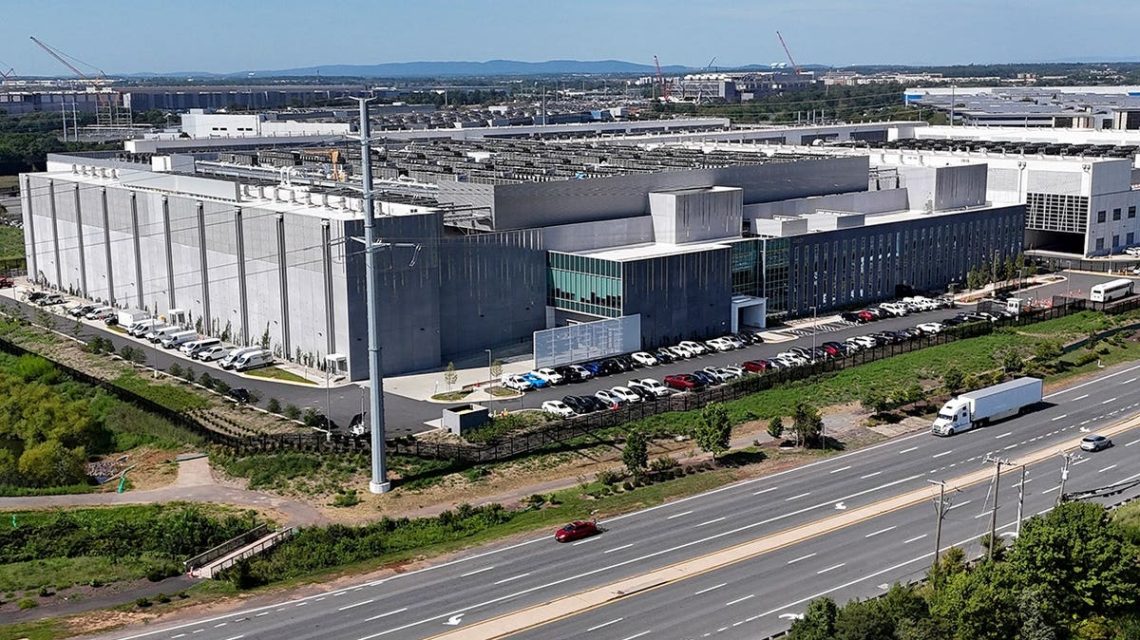
Efforts to bolster the infrastructure supporting America’s technological goals face challenges from local communities opposed to hosting such projects. This situation contrasts Washington’s attempts to stay competitive with China against increasing local discontent.
Representative Suhas Subramanyam of Virginia, who serves the area known as America’s ‘Data Center Alley,’ cautions that local opposition could hinder the progress Washington deems essential unless Congress intervenes. He highlights the necessity of gaining community support to maintain momentum in expansion.
‘The communities are feeling overwhelmed by industry pressure and feel unheard,’ Subramanyam shared.
Subramanyam proposes a federal plan aimed at resolving the conflict between unchecked development and complete bans. His proposal comprises addressing location choices, utility costs, energy and water metrics, and security for facilities and their surrounding areas.
A case in point is Ashburn, Virginia; the hub of Data Center Alley, where community dissatisfaction is notable.
If you’re concerned about competition with China regarding data centers and AI, collaborating on a community-inclusive plan should be a priority, he argues.
The Fair Share Act introduced by Subramanyam encourages states to make substantial power consumers bear a greater share of infrastructure expenses required to support them.
At the federal level, withholding federal funding for non-compliance would ensure cooperation, he adds, stressing data centers should contribute fairly to infrastructure costs.
Recent reports from Fox News Digital highlighted noise and encroachment complaints arising from a large data center adjacent to an Ashburn cul-de-sac.
Despite acknowledging infrastructure necessity, Subramanyam’s district residents criticize the uneven distribution of associated costs and burdens.
Loudoun County reports data center revenue has enabled it to decrease its real-property tax rate, from $1.145 per $100 of assessed value in 2016 to $0.805 in 2026.
However, Subramanyam advises weighing these benefits against costs that arise elsewhere, particularly on utility bills.
‘What isn’t acceptable is the escalation of utility costs and communities funding the power infrastructure,’ he stated. Concerns also extend to water, air quality, and other community aspects.
The sector denies that data centers are causing increased residential power bills, citing an analysis from E3, an energy consulting group, which found no historical link between data centers and rising residential electricity costs under existing rate structures.
Fox News Digital approached the Data Center Coalition, based in Data Center Alley, for comments on the proposed package.
Subramanyam believes infrastructure of national significance cannot progress on an ‘ad hoc’ basis under disparate state and local regulations.
Additional proposal components include establishing federal standards for siting and measurement, alongside security measures against critical infrastructure threats, both domestically and abroad.
Spanberger outlines the necessity for increased local governance, reallocating infrastructure costs to major power users, and setting new standards for water usage and grid reliability.
Spanberger shared her insights on data centers’ impacts, including on electric bills, water, land, air, and quality of life, during her September address to Fox News Digital.
Political leaders, across the spectrum, accentuate the complexity and significance of the issue. Texas Governor Greg Abbott, alongside others, devises plans addressing data centers’ concerns.
West Virginia pursues a divergent tactic by initiating a microgrid program for welcoming large-scale undertakings, sparking debate on local power limitations while proponents explore potential tax elimination.
A forum in Shepherdstown, with Jefferson County stakeholders, drew scrutiny over possible loss of local control. Cara Keys, county Commissioner, noted the duality of supporting data centers while opposing absent regulations.
‘You can back data centers and yet oppose lack of legal guardrails,’ Keys articulated.
For Subramanyam, the divergent strategies on either side of the Blue Ridge underscore the patchwork needing federal action before local resistance intensifies.
The absence of viable strategies requires either complete inaction or total bans, neither of which he considers suitable moving forward.
Subramanyam’s background includes being born and raised in Allentown, Pennsylvania, with professional experience spanning both New York and Washington bureaus of Fox News since 2013.
 Jay Clayton Appointed as White House AI Czar
  The Growing Role of AI in Immigration Law
  Growing Threat of AI-Driven Scams and Deepfakes
  Trump Announces Creation of New AI Coordination Force
  The Challenges and Risks of Autonomous AI Models
  Conservative Activist Urges AI Safety Measures