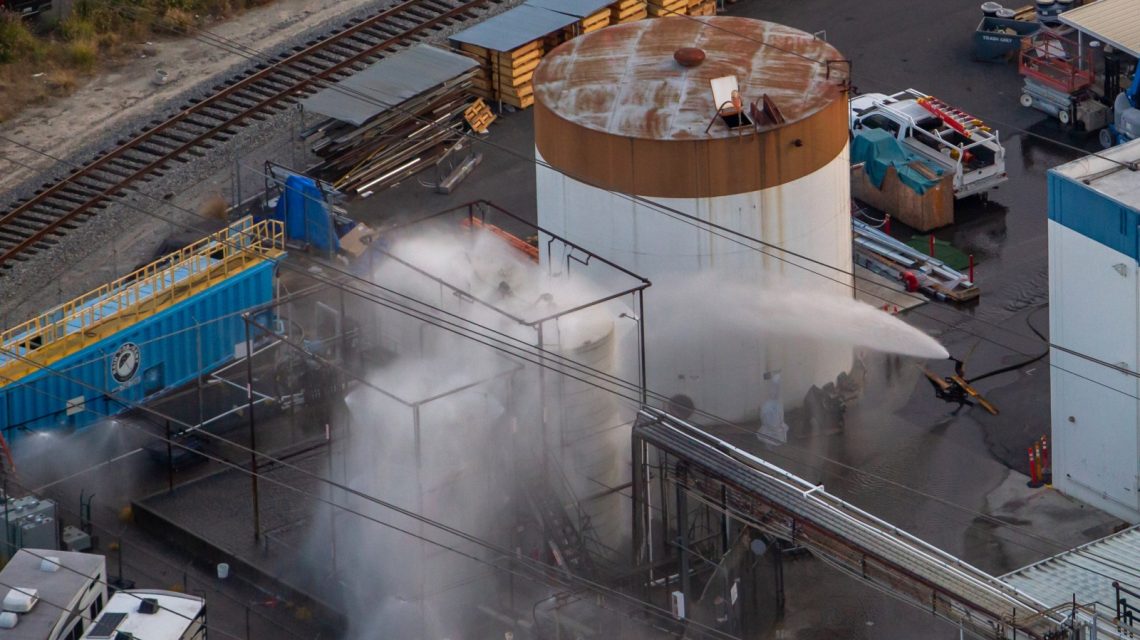
A massive chemical tank has been at the center of an emergency in Southern California. The tank has reached temperatures of at least 100 degrees Fahrenheit, heightening explosion risks. Fire crews in Garden Grove are working to stabilize the tank holding methyl methacrylate, a volatile chemical used in various industries. Rising temperatures have raised fears of a ‘thermal runaway’ reaction, which could lead to an explosion.
Evacuations and Response
The overheating tank has resulted in the evacuation of over 40,000 people from Garden Grove and nearby cities. Despite ongoing threats, two developments may help reduce the risk. One involves a structural crack providing pressure relief, while the other is favorable weather conditions.
Crack in Chemical Tank Provides Pressure Relief
Fire crews discovered a crack that might act as a pressure-release valve.
This crack helps gases escape, preventing dangerous pressure buildup. “This new information could change our strategy to this event,” said OCFA interim fire chief T.J. McGovern.
The venting of pressure significantly decreases the possibility of catastrophic failure. Mitigating pressure prevents violent ruptures, allowing crews to better manage the situation. A clarifying statement from OCFA noted there is only one known crack in the tank, with no active leaks detected.
Garden Grove Weather Provides a Second Advantage
“Mild temperatures and limited wind activity will continue,” said NWS meteorologist Joe Wegman.
Temperatures ranging in the low 70s during the day and 50s at night slow heat buildup inside the tank. This stability aids responders in controlling the situation. Lower wind speeds also help localize potential hazards. However, even light winds could still carry chemicals into populated areas.
Constant water spraying helps manage tank temperature. Combined with favorable weather, these efforts contribute to slowing potential disaster progression.
Background and Community Impact
The emergency started on May 21 at a GKN Aerospace facility. A faulty valve has complicated efforts to drain or neutralize the tank’s contents, forcing authorities to rely on indirect intervention.
This complex incident ranks as one of the most challenging hazardous material emergencies in recent California history. Residents affected by evacuations describe displacement challenges and uncertainty about returning home.
Local resident Ashley Clavijo noted the unsettling nature of the evacuation. Roseletty Feliciano, another evacuee, expressed frustration over the lack of opportunity to retrieve essentials before leaving.
Federal and State Government Response
The Trump administration has been actively monitoring the situation. The U.S. EPA and FEMA are cooperating with local agencies for air quality monitoring and emergency planning. California Governor Gavin Newsom has declared a state of emergency, seeking additional federal resources and funding to assist affected residents.
State efforts include establishing emergency shelters and expanding air quality monitoring. Governor Newsom emphasized providing more resources to stabilize the situation and assist displaced residents.
Uncertainty Ahead
Despite positive developments, danger persists. The tank remains unstable, and monitoring capabilities have been stretched to their limits. Evacuation orders continue, with ongoing assessment and preparations for all potential scenarios.
 Suncor v. Boulder: Understanding the Supreme Court Case and Its Implications
  Hawaii Faces Challenges from Record-setting El Niño and Hurricanes
  Infections Linked to Global Cancer Cases
  G. L. Mezzetta Inc. Recalls Peperoncini Due to Pest Concerns
  Leila’s Kidney Transplant Journey: Setbacks and New Beginnings
  Unexpected Ocean Conditions Bring Challenges to Ventura County