
Americans focus more on the Supreme Court’s fairness than its size. Trust in the court is declining, not due to specific rulings, but because of concerns that it is becoming a political tool. This concern arises as Democrats propose expanding the court, frustrated by a conservative supermajority they see as illegitimate. Republicans consider these Democratic moves, alongside threats to abolish the filibuster, compelling them to potentially act early. The filibuster has already been weakened by judicial appointments, and its future is uncertain.
The cycle of threats between parties creates a risk of an overly expanded court, with more justices appointed by winning political parties. This threatens the court’s independence. Currently, Republicans don’t need to draft their own expansion plans, as Democrats have introduced such legislation multiple times, enabling the president to fill new seats immediately. Paradoxically, if a Republican were in power, it could cement a conservative majority, contrary to Democratic intentions. Democrats wouldn’t support this under Republican dominance.
The situation presents an opportunity for compromise. One proposed solution is straightforward: Republicans should prepare two bills. The first mirrors the Democrats’ expansion proposal. The second offers a constitutional amendment fixing the court at 11 justices, with seats filled by the next two presidents from any party. This prioritizes institutional stability over political gain. A constitutional amendment removing court size from political battles presents a durable solution, unlike statutes subject to repeal based on party shifts.
The difficulty in passing such an amendment makes it lasting. With both parties claiming to defend the court’s integrity, there’s a rare chance to achieve this change. Americans want court stability, even amid disagreements over specific rulings. Observing governance over 30 years, Marc Hodak notes that once institutional rules become negotiable, continuous negotiations follow. The initial restraint vanishes, risking destructive consequences.
The Supreme Court’s stability over 150 years allowed it to withstand decisions that angered parts of the population. Future threats risk turning this vital institution into a partisan tool. Our institutions have historically helped the nation through challenges; an independent Supreme Court remains essential for continuity, regardless of its current composition or decisions benefiting parties today.
Despite leaders’ stated commitment to the court’s role in checks and balances, doubts about their political courage persist. However, with a beneficial deal available, their instincts for survival might guide us through present challenges.
Marc Hodak advises corporations on governance, teaching corporate governance at NYU Stern and SMU.
 The Impact of Arts and Closure on Democracy
  U.S. Ambassador Comments on Iran War Duration Amid Political Concerns
  US-China Relations Under Scrutiny: Expert Warns of Escalating Tensions
  No Timeline for End of Iran Conflict
  German Chancellor Merz Vows to Pursue Reforms Despite Election Setbacks
 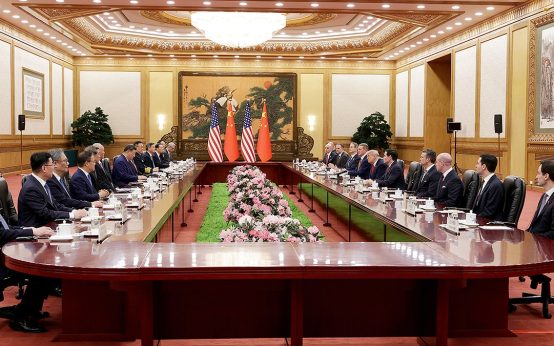 The Technology Rivalry: Trump’s Meeting with Xi and the AI Ecosystem Clash