Oregon has dramatically increased its investment in low-income housing over the past five years. The state has contributed $1.4 billion to developers, nearly doubling the cost per apartment to $540,000. More projects await $850 million in additional state funding, supplemented by federal tax credits managed by the state.
Despite these efforts, Oregon’s public records law prevents disclosing specifics on spending for subsidized housing projects. This hinders researchers and journalists from evaluating these costs. The urgency of this issue in the Pacific Northwest, linked to the homelessness crisis, cannot be overstated. Controlling construction costs might allow more apartments to be built or rents to be reduced significantly.
Margaret Van Vliet, former head of Oregon’s housing agency, urges lawmakers to reconsider this transparency exemption. Despite large investments, homelessness in Oregon continues to worsen. “For all the public money,” she noted, “we seem to be digging a deeper hole.”
In contrast, open access to financial records in other states has exposed spiraling costs. A Los Angeles Times investigation in 2020 revealed that some low-income units in California surpassed $1 million each in costs due to regulatory pressures. Another study indicated that California’s construction expenses could build more units if matched with Colorado’s costs.
Jason Ward from the Rand Corp. reports that Oregon’s secrecy is hard to justify. His research, which accessed similar data across 17 states, highlights the importance of transparency. “Public funds used for housing should be openly accountable,” Ward stated.
Oregon’s Legislature approved the records exemption in 1997. At the time, the housing agency’s size and budget were significantly smaller. Officials cautioned that opening financial records could expose developers to risks such as hostile takeovers.
Not all housing costs are hidden. Portland’s regional government publishes costs for local projects, with units reaching $900,000 each. Detailed costs can be requested when projects are managed by public housing authorities, though these make up a minor portion of state-sponsored units.
The state housing agency provides total project costs but redacts detailed expenses including material costs, contractor profits, and fees paid to various stakeholders. A spokesperson confirmed they track cost metrics per unit and square footage but are legally barred from sharing it.
The state’s sunshine committee reviews public records exemptions. Co-chair Charlie Fisher suggests revisiting the low-income housing carve-out. “Understanding public spending is a fundamental reason for public records access,” Fisher said.
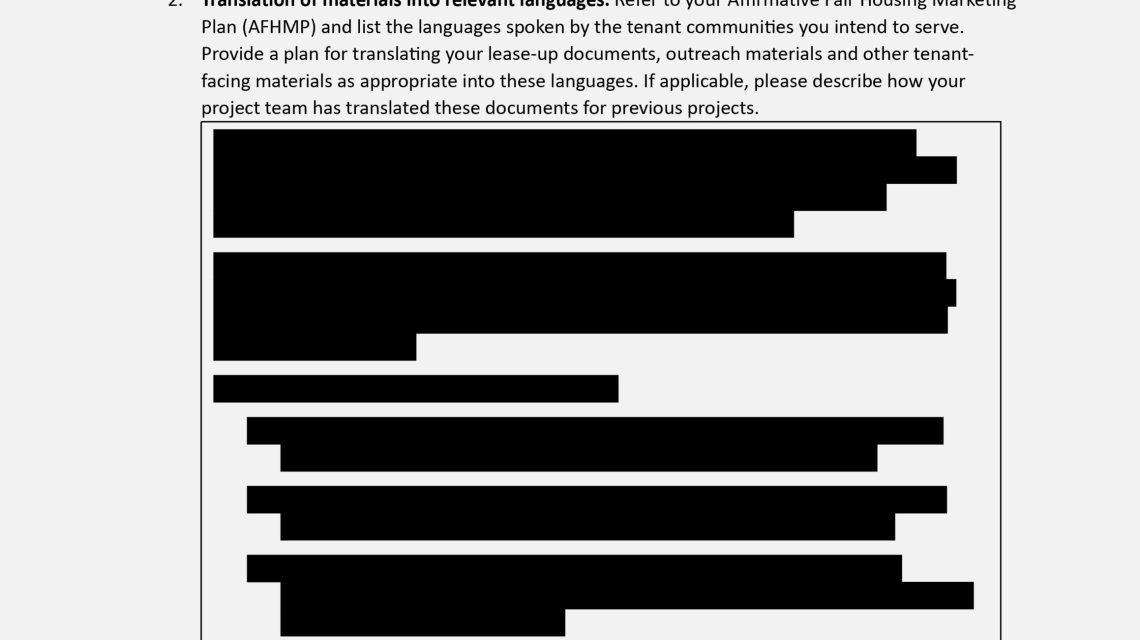
Exemptions affect more than financial transparency. Requested financial records for Portland projects revealed redactions in unusual places, like tenant language preferences and outreach material translations. These omissions extended to details about potential financial risks and risk mitigation plans.
A representative from Oregon Housing and Community Services stated that redactions align with laws shielding market studies and financial forecasts. Andrea Bell, the agency’s director, emphasized a commitment to transparency and acknowledged growing public interest in construction costs.
Meanwhile, obtaining public records in Oregon incurs costs. ProPublica faced a $130 charge for document collection and redacting, with fee waivers denied.
California and Washington provide contrasting examples of transparency. Financial details are public in California, yet demand for funding still exceeds supply. In Washington, developers are accustomed to public record access without facing development issues.
 The War on Poverty: A Lesson on Intentions and Outcomes
  Reporters Blocked from White House by Trump Administration
  Universities Should Reject Political Influence on Research Funding
  Trump’s Approach to China: Trade Dynamics and Challenges
  Media Outlets Sue After White House Ban
  American Public Opinion on Press Freedom