Tehran is increasingly building financial and military connections with Beijing and Moscow. This expansion serves as a crucial support system for Iran as it attempts to navigate around U.S. sanctions. Regional security experts highlighted this development on Wednesday, noting that Iran is reinforcing its ties with non-Western blocs to collaborate more closely with Russia and China. These actions position Iran as a central figure that challenges American influence.
The warning coincided with President Donald Trump’s announcement regarding an economic operation against any country. Trump labeled this as the “most severe economic operation ever taken,” with significant repercussions for nations and businesses that assist Iran economically during his efforts to further isolate Tehran. Trump stated, “This will be Economic Warfare and Isolation on an unprecedented scale.”
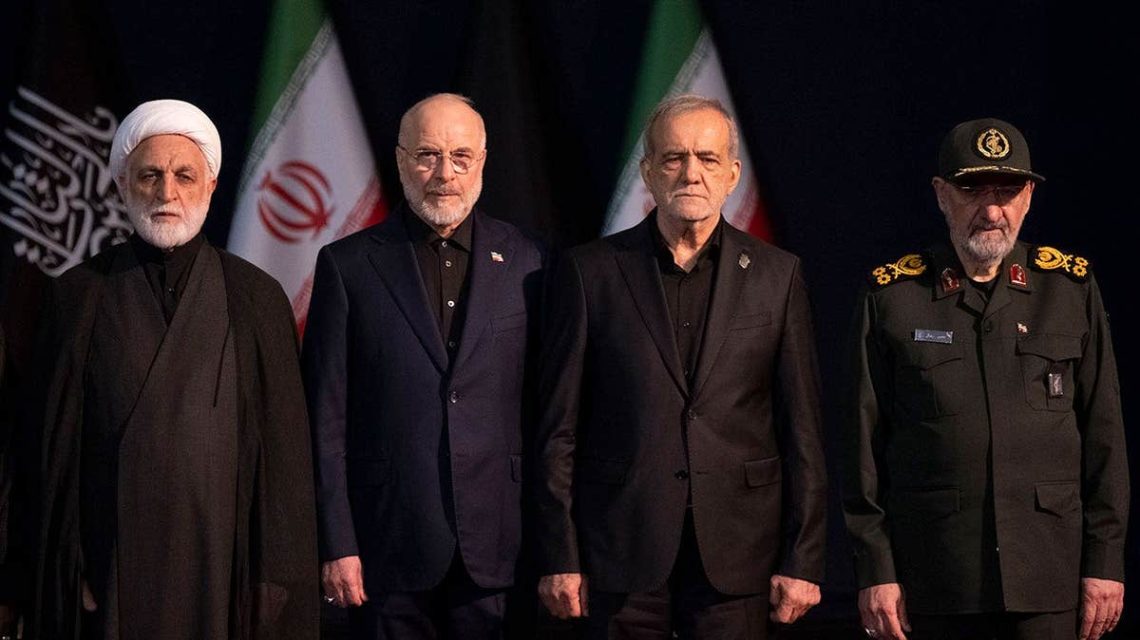
Iranian leaders, including Parliament Speaker Mohammad Bagher Ghalibaf and President Masoud Pezeshkian, attended a ceremony in Tehran on July 3, 2026. Behnam Ben Taleblu from the Foundation for Defense of Democracies expressed the need for Iran to adjust to both U.S. and Israeli military pressure, in addition to political and economic pressure from the U.S. He noted Iran’s pursuit of stronger integration with Russia and China.
Groups like BRICS and the Shanghai Cooperation Organization (SCO) have emerged as key platforms for Iran’s international outreach. Trump has previously criticized BRICS, as reported by CNBC. Iran and its associates, including North Korea, Russia, and China, engage in cyber activities as part of a financial confrontation with the U.S. Abdolnasser Hemmati, Iran’s Central Bank governor, announced that Tehran plans to join the New Development Bank, sponsored by BRICS, even though the bank could not affirm Iran’s membership.
Taleblu explained Iran’s aim to benefit from BRICS and other groups to shield itself from U.S. pressures. Iran seeks formal integration into economic frameworks developed by Russia and China, challenging both the U.S. dollar and American influence. Taleblu urged Washington policymakers to recognize how these state threats are increasingly interconnected.
Amidst U.S. negotiations breaking down and with tensions in the Hormuz Strait affecting global oil flow, Iran has turned to Russian support. A European government document confirmed that Russia is sending ammunition and technology to Iran. Such exchanges assist Iran in resisting U.S. influence in the region.
Taleblu also noted Iran’s role in what he calls the “Axis of Aggressors,” which includes authoritarian states like Russia and China. This group, along with the “Axis of Resistance,” which comprises regional proxy groups, opposes the U.S. and the liberal world order.
Even if Iran’s economic objectives in BRICS are not fully realized, Moscow and Beijing’s political and military backing remains crucial. Taleblu clarified that Iran acts as a conduit, enabling the transfer of resources from state entities to non-state actors. These developments illustrate Iran’s growing significance in the web of global alliances challenging U.S. interests.
 US Monitors Russian Pneumonic Plague Case
  Poland Prepares for Potential Conflict Amid NATO Concerns
  Drone Warfare Redefines Ukraine’s Frontline Conflict
  Key Developments in the Iran Conflict Affecting Global Oil Markets
  U.S. Military Strikes Vessel in Caribbean, Allegedly Involved in Drug Trafficking
  Australia Probes FlyDubai Co-Pilot’s Connections