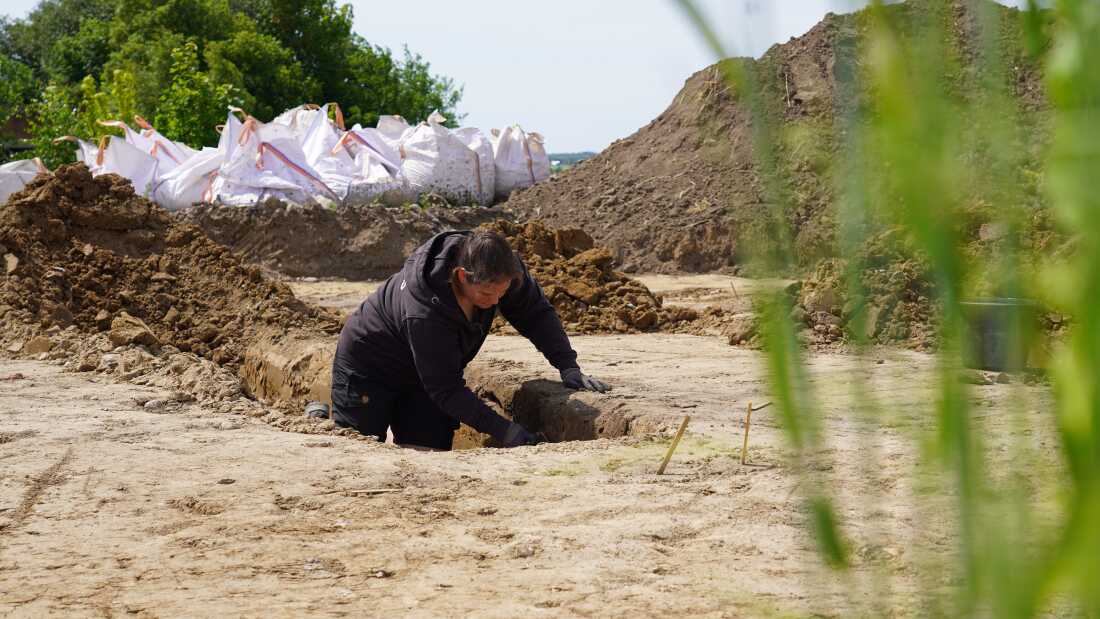
SØFTEN, Denmark — Archaeologists have unearthed a vast textile production site from the Viking Age in Denmark, which highlights the advanced nature of Viking society. The site, discovered by experts from the Moesgaard Museum, spans 100,000 square meters (over 1 million square feet) and dates back more than 1,000 years.
The excavation revealed an area for processing flax and over 80 pit houses, semisubmerged huts used as workshops and homes during Viking times. Located in Søften, about 10 kilometers (6 miles) north of Aarhus on the Jutland peninsula, the site’s origins trace back to the late Iron Age and early Viking Age, between A.D. 600 and 950.
Archaeologist Liv Stidsing Reher-Langberg led the 10-month excavation, noting a focus on textile production that differentiates this settlement from others of the period. “We have spindle whorls, we have weight looms; that tells us about what has been going on in the pit houses,” said Reher-Langberg. The dig also yielded silver coins, glass beads, and pottery.
Separate areas for production and craftsmanship were found, alongside a residential house, suggesting oversight by a powerful figure controlling resources and production. Reher-Langberg mentioned that for the past three decades, individuals using metal detectors have uncovered several silver coins in the vicinity.
Prior interest followed a trial excavation conducted about a year and a half ago, preceding construction work for a new road and industrial area. “We could see in the trenches that it just keeps on going, with these houses and pit houses and textile production features,” Reher-Langberg added.
Moesgaard Museum historian Kasper Andersen described the discovery at Søften as “another piece in the puzzle” to understanding the region’s economic, cultural, and political structure of the time. During the Viking era, Aarhus—known then as Aros—served as a hub for royalty and international trade.
Last year, another Viking site in Lisbjerg, just 4 kilometers (2.5 miles) away, was identified as likely to have housed members of the nobility. Resources from settlements like Søften were brought into a larger international trade network, Andersen explained.
An aerial image captures the archaeological site in Søften near Aarhus, Denmark. “When you have a production site of this scale, it cannot be only because of the local area. It needs to be understood as part of a greater network, a much bigger international perspective,” Andersen emphasized.
Reher-Langberg anticipates future carbon dating and pollen analysis to resolve questions regarding the specific type of textile production conducted on-site.
Historically, the Viking Age from A.D. 793 to 1066 saw Norsemen known as Vikings engaging in large-scale raids, colonization, conquests, and trade throughout Europe up to North America. Andersen asserted that the discovery of Søften illustrates that Vikings were “not just simple, uncivilized, barbaric hordes, rambling about Europe.” To support a site like Søften, a well-organized society and market were necessary, indicating a trade network extending beyond mere local confines.
 The Curious Case of Mark Jackson’s NBA Hoops Card
  Communities Continuing Recovery from Hurricane Helene Explored through Graphic Novel
  Art Institute of Chicago Returns Nazi-Looted Painting to Heirs
  Chicago History Museum Responds to Protest with Aquí en Chicago Exhibit
  Ari Emanuel’s Memoir Explored
  Benito Juarez Community Academy Students Celebrate Día de los Muertos Through Art