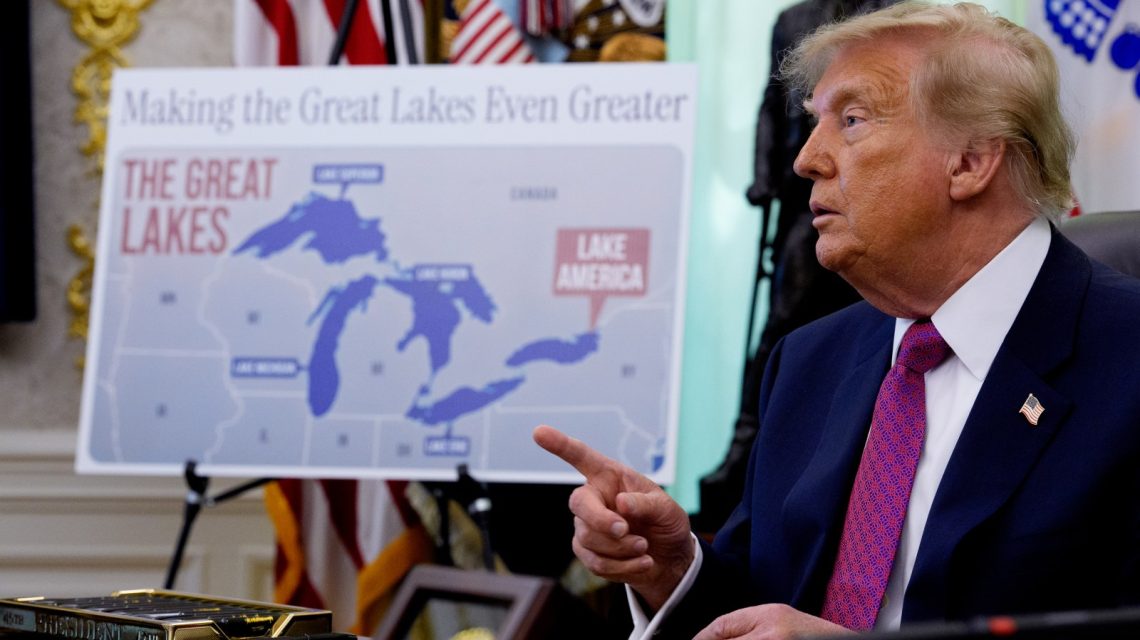
Trump’s Renaming Decision
President Donald Trump has decided to rename Lake Ontario as “Lake America.” This action has sparked queries regarding the extent of presidential power in altering maps, geographic names, and international conventions. Trump’s executive order, signed on August 27, mandates the federal government to implement the name change, marking another effort in altering official U.S. geographic designations. Secretary of the Interior, Doug Burgum, has been instructed to update the Geographic Names Information System, the federal standard for place names. The change is effective immediately for federal purposes, yet it does not force adoption by Canada or other international bodies and private mapmakers.
Recent Efforts and Future Possibilities
This move comes about two years after Trump’s order to rename the “Gulf of Mexico” to “Gulf of America” in U.S. records. During discussions regarding the Lake Ontario decision, Trump hinted at the possibility of renaming sizable entities like the Atlantic and Pacific Oceans. Such actions could result in federal agencies using different names in official documents, yet they would hold symbolic significance largely within the U.S. due to international sovereignty clauses. The U.S. Board on Geographic Names standardizes federal naming practices, aiming for consistency, but the renaming of global features like oceans involves complex international legal and diplomatic factors. Coastal nations control their territorial waters and Exclusive Economic Zones while international waters remain open space for global community use.
Renaming Impact on International Relations
Trump’s executive decision to rebrand Lake Ontario follows remarks amid ongoing trade tensions with Canada. The president publicly pondered the name change on social media, later announcing it officially at the Oval Office. He claimed no particular message was intended for Canada, notwithstanding criticisms regarding the trade relationship between the two nations. This decision echoes Trump’s previous efforts with the Gulf of Mexico, revealing a broader willingness to use executive powers over federal name conventions. Nonetheless, such actions have limited practical impact, particularly given Lake Ontario’s shared status between the U.S. and Canada, forming part of their international border. Federal agencies can adopt new names, but Canada and international entities are under no obligation to follow suit.
Authority and Impact of Geographic Name Changes
The renaming of the Gulf of Mexico as the “Gulf of America” prompted similar debates concerning ownership and authority over naming rights. While the federal designation was changed, territorial jurisdiction over the gulf remains divided amongst the United States, Mexico, and Cuba, governed by international law. Trump’s executive order did not alter control over the gulf’s waters; instead, it directed federal agencies to use the Gulf of America designation in publications and databases. The National Oceanic and Atmospheric Administration updated regulatory references within legal limits, while acknowledging that statutory revisions require congressional action.
These instances underline the separation between naming a place and exercising authority over it. Countries can decide how they refer to geographic features in official documents, but that does not equate to ownership. The same principle would likely apply if ocean renaming was attempted. Although a president can influence federal nomenclature, redefining widely accepted global names exceeds merely altering government databases. Oceans, unlike domestic landmarks, exist beyond any single country’s domain, serving as shared spaces.
Trump’s naming powers have fixed boundaries. He can dictate what federal agencies call a place, but international adoption of new names remains uncertain.
 The Cost of Challenging Beijing
  Analyzing Midterm Elections and Party Dynamics
  Allan Lichtman’s Framework for Assessing Presidential Greatness
  Florida Senate Race Tightens as Recent Polls Show Dead Heat
  Ethics Complaint Targets Colorado Representative Lauren Boebert
  Ken Paxton’s Campaign Funding and Polls