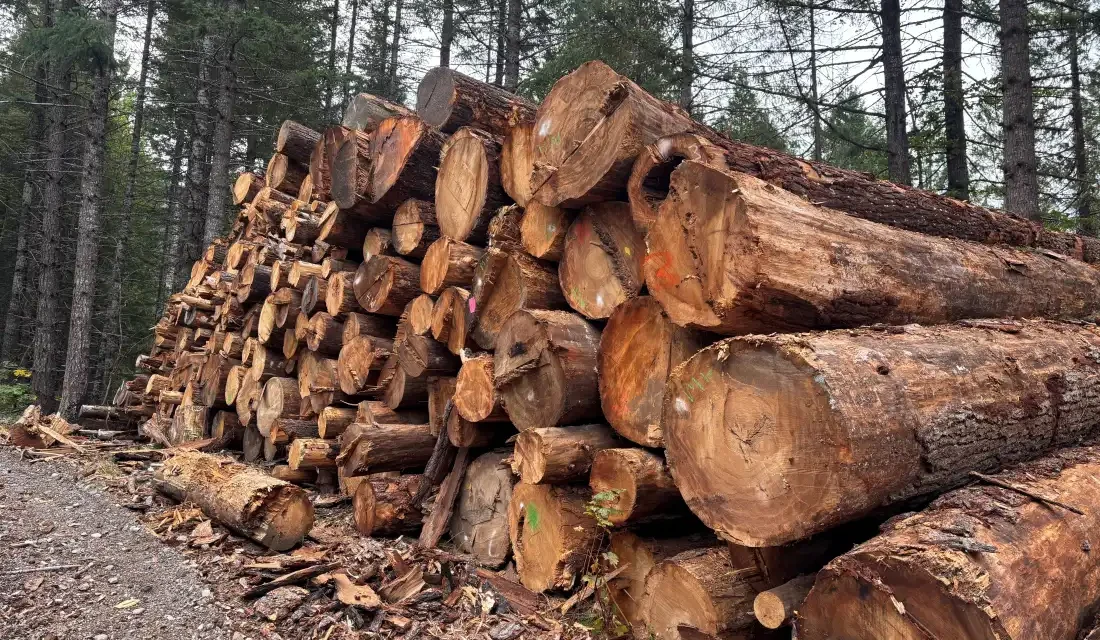
Logs from a salvage timber sale after a recent wildfire in the Willamette National Forest in Oregon. Kirk Siegler hide caption Kirk Siegler.
EUGENE, Ore. – President Trump plans to open up 44 million acres of the nation’s untouched national forests. He believes this will restore timber jobs to small towns and reduce wildfires in overgrown areas. Last year, he hinted at this with executive actions aimed at increasing timber sales and reversing the Roadless Rule. This 25-year-old rule has hindered new logging in undeveloped forest lands.
As the Roadless Rule’s official repeal is anticipated, the reality in timber regions is complex. Those earning their livelihood in these forests face issues beyond tree access. Sean Smith, CEO of Starfire Lumber in Cottage Grove, Ore, acknowledges that executive orders set a tone but emphasizes other pressing challenges. High diesel prices, influenced by Trump’s conflict with Iran, are one issue. Inflation elevates costs for essentials like steel, saw blades, and ball bearings necessary to maintain operations.
The repeal of the Roadless Rule, which has largely blocked new road building and logging on 44 million acres of pristine forests since 2001, is not a top priority. Still, Smith believes opening local roadless forests for health projects could offer mills a more reliable timber supply. He notes that the nearby Willamette National Forest is dangerously overgrown, increasing the risk of catastrophic wildfires. He asserts his concern is about preventing these fires, not seeking cheap timber.
Trump claims a timber boom is imminent, yet the industry today is only a fraction of its former self. While some endorse the repeal to allow the Forest Service flexibility in wildfire prevention, challenges persist even in forests with existing roads. Lawsuits, red tape, and a worker shortage make progress difficult.
Jeff Brink, a second-generation logger, points to labor shortages and high fuel costs as significant obstacles. While his company survives due to restoration projects and salvage logging, smaller loggers face an uncertain future. U.S. federal land timber sales have dropped nearly 90% since the 1990s. Many mills, especially those not near urban centers, have closed. Since 2024, Oregon has lost seven mills, part of a broader regional decline.
Experts predict a modest increase in federal timber sales if the Roadless Rule is overturned, far from the expected boom. This minor uptick does little to excite those in the field.
Environmental groups warn they will sue once the rule is repealed. Past protests against timber sales in the 1990s linger as a cautionary backdrop. Timothy Ingalsbee, a retired Forest Service firefighter, calls the promise of new road building and logging a lie. He believes this approach will lead to more human-caused wildfires, which are already rising.
Ingalsbee argues that the administration’s focus isn’t genuinely about prevention or job creation but more about ideology. He suggests the U.S. government is rushing to open lands for maximum economic gain, exploiting timber, oil, and coal resources.
There’s a shared frustration over Congress’s inaction. When the Roadless Rule was introduced in President Clinton’s era, it wasn’t codified by Congress, resulting in ongoing political contention. Sean Smith of Starfire Lumber tires of policies changing with each administration. This inconsistency creates a challenging business environment, leaving stakeholders uncertain about long-term strategies.
 Southwest U.S. Faces Heavy Rains and Flooding Threats
 Pentagon Confirms Deployment of US Space Weapons as UK Develops Space Cleanup Technology
 Study Challenges Long-Held Beliefs About Plastic Safety
 New World Screwworm Threatens Livestock in Texas
 Record Capture of Reticulated Python in Puerto Rico
 Controversy Over Tree Removal at East Potomac Golf Links