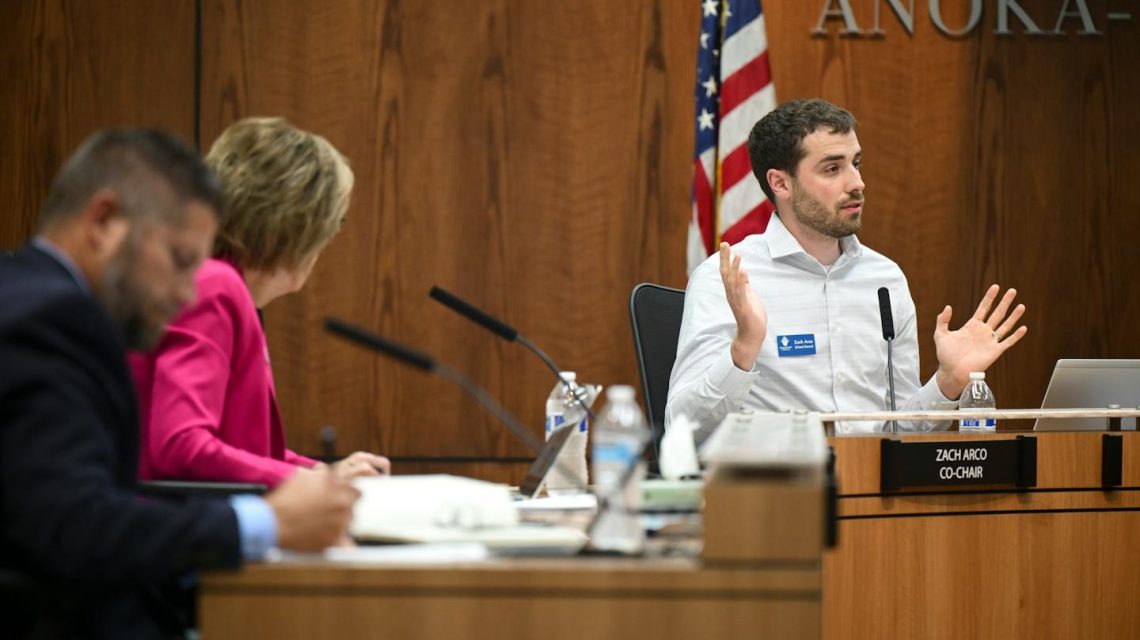
The Anoka-Hennepin school board is currently deadlocked, leaving social studies teachers in Minnesota’s largest district without guidance on new state standards set for the fall. This comes after extensive preparation by educators and community members for these revised standards. However, disputes over ethnic studies requirements have split the school board, resulting in a 3-3 vote that halted the introduction of new curriculum materials.
Teachers intended to use these materials for courses across different grade levels such as elementary social studies, eighth-grade global studies, and high school subjects like civics, human geography, and U.S. history. John Wolhaupter, the president of the Anoka-Hennepin teachers union, expressed concerns about the lack of a clear plan for teachers come fall.
Past issues in the district over curriculum, notably in social studies, psychology, and science, have seen similar clashes. Teachers and their union argue that certain board members are overstepping, while conservative members claim they are ensuring proper oversight.
These curriculum proposals followed years of planning, incorporating both board feedback and community input. A study committee started in 2022 to strategize on implementing the revised standards. Workshops and community events further engaged educators and residents in this process.
By mid-2024, teachers were authorized to draft pilot curriculums, though the project ultimately stalled. Dave Evensen, a teacher, highlighted how educators have struggled to understand the concerns board members have with the materials.
Board Member Zach Arco suggested aiming for minimal compliance with the new standards, especially ethnic studies. Teachers found this term unclear and felt that more was expected from students.
District leaders warned that decisions needed to be made quickly. Superintendent Cory McIntyre emphasized that resources currently available are insufficient for the revised standards. Sarah Hunter, executive director of secondary education, noted the gap in required materials.
Supporters of the curriculum proposals argue that the board’s responsibility is not to alter state standards but to determine how they should be implemented. Board Member Kacy Deschene stressed that the board should focus on teaching methods rather than rewriting standards.
Arco opposed ethnic studies lessons due to their perceived political nature. He raised concerns about the framing of these subjects and advocated for teaching a broader historical context in relation to slavery.
He added that the high school materials appeared to meet the necessary standards. Meanwhile, Evensen explained that new standards encourage higher-level skills like understanding diverse perspectives and critical analysis. He underscored that students are learning to form educated opinions, even on contentious topics.
Teachers remain uncertain about meeting state requirements without approved materials and are considering open-source materials to meet needs. Concerns about additional summer work to write curriculum also linger, should the board revisit the issue before the fall term.Our teachers have put in years of effort,
Wolhaupter pointed out,but their work is being undone over political disagreements.
 Clarification on Policy for LGBTQ+ Students in New York School District
 Colleges Struggle With Hazing and Drug Issues
 Anoka-Hennepin School Board Debates Future of Social and Emotional Learning
 Students Serve Thanksgiving Dinner and Learn Agriculture at Chicago High School for Agricultural Sciences
 Current Events Recap
 Scrutiny Over AI Gun Detection in Schools: Lawsuits and Challenges