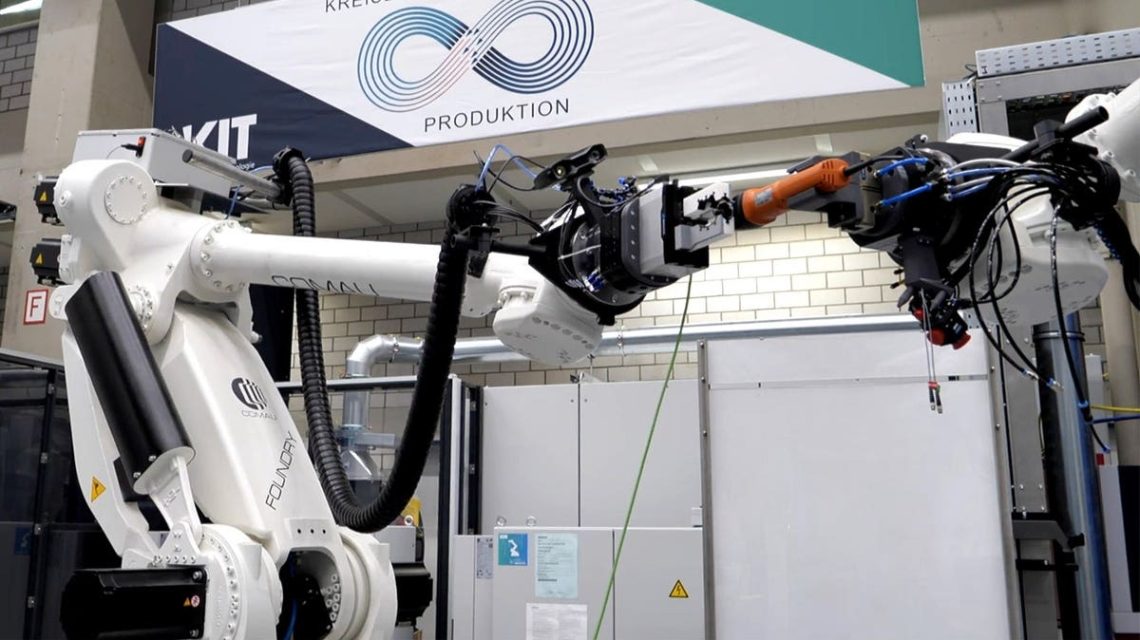
Robots have played a significant role in manufacturing for decades, assembling countless products that we use daily. Now, researchers are expanding their capabilities by teaching them to disassemble products when they malfunction. This new skill could become crucial as automation continues to rise.
Growth in Industrial Robotics
Over 4.6 million industrial robots operate globally. As manufacturers continue to automate, an important question emerges: what happens to complex machines when parts wear out or break?
Innovative Solutions from Germany
Researchers at the Karlsruhe Institute of Technology in Germany have created a robotic disassembly system. This system doesn’t assume that components will perform perfectly. Instead, it addresses the challenges posed by aged machines with missing parts or altered designs.
“A robotic disassembly system uses probabilistic planning to change tactics when damaged or aging machinery creates unexpected obstacles.” – Jan Baumgärtner and research team at KIT
The Complexity of Disassembling Machines
Building new products in a factory involves predictable processes. Robots know each step, following a programmed sequence. However, disassembling old machines is different. Years of use can distort parts, and prior repairs might have altered the assembly. Traditional automation struggles here because unexpected obstacles can halt the entire process.
According to researcher Jan Baumgärtner, assembling involves clear steps. Dismantling broken items, however, requires robots to adapt and rethink the situation.
Functionality of the Robotic System
The system begins with a CAD model representing the product’s construction. The robot then observes each part’s behavior. If a component doesn’t function as expected, the system updates its knowledge accordingly. For instance, if a screw behaves unexpectedly, the robot addresses this change in its subsequent actions.
The system employs a Partially Observable Markov Decision Process (POMDP). Essentially, the robot works with uncertain information, continually adjusting its strategies as new details emerge. This method combines with CAD data, inspection information, and the robot’s capabilities to enhance the disassembly process.
Adaptive Strategies in Action
In tests, the system demonstrated adaptability. When faced with a stubborn screw in an electric motor, the robot initially tried unscrewing it. Finding that approach ineffective, it switched to a milling tool to remove the material blocking access. In another test involving an angle grinder, the robot identified a missing screw, saving time by avoiding unnecessary searches.
This adaptability proves beneficial. As uncertainty increases, traditional deterministic planning falters. The probabilistic planner, however, excels by finding alternative disassembly routes, resulting in faster outcomes.
Future Applications and Economic Implications
Currently, the research targets specific components like electric motors and angle grinders. However, the concept could scale to larger systems with multiple robotic arms and varied tools. Baumgärtner envisions a reverse assembly line using this technology.
Could this technology make repairs cheaper? Baumgärtner aims for a circular economy where manufacturers reuse valuable components from old devices.
The system might prioritize retaining specific parts. If a manufacturer values particular components highly, the robot adjusts its approach to maximize preservation.
The ultimate goal is ambitious: enable automated repairs to be more cost-effective than producing new items, though this remains a future aspiration rather than a current reality.
Implications for Product Longevity
While local electronic shops may not adopt these systems soon, the research indicates a shift in how manufacturers view broken products. Many discarded electronics become e-waste. However, improved automation might change this by making recovery of high-value parts possible.
Refurbishing could also become viable in certain industries. Intelligent machines could reduce waste by salvaging functional components.
The major question is whether manufacturers will design future products for easier automated disassembly. A focus on deconstruction during design could simplify repairs later.
Takeaways on Technological Advancements
What stands out here is the ability of robots to adapt in uncertain conditions. Traditionally, factory robots thrive where everything is controlled. Broken products don’t conform, but teaching robots to adapt holds potential. Repair and recycling economics often decide if something gets a second life or ends up discarded. Though this remains research-focused for now, the idea is significant. Smarter robots might help recover valuable components, conserving resources by avoiding discarding entire machines for one failed piece.
 The Challenges and Risks of Autonomous AI Models
  Conservative Activist Urges AI Safety Measures
  FBI Modernizes Cybersecurity to Counter AI Threats from China and Russia
  Keurig Dr Pepper Introduces AltaRounds to Reduce Coffee Pod Waste
  Impact of Trump’s AI Accord in Washington
  Fox News Achieves Top Spot on YouTube and Social Media Platforms