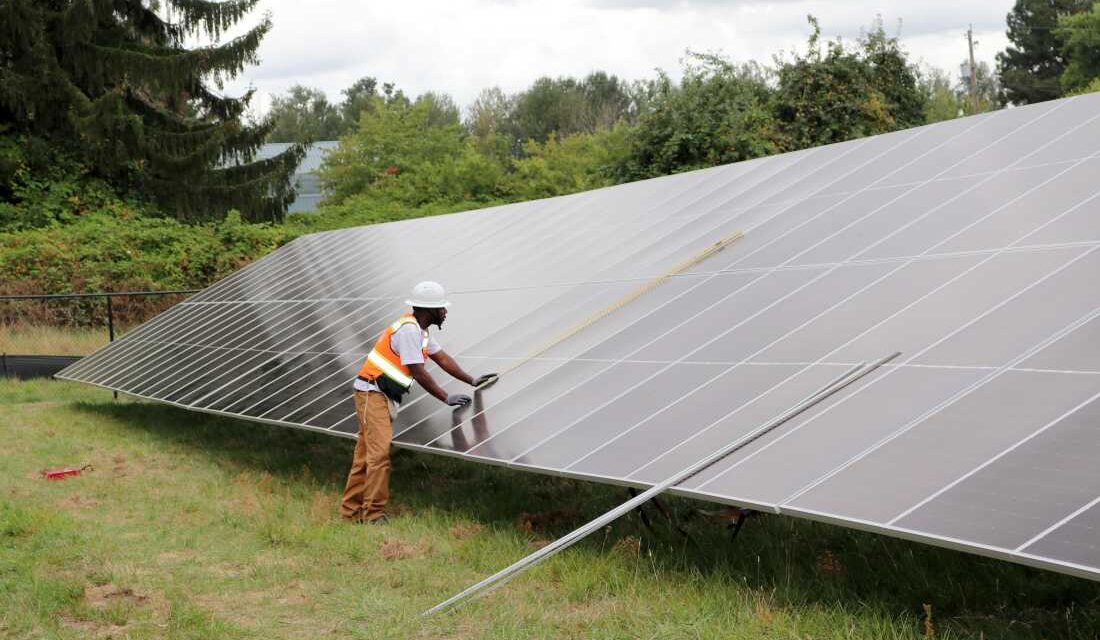
In Portland, Oregon, the PDX Community Solar project receives funding from the Portland Clean Energy Fund, exceeding $4 million. It supplies power to eligible low-income residents in the Cully neighborhood. Monica Samayoa/Oregon Public Broadcasting provides insight into this impactful initiative.
NPR is focusing on community-led climate solutions this week, highlighting efforts to combat climate change locally amidst reduced federal involvement. While federal plans stall, local governments and communities strive to reduce emissions and adapt to extreme weather.
Portland’s Climate Initiatives
Over the past seven years, Portland has implemented several initiatives to aid low-income residents and combat climate change:
- Community solar projects benefit 150 low-income families, reducing emissions and energy costs.
- Distribution of over 20,000 free air conditioning units to vulnerable households for heatwave preparation.
- Energy efficiency upgrades in 3,100 homes.
- Training for 2,000 individuals in renewable energy and construction sectors.
These efforts are powered by a billion-dollar initiative, the Portland Clean Energy Fund, focused on providing climate, racial, and social justice. This trailblazing fund resulted from a 2018 voter-approved measure, leveraging a 1% retail sales tax on large corporations, which spares consumers directly. Since implementation, the fund has amassed nearly $1 billion, with projections reaching $1.6 billion by 2029.
“It’s a fund that’s intended to scale up local, community-based climate solutions that address our climate realities, community resilience, and economic resiliency,” said Sam Baraso, program manager of the Portland Clean Energy Fund.
Origin and Purpose of the Fund
The fund’s inception goes back almost a decade, initiated by leaders from minority-run nonprofits seeking funding for climate action. They identified an urgent need to address climate impacts, such as severe heat waves and wildfires. To tackle this, they proposed taxing large corporations, centering on those most affected by climate change.
“The Portland Clean Energy Community Benefits Fund emerged from frontline communities often disproportionately impacted by the climate crisis, and historically excluded from decision-making,” Baraso stated.
Achievements and Environmental Impact
Notable projects funded by this initiative include:
- Distributing over 20,000 free portable air conditioning units since 2022.
- Implementing a community solar project aiding 150 low-income families.
- Planting 15,000 trees in urban heat-prone areas over five years.
- Transforming six parking lots into urban gardens, equivalent to eight NBA basketball courts.
Since 2021, the fund has allocated four rounds of grants amounting to $262 million. These grants range from $8,000 to $10.3 million, significantly contributing to greenhouse gas reduction. To date, funded projects have reduced carbon emissions by an estimated 25,500 metric tons, akin to removing 6,000 gasoline vehicles from roads annually. This reduction is expected to grow as new projects roll out.
Economic and Social Debate
The fund’s surplus has sparked debates regarding allocation, including proposals from Mayor Keith Wilson to refurbish the Moda Center with eco-friendly technology and the Portland Police Association’s bid to allocate 25% of annual revenues for hiring additional officers.
“That’s what keeps this going—people seeing themselves as beneficiaries and envisioning benefits for future generations,” Baraso emphasized.
Inspiration for Other Cities
Portland’s climate fund success draws attention from other cities, including Ann Arbor, Denver, and Seattle, each tailoring their mechanisms to local regulations and community needs. Ann Arbor opted for a property tax increase, while Denver established a sales tax, generating $41 million in its first year.
Assistant Professor Amruta Nori-Sarma highlights the necessity of community involvement in similar climate funding, as local input ensures effective solutions based on unique municipal contexts.
“The Portland fund stands out due to its well-structured funding mechanism,” Nori-Sarma noted.
The Portland Clean Energy Fund is on track to conclude its initial five-year plan by mid-2029, with a substantial $1.6 billion reinvestment goal into the city.
 Cornell University Implements Ban on Processing Wild Game in Campus Kitchens
  Lake Mead’s Historic Low Water Levels Highlight Colorado River Crisis
  Impact of Saharan Dust on U.S. Weather
  Hanoi’s Urban Transformation: Growth and Challenges
  Grayslake Residents File Lawsuit Against Data Center Project
  Colorado River Water Crisis Deepens as Lake Mead Hits Record Low