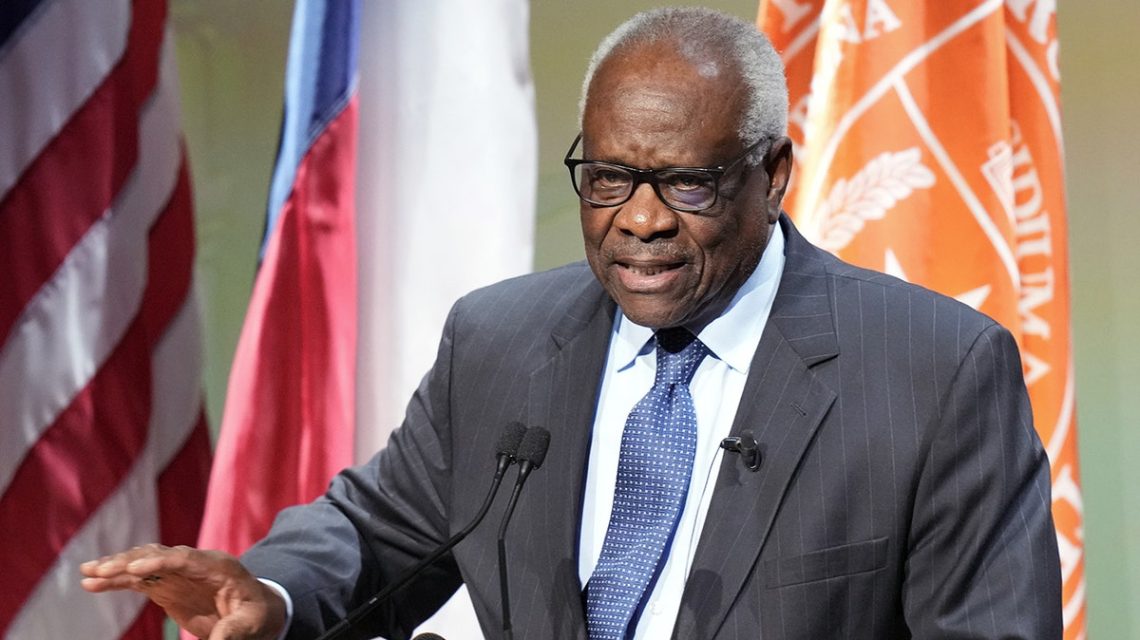
Supreme Court Justice Clarence Thomas addressed criticism regarding his racial identity due to his political views. “I mean, how stupid is that? Look at me,” remarked Thomas as he gestured to his arm. He recalled hearing comments like, ‘Oh, black is a state of mind.’
Thomas shared these thoughts during a dialogue with Peter Robinson at the Hoover Institution. Their discussion covered the influence of Black Americans in politics. Thomas explained how economist Thomas Sowell, a fellow Black conservative, influenced his understanding of race and politics and encouraged him to challenge predominant expectations of Black political opinions.
Liberty dies when comfort is chosen over courage
Justice Thomas spoke at a special lecture at the University of Texas, emphasizing the importance of personal conviction.
Reflecting on his youth, Thomas mentioned feeling pressured to hold specific political beliefs due to his race. He noted the challenge of resisting mainstream voices in politics and media that told him he was wrong for his views. While attending Yale Law School, Thomas questioned the logic behind school busing, doubting the benefit for Black families whose children were sent across town to unfamiliar schools.
Thomas highlighted a disconnect between the views of Black political leaders and everyday Black Americans, citing school busing and racial preferences as points of contention. He noted that the leaders often held different views than their constituents.
Thomas indicated that reading Sowell’s work, “Race and Economics,” helped validate his independent thoughts and lessened his sense of isolation. He described this discovery as liberating and sought to connect with Sowell given their newly found common ground.
Initially, as a Yale student, Thomas had dismissively rejected Sowell’s “Black Education: Myths and Tragedies,” reflecting a shift in his perspective over time. Sowell’s example eventually empowered Thomas to express his beliefs against critique.
Thomas emphasized that criticism often involved questioning his identity rather than addressing his arguments. He stated, “If they can prove you wrong, fine. But if they call you names or say you’re not black, I mean, how stupid is that? Look at me.” He pointed out societal pressure for Black Americans to adhere to certain viewpoints.
Ultimately, Thomas viewed Sowell as an exemplar of self-reliance, appreciating that Sowell did not dictate what others should think but encouraged independent thought.
“There seems to be this overwhelming pressure for us to agree with the prevailing notions which I consider almost illusory in a sense,” Thomas remarked.
Elaine Mallon is a writer for Fox News Digital and Fox Business, covering national politics.
 Trump’s Diesel-Deal Feud with Zelensky Obscures a More Important Effort
  Trump’s Stance on Energy Prices and Ukraine-Russia Conflict
  Elon Musk’s Political Contributions and Federal Influence Explored in Michael Lewis’s ‘Blockers’
  Political Insights with Tamara Keith and Amy Walter
  Peltola’s Lead in Alaska Senate Race Presents Challenge for Sullivan
  Trump Announces Energy Ceasefire Between Russia and Ukraine