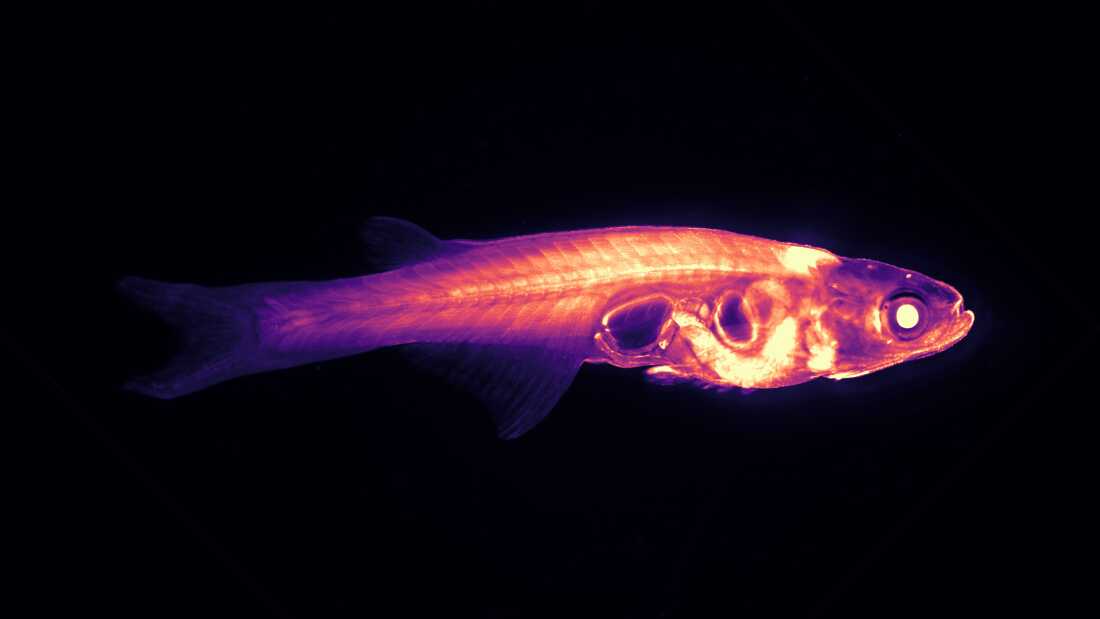
Fluorescent proteins visible within the transparent Danionella fish allow scientists to observe processes in its brain and body. Researchers at a major brain science center aim to study Danionella fish to uncover insights into the brain-behavior connection.
One of the leading centers for brain science is making a significant investment in a small, transparent fish. The Howard Hughes Medical Institute’s Janelia Research Campus near Washington, D.C., plans to leverage artificial intelligence and the unique Danionella fish to understand how the brain governs complex behaviors, such as social interaction.
It’s a big, risky bet,
says Gerry Rubin, Janelia’s founding executive director and head of biology. But that’s what makes it interesting.
Janelia plans to expand the space devoted to fish to 6,000 square feet, accommodating thousands of new tanks. This expansion is expected to increase the number of scientists studying Danionella from approximately 10 to over 100.
The goal is to observe an entire fish brain functioning in real-time, enabling researchers at Janelia to learn how the brain influences behavior in various species, including humans. We all evolved from fish, and our brains share many features of the brains of fish,
says Nelson Spruston, Janelia’s executive director.
The Brain as a Black Box
Danionella fish present advantages over other typical lab animals like rodents. Unlike most species, the brain in many animals is obscured by skull and skin, complicating observation. Danionella fish, however, lack the upper skull and possess see-through skin.
Nonetheless, Danionella isn’t as well understood as other models, such as zebra fish, which are larger and transparent only during their larval stage. The Danionella cerebrum, favored by neuroscientists, was identified as a distinct species only in 2021. Despite this, its presence in labs is growing.
Having an animal with a clear head and body is extremely useful for neuroscience,
says Matt Lovett-Barron, a scientist studying Danionella at the University of California, San Diego.
From Flies to Fish
Janelia is recognized for its work with fruit flies, notably mapping 54.5 million connections in the insect’s brain in a 2024 project. Now, Janelia is embarking on a new, ambitious challenge, one aimed at addressing a fundamental biological mystery.
The brain-behavior question addresses how physical processes, such as neuron firing, can influence memory, experiences, and decision-making.
Janelia scientists argue that studying isolated parts of an animal’s brain won’t provide answers. If you really want to understand how the brain is working as a whole, you really need to see all the neurons firing at once,
Rubin says.
The transparent nature of these fish facilitates observation but introduces challenges, including handling a brain with three times more neurons than fruit flies.
This is going to produce so much data that we’re going to need something like artificial intelligence to analyze it,
Rubin explains.
A New Kind of Science
Janelia’s strategy involves developing tools that simplify Danionella study for scientists globally. This entails mapping every brain connection, akin to the fruit fly project, and fostering methods that integrate artificial intelligence for accelerated discovery.
Currently, scientists often immobilize Danionella fish for brain studies. Spruston emphasizes a desire to change this. The ultimate goal is to do these experiments in freely swimming animals,
he notes, acknowledging engineering challenges ahead.
Those studying Danionella express eagerness for advancements. Lovett-Barron mentions that improved tools would assist in studying how fish use visual cues for synchronized movement in schools. Scientists place fish in virtual environments to observe social interactions.
Enhanced tools for observing brain activity would expedite such studies, Lovett-Barron suggests, recognizing the long-term nature of answering the brain-behavior question.
O’Shea expresses optimism about understanding one complex behavior in fish within a decade. Meanwhile, Janelia scientists make progress on different fronts, such as monitoring numerous neurons simultaneously.
They’ve succeeded with larval zebra fish, which possess approximately 80,000 neurons. O’Shea believes scaling up for adult Danionella fish, with around 650,000 neurons, is achievable. In comparison, humans have about 86 billion neurons.
 Exploring Spider Webs, TV Pixels, and Storytelling in Science
  Henri Kagan and Kenso Soai Win 2026 Nobel Prize in Chemistry
  How Little Brown Bat Genes Are Outsmarting a Fungal Killer
  The Impact of Generative AI on Critical Thinking Among Knowledge Workers
  New Insights from Research on Ancient Ethiopian Palace
  Moose Street Brawl in Colorado Captured on Video