Probing the Galactic Center
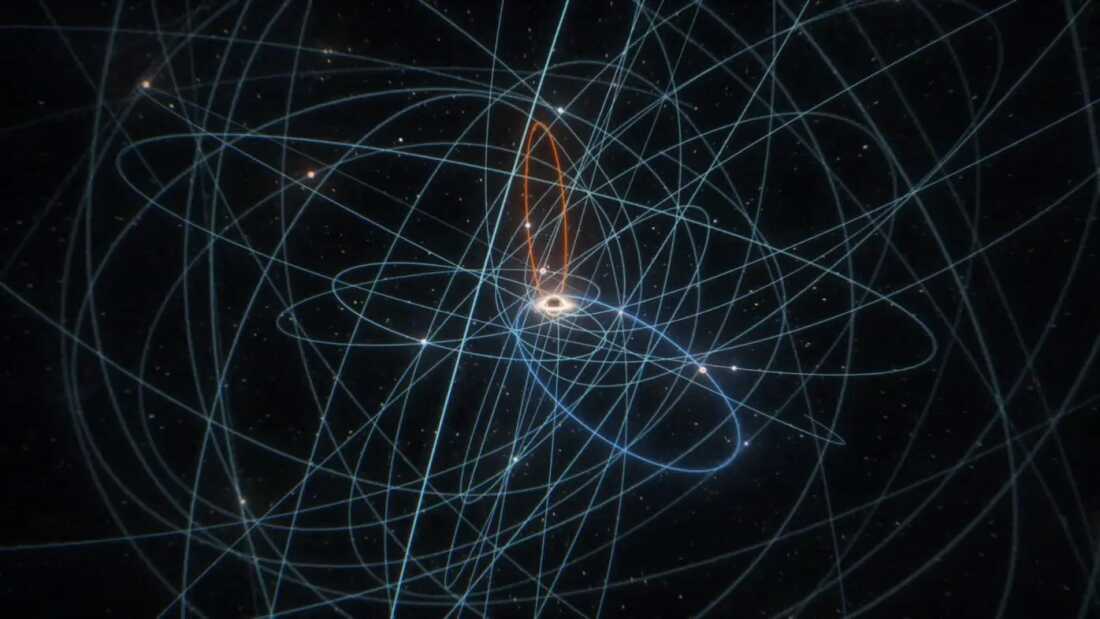
A new image captures the paths of stars orbiting the massive black hole at the center of the Milky Way. A star named S301 approaches the black hole at incredible speeds. At its closest, S301 travels over 15,000 miles per second.
In 2002, scientists calculated a massive entity’s mass in the Milky Way’s core. It was four million times the mass of the Sun, suggesting it is a supermassive black hole. Astronomer Stefan Gillessen likens it to the one in the film “Interstellar.” A dark shadow surrounded by a halo of light characterizes the black hole.
Black holes defy the senses; their gravity traps even light.
Astronomers face challenges in observing black holes. Their immense gravitational pull makes them difficult to visualize. Newly reported research in Nature reveals the fastest star ever seen, racing around the black hole Sagittarius A* at the galaxy’s center.
Discovering the Fastest Star
Gillessen highlights that the discovery focuses on the star’s proximity to the black hole. S301 serves as a tool to study gravity’s influence on space-time. Though enigmatic, black holes dominate the universe. Basic questions about them persist. Gillessen emphasizes their importance in understanding galactic evolution.
The European Southern Observatory’s telescopes in Chile allowed the team to gather infrared light. This light helps see through cosmic dust to the galaxy’s core. Ph.D. student Felix Mang noticed S301’s rapid movement.
Tracking a Stellar Speed
Mang tracked S301’s path over years, using Newton’s gravity laws adjusted with Einstein’s relativity. The star’s 8.7-year orbit formed an elongated ellipse. The black hole sits at the ellipse’s end, and S301’s speed peaks at about 15,000 miles per second. This marks it as the galaxy’s fastest star.
The star’s orbit allows researchers to study the black hole’s gravitational potential. Its high speed and interaction with the black hole provide insights into space-time’s warping.
Implications for Black Hole Research
Astrophysicist Erin Kara sees the discovery as pivotal, paving the way for groundbreaking measurements of black holes. Future research aims to measure the Milky Way black hole’s spin. Previous rotations were calculated in active, gas-consuming black holes in other galaxies. Using S301 to measure Sagittarius A*’s spin would be a first for a quiet galaxy.
Such calculations could reveal how the black hole formed and inform our understanding of the Milky Way’s evolution.
The Broader View
Kara admires black holes’ dual nature: exotic yet crucial for understanding physics and galactic formation. The concept of a star circling a black hole captivates Gillessen. He imagines an extraterrestrial on a hypothetical planet orbiting S301. The black hole would dramatically appear in the sky every nine years, offering a stunning view.
This vision reflects the awe and complexity surrounding black holes and their role in our universe.
 Archaeological Discovery Unveils Ancient Burial Offering in Peru
  Figeater Beetles: An Unusual Sight in Los Angeles
  Eugenia Cheng Explores the Question, ‘Is Math Real?’
  Ancient Marble Statue Unearthed in Sardis Reveals Lydian Heritage
  Metal Detectorists Discover Ancient Gold Bracelets in England
  Viewing The Total Solar Eclipse Of 2026