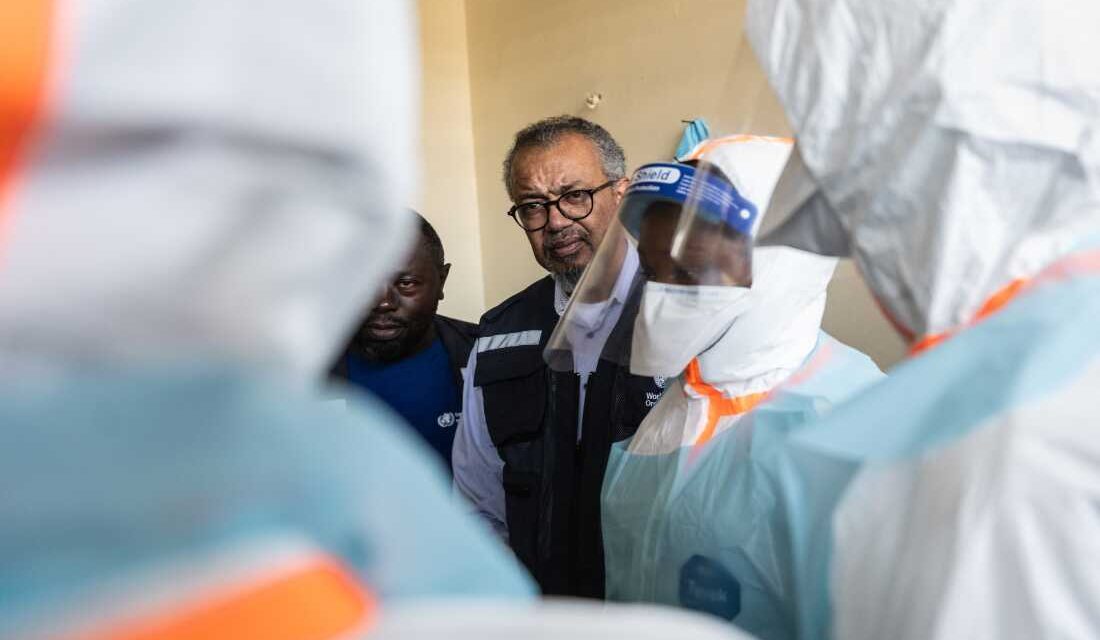
On Sunday, May 31, 2026, the Director General of the World Health Organization (WHO), Tedros Adhanom Ghebreyesus, visited the Evangelical Medical Centre (CEM) in Bunia, Congo. This visit coincided with the announcement of at least 282 confirmed Ebola cases in Congo’s current outbreak, reported by the Ministry of Health.
Current Situation in Ituri Province
The epicenter of this outbreak is in the eastern Ituri province, where 264 cases have been confirmed. The Bundibugyo virus is the strain affecting the area, and it lacks an approved treatment or vaccine. The Ministry of Health has identified several challenges in managing the outbreak, including early case detection, rapid isolation, contact tracing, and ensuring safe burials. The current contact tracing success stands at 45%, with 220 suspected cases being investigated.
Stories of Recovery
Survivors of the outbreak have shared their experiences. Baraka Bulambulu, a nurse, expressed his joy after testing negative for Ebola. He and other health workers received recovery certificates from the WHO Director-General as a new treatment center opened in Bunia. Bulambulu shared his relief, noting, “The first test was positive, but the subsequent two were negative. Surviving this illness is an indescribable joy.”
Ezo Étienne, another nurse who recovered, described his initial symptoms, which began with dizziness during patient rounds. “I felt something was wrong,” he recalled. “After noticing low blood pressure, I rested but soon started vomiting.”
Importance of Health Workers
WHO highlighted that all five survivors were health workers, including four nurses and one laboratory worker. Treatments have primarily focused on symptom management. Tedros encouraged the health workers by saying their courage brings hope and demonstrates that the outbreak can be contained.
Regional Impact and Challenges
Uganda, which has reported nine cases, has closed its border with Congo to prevent further spread. Previous Ebola outbreaks have occurred in both countries, but the Bundibugyo virus is less common. Remote locations and regional violence complicate the response efforts.
“Recovering from Ebola is a victory,” said Dr. Dieudonne Mwamba Kazadi of Congo’s National Institute of Public Health. “Early treatment in specialized facilities increases the chances of recovery.”
Despite the obstacles, the recoveries highlight the potential for overcoming Ebola through timely intervention and dedicated care.
 States Tighten Regulations on Tianeptine, Known as ‘Gas Station Heroin’
  Medicare Lab Test Payments: Upcoming Changes and Their Implications
  Gen Z Faces Economic Barriers to Dating and Intimacy
  Understanding and Preventing Suicide: A Public Health Priority
  Presley Gerber’s Death Highlights Concerns in Addiction Treatment Approaches
  MAHA Activists Challenge Trump and RFK Jr. on mRNA Vaccines