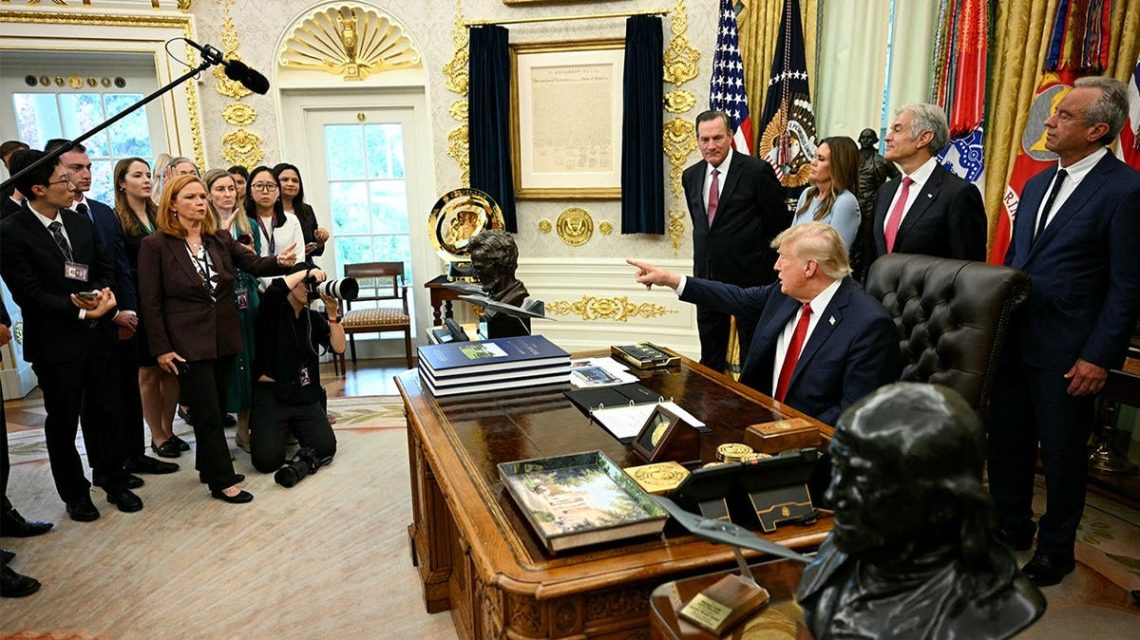
President Donald Trump has initiated a controversial action by banning CNN, MS NOW, and Politico from the White House. This decision was announced amidst allegations of reporting ‘fake news.’ Trump publicly stated these outlets should not report ‘fiction and lies’ when covering the presidency.
Aaron Terr, legal expert from the Foundation for Individual Rights and Expression (FIRE), predicts the Trump administration will face challenges in court due to the decision’s apparent unconstitutionality. Terr stresses that when the White House is open to the press, the First Amendment protections are also applied, making the ban legally questionable.
Over the weekend, affected reporters relocated to Pennsylvania Avenue to continue their work. A suit seeking an injunction against Trump’s ban has been filed by CNN, MS NOW, and Politico.
“The public has a vital interest in receiving accurate, independent information about its government. No administration should restrict a news organization because it objects to its reporting,”
the media pool declared in a joint statement. Major networks like ABC, CBS, and NBC refused to replace CNN in pool coverage, emphasizing the importance of press freedom.
Jacqui Heinrich, President of the White House Correspondents’ Association, expressed concern over the implications of restricting access based on coverage. This extends beyond the current case, potentially affecting any news outlet in the future. The WHCA demanded the immediate restoration of access for the banned media outlets.
Terr explains that while reporting from the White House is not a constitutional right, court precedent holds that once access is granted, it cannot be revoked for ideological reasons.
“The principle here is that once the government provides access, it then can’t condition that access on whether you’re expressing a viewpoint that the government agrees with,” Terr explained.
The broader First Amendment principle asserts that the government cannot retaliate against protected speech, including revoking press access. Terr highlights the risks of government-controlled media in contrast to potential biases that exist in independent outlets.
In closing, the First Amendment serves to ensure media freedom from government oversight, granting reporters autonomy in news coverage. This allows the American public to determine the credibility of the information presented.
 Illinois Governor Discusses Focus Amid Controversy Surrounding Influencer
  Public Support for Supreme Court Remains Amidst Declining Trust
  President Trump and Mayor Mamdani: Testing a Complex Relationship
  Democratic Congressman Endorses Republican Colleague for Reelection
  Seattle Expands Nondiscrimination Protections to Include Nonmonogamous Relationships
  Political and Policy Developments