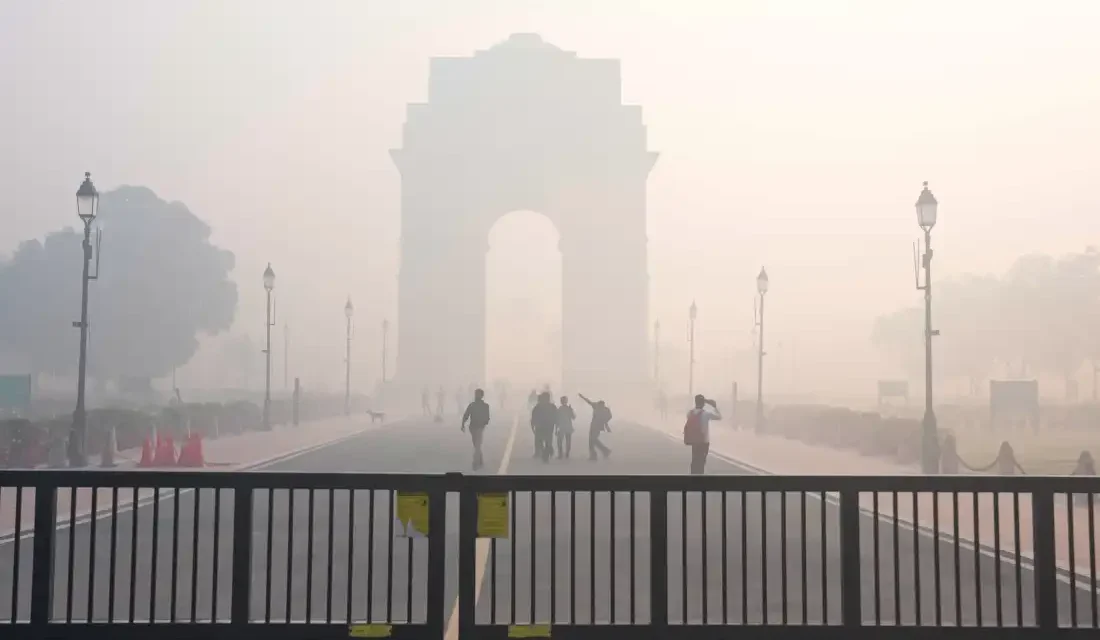
In New Delhi, a dense layer of smog enveloped the city following Diwali celebrations, as firecrackers lit up the night sky. This exacerbated the already high pollution levels, intensifying the seasonal air pollution crisis affecting the city annually.
Despite restrictions on fireworks, residents celebrated the Hindu festival with numerous firecrackers on Sunday evening. This released smoke and fine particulate matter into the atmosphere. By Monday morning, the air quality index exceeded 350 in several areas, reaching severe levels and posing substantial health risks. Monitoring stations recorded similarly worrying levels across the city, while visibility diminished, with a gray haze blanketing the streets and skyscrapers.
In an effort to curb pollution, India’s Supreme Court had restricted conventional firecrackers in October, permitting only approved “green firecrackers” under specified conditions for three hours on Saturday and Sunday. These crackers emit fewer pollutants but still contribute particulate matter and other emissions, worsening the city’s hazardous air quality.
Isyad, a New Delhi resident, shared the health impacts of the smog. “The pollution causes irritation in the throat and itching in the eyes,” he stated.
New Delhi and its metropolitan area, with over 30 million inhabitants, consistently rank among the world’s most polluted regions during winter. Pollution worsens as Diwali fireworks coincide with cooler weather and smoke from crop-residue fires in neighboring states, Punjab and Haryana. After harvesting rice, farmers often burn leftover stalks to ready their fields for the next planting season. This smoke drifts towards New Delhi, compounding the pollution from vehicles, industries, construction dust, and other sources.
The issue peaks in late October and November, when cooler temperatures, low wind speeds, and stagnant atmospheric conditions hinder the dispersion of pollutants, resulting in a persistent haze affecting the capital and surrounding areas.
Authorities in New Delhi have introduced measures to tackle pollution, such as limiting construction activities and restricting diesel generators. Additionally, courts have sought to impose firecracker restrictions. Despite these efforts, severe pollution returns each year. Environmental advocates argue for long-term solutions like cleaner energy and stricter vehicle emission controls to prevent the recurring crisis.
Shweta Narayan, a public health expert at the Global Climate and Health Alliance, criticized the government’s response as “knee-jerk” and “temporary.” She remarked, “Interventions only occur when the government is pressured to act.”
 Strategies for Muscle Preservation on GLP-1 Medications
 North Siders Debate Over Proposed Electrical Substation
 Insights from a Hospital Executive’s Journey Working ER Shifts
 Cumberland Island Land Swap Proposal Sparks Controversy
 Biden Reflects on Memoir and Health Challenges
 Former Aide Criticizes Trump’s Advisers on Health Initiatives