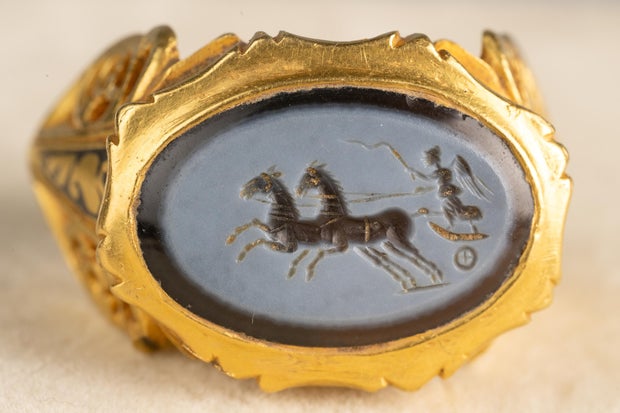
A Roman gold ring dating back more than 1,700 years has brought significant fortune to an amateur metal detectorist in England. The ring, depicting Victoria, the Roman goddess of victory, is referred to as the Ilminster Ring. It was discovered by Kevin Minto while he was metal detecting a field in Ilminster, a town that now bears the ring’s name, as reported by the South West Heritage Trust.
“The Ilminster Ring is both large and heavy, with elaborate goldwork and a beautifully executed intaglio,” stated Amal Khreisheh, senior curator at South West Heritage Trust. “While other examples are known, these elements combine to create a spectacular ring that is only paralleled by continental discoveries.”
The ring originates from Roman-occupied Britain circa 279 AD. Its impressive features include an engraved gemstone, known as an intaglio, showcasing the Roman goddess Victoria, famously referred to by her Greek name, Nike, riding a chariot drawn by two horses. Weighing 48 grams, it is larger than most contemporary heavyweight rings.
Discovered by Minto in 2018 in Somerset, England, the ring recently sold for $105,000. The South West Heritage Trust confirmed the purchase amounting to over 78,000 pounds. According to Khreisheh, the ring’s discovery offers insights into the lives of South Somerset’s Roman inhabitants during a tumultuous period from 286 to 296 AD. It is believed the ring was buried shortly thereafter, around 297 AD, as part of a larger hoard consisting of coins, lead, and pottery artifacts.
Ilminster, a small town in southwestern England and part of Somerset, is renowned for its ancient Roman findings. The ring was part of a larger collection of coins also unearthed by Minto, according to the trust. The county was home to the famous Frome Hoard, which involved more than 52,000 Roman coins discovered by another metal detecting enthusiast in 2010. Currently, the Frome Hoard is housed in the Museum of Somerset, where the Ilminster ring is now on display.
Additionally, the county is notable for the Chew Valley Hoard, a collection of over 2,500 silver coins from the Norman Conquest of England in the early 11th century, valued at more than $5 million. The Chew Valley Hoard also resides at the Museum of Somerset.
 New York Magazine’s Men’s Style Issue Sparks Debate
  Early Halloween at Triton College with ‘Trunk-or-Treat in Space’
  Midwest Underground Railroad Network Earns National Recognition
  Art Collective Challenges Presidential Policies with Satirical Installations
  Exploring the Depth of ‘American Hagwon’ by Min Jin Lee
  Exploring Architectural Heritage: Marie Olmos’ Journey in Oak Park