
U.S. President Donald Trump held a strategic meeting in the White House Situation Room with his advisors but has yet to decide on extending a ceasefire with Iran and reopening the Strait of Hormuz. Iran has not confirmed the finalization of the agreement.
Prior to the meeting, Trump expressed his intention to reach a ‘final determination.’ A senior administration official, who spoke under anonymity, noted that the two-hour session concluded without reaching a decision. The official highlighted Trump’s insistence on a deal that meets his ‘redlines’ and imposes limits on Iran’s nuclear plans.
The talks were confirmed by Trump following reports from The Associated Press and other outlets about U.S. and Iranian negotiators agreeing on a tentative arrangement. This deal aims to extend the ceasefire by 60 days while new discussions take place regarding Iran’s contentious nuclear program.
During the discussions, Trump shared on social media his condition that Iran must agree not to develop nuclear weapons, stressing the importance of reopening the strait for international commerce and the removal of sea mines.
The Iranian negotiator, Mohammad Bagher Qalibaf, communicated the nation’s skepticism, stating that Iran values only actions over verbal guarantees, reflecting ongoing distrust after U.S. and Israeli attacks during previous negotiations. He emphasized, through social media, that concessions would come not through talks but through strength.
Before the conclusion of Trump’s meeting, Iranian Foreign Ministry spokesman Esmail Baghaei confirmed that the agreement had not yet been finalized. Concurrently, U.S. Vice President JD Vance indicated efforts to establish broad terms around Iran’s nuclear aspirations, leaving details for future negotiation. However, Baghaei noted that Iran concentrates on ending the hostilities rather than discussing nuclear specifics at this stage.
Iran desires inclusion of a truce with Israel and Hezbollah in Lebanon within any agreement. Additionally, there is a push for the release of billions in frozen assets. Ebrahim Azizi, a notable Iranian figure, reiterated that Iran dictates terms around exchange—money and credit—in their dealings.
As per the International Atomic Energy Agency, Iran possesses 440.9 kilograms of uranium enriched up to 60% purity, approaching weapons-grade levels. Iran insists on the peaceful nature of its nuclear program, remaining hesitant to deplete its stockpile, which is stored at several sites previously targeted by U.S. strikes.
Trump reiterated his requirement for the removal of the enriched uranium as a part of any deal. He stated it would be done by the U.S., coordinated with Iran and the IAEA, and ‘DESTROYED.’
The draft memorandum details that Iran would be prohibited from imposing tolls on the Strait of Hormuz and required to clear all mines in the area within 30 days. The U.S. would sequentially ease its port blockades and relax sanctions to allow Iran to increase oil sales.
Baghaei mentioned Iran and Oman, situated on opposite sides of the strait, would manage it, setting transit mechanisms in alignment with their and global interests. Recent discussions between the nations’ foreign ministers reinforced solidarity against mutual threats.
Previously, Trump issued a warning to Oman against forming any agreements with Iran regarding control of the strait, threatening military action. Iran’s blockade of the strait followed a covert attack by the U.S. and Israel, which resulted in significant Iranian casualties.
The strait’s closure led to a global spike in fuel and goods prices. Iran has permitted limited commercial passage recently, a divergence from the pre-war traffic levels. It has also instituted toll charges for some vessels, establishing the Persian Gulf Strait Authority, leading to additional U.S. sanctions, which the Iranian agency controversially views as validation of its operations.
Despite violations, the ceasefire has largely held over the past seven weeks, allowing for continued negotiations rather than a return to full conflict.
Additional reporting was contributed by Associated Press writers Jennifer Peltz, Farnoush Amiri in New York, and Matthew Lee in Washington.
 Israeli Leader’s Upcoming U.N. Assembly Speech Marked by Controversy
  United States Secures Arctic Defense Pact
 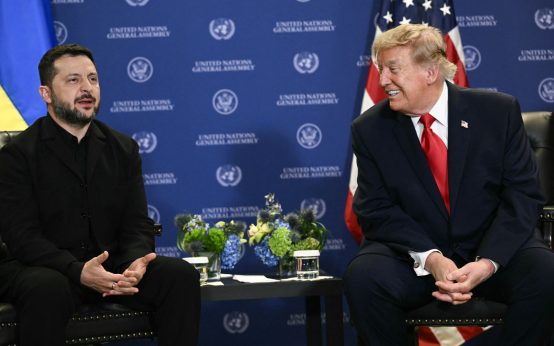 Trump’s Engagements at the UN: Focus on Ukraine and White House Developments
  Trump Administration to Admit 17,500 Afrikaner Refugees from South Africa
 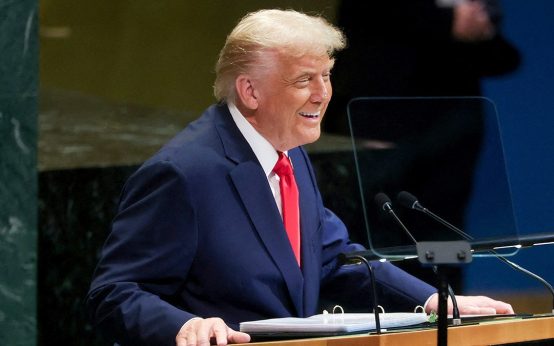 Trump’s Vision for Global Security: Iran, AI, and the Role of the U.S.
  Concerns Raised Over Canadian Assisted-Dying Program