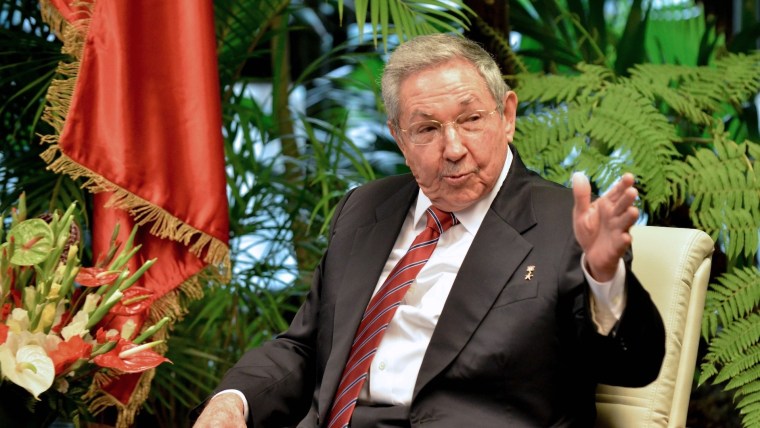
The United States Justice Department has indicted former Cuban President Raúl Castro concerning the 1996 incident where two civilian planes were shot down, resulting in the deaths of four Cuban exiles. Acting U.S. Attorney General Todd Blanche announced the charges in Miami. The charges include conspiracy to kill U.S. nationals, murder, and the destruction of aircraft. Five Cuban fighter pilots involved in the shooting were also indicted.
Details of the indictment were unveiled in front of Miami’s Freedom Tower, a landmark for Cuban Americans who fled the communist regime. The announcement took place on May 20, recognized as Cuban Independence Day. Blanche stated, “Raúl Castro and five co-defendants participated in a conspiracy leading to Cuban military aircraft firing missiles at civilian planes, resulting in the deaths of four Americans. These are the charges brought by a federal grand jury.”
All military orders related to the killings traveled through a chain of command, with both Castro Ruz and Fidel Castro identified as final decision-makers.
The announcement received cheers from a crowd in downtown Miami. Officials remembered the four Cuban American men who died in the attack: Carlos Costa, Amando Alejandre Jr., Mario de la Peña, and Pablo Morales. These individuals were part of Brothers to the Rescue, an organization formed in 1991 to aid Cubans leaving the country by raft. However, the planes occasionally entered Cuban airspace.
On one mission, the group’s planes were shot down by a Cuban MiG-29 in international airspace. Cuba claims the planes violated its airspace, but reports from the United Nations’ International Civil Aviation Organization and the Inter-American Commission on Human Rights concluded the deaths occurred due to Cuban State actions in international airspace, bypassing interception standards.
The Clinton administration and Congress condemned Cuba’s actions, introducing sanctions and convicting an individual for supplying Cuba with information about the group’s missions. The event remains contentious in U.S.-Cuban relations, with many calling for Castro’s indictment.
Blanche noted law enforcement’s long-term focus on the incident, achieving recent progress in gathering evidence for the indictment. However, details presented to the grand jury have remained private.
Relatives of the victims attended the announcement. Miriam de la Peña, mother of Mario Manuel de la Peña, expressed gratitude, emphasizing that the deaths of their loved ones would now be recognized as murders stemming from a dictatorship.
The likelihood of Cuba extraditing Castro is slim. Blanche hinted at possible U.S. action in Cuba, mentioning a warrant for Castro’s arrest and hoping he would come to Miami to face the charges.
Cuban President Miguel Díaz-Canel condemned the indictment, accusing the U.S. of misrepresenting the 1996 incident. U.S. lawmakers of Cuban descent who pushed for the indictment consider it a first step towards justice.
Despite resigning as president in 2018 and as secretary of the Communist Party in 2021, Castro remains influential in Cuba. Celebrations for his 95th birthday were planned before the indictment, showcasing his ongoing legacy.
U.S. Pressure on Cuba
Castro’s indictment coincides with U.S. pressure on the Cuban government for political and economic changes, even suggesting potential military action during the Trump administration.
President Donald Trump criticized Cuba, citing its dire electricity and food shortages. Secretary of State Marco Rubio addressed Cubans, emphasizing the hardships they face due to their government’s mismanagement of resources.
The Cuban government views these U.S. actions as attempts to undermine their independence. Díaz-Canel rebuked Rubio’s message, voicing the nation’s enduring anti-imperialist sentiment.
The cessation of Venezuelan oil shipments to Cuba has exacerbated fuel shortages, resulting in prolonged power outages. Residents in Havana report significant difficulties due to these shortages, impacting both power and water supply.
The Cuban government accuses the U.S. of attempting to force a political shift by restricting resources. Some residents resonate with this perspective, highlighting the hardships induced by U.S. sanctions.
 Pacific Hurricanes Pose Flood Risk to Southern California
  Israel’s U.N. Ambassador’s Viral Video Reaches Iranian Audience
  Trump’s Remarks on Ukraine-Russia War Casualties and Peace Efforts
  Tony Blair Warns Europe to Maintain U.S. Alliance
  Trump Rejects Iranian Proposal on Strait of Hormuz
  Tensions Rise as Russia Accuses Europe of Blocking Ukraine Peace Efforts