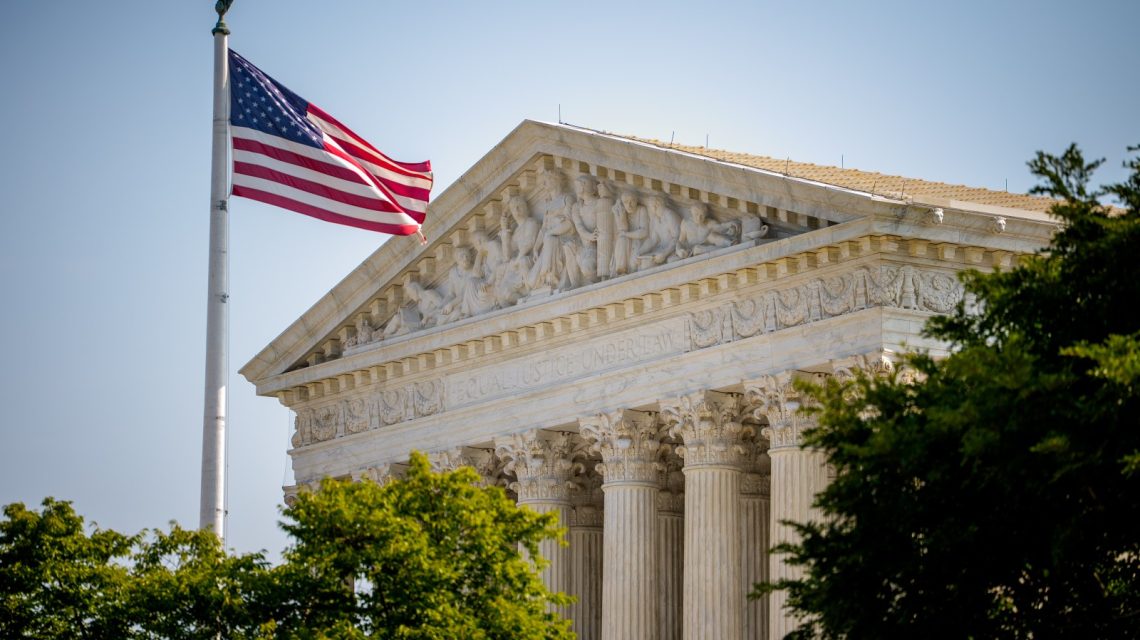
The United States Supreme Court refused an appeal by Missouri state leaders aiming to use a contested congressional district map for the upcoming midterm elections. This map had been advocated by former President Donald Trump. The case has garnered significant attention as it questions how late courts can modify congressional maps before an election and if voters in the primaries can be reassigned to different districts for the general elections.
Missouri State Attorney General Catherine L. Hanaway argued that switching maps before the midterms would be too late, describing the situation as a potential “federal-election-administration disaster.” On Tuesday afternoon, Justice Brett Kavanaugh denied the bid to retain the new map, thereby upholding a Missouri Supreme Court decision to use a 2022 map instead.
Abha Khanna, a partner at Elias Law Group and counsel on the case, commended the court’s choice, asserting, “The state constitution is clear that Missourians should get the final word on whether their congressional map can undergo an extreme mid-decade gerrymander at President Donald Trump’s request, and now they will. This is a win for democracy and for the hundreds of thousands of Missourians who signed a petition to make sure they would have a chance to weigh in on the gerrymandered HB 1 map.” This ruling in Missouri could influence election disputes nationwide as other states aim to meddle with their congressional maps.
The Missouri Supreme Court made the right call in this case.
How Missouri Arrived at This Point
In September 2025, the Missouri legislature passed House Bill 1, designing a new congressional map to replace one from 2022. Republican Governor Michael Kehoe signed it into law. Missouri then used this map during its August 2026 primary elections, where around 1.2 million people voted.
An activist group, People Not Politicians, led by Richard von Glahn, initiated a referendum campaign to allow voters across the state to decide on the map. This legal battle expanded to a series of lawsuits challenging Missouri’s referendum process’s applicability to congressional redistricting legislation. Missouri courts initially upheld the map while the litigation persisted. State officials argued these decisions resulted in reliance on the map by election administrators, candidates, and voters throughout the primary.
On September 3, the Missouri Supreme Court reversed a lower-court decision, issuing an injunction that halted the use of House Bill 1, instructing that the 2022 map should be used instead.
Missouri’s Plea to the Supreme Court
Missouri’s argument emphasized that the primary elections had already been conducted using the new map, and challenging these district lines at this juncture was “impractical” and “impossible” according to a lower court. Missouri contended that voters might be moved to different districts and compelled to vote for candidates they did not choose during the primaries. Justice Kavanaugh’s denial of relief left these points unresolved and allowed the Missouri Supreme Court’s order to remain effective. This decision does not reflect a ruling on the legal merits but denies the immediate intervention Missouri sought to prevent election disturbances.
Richard von Glahn of People Not Politicians noted that their efforts to challenge the new map accomplished a crucial legal victory. “The Missouri constitution is clear as was the Missouri Supreme Court,” he said. More than 305,000 citizens, including Republicans, Democrats, and Independents, lobbied against this political move last fall.
A Broader Constitutional Debate
The appeal included several constitutional claims. Foremost was an Elections Clause claim that contested the impact of Missouri’s redistricting process by referendum. Missouri argued that the state supreme court allowed about 3.3% of voters to nullify a map approved by both the legislature and the governor.
There were concerns about potential legal breaches in altering districts between primaries and general elections. Republican entities, including the Republican National Committee, criticized the Missouri Supreme Court for subjecting the state to electoral chaos at the behest of a small fraction of voters.
Supporters of the court’s decision highlighted the necessity of halting the map while the referendum petition is reviewed. They emphasized state laws that mandate the procession of a statewide vote on such legislative adjustments.
Implications Beyond Missouri
The case’s national importance lies in addressing how late elections can be impacted by alterations in congressional maps. Missouri’s Supreme Court filings indicated that should similar precedents be established, states could face court-mandated adjustments close to an election day.
The Purcell principle weighs against last-minute changes to avoid voter confusion and administrative challenges. Missouri cited this in requesting emergency intervention. Though Kavanaugh declined relief, emphasizing the issues raised could extend beyond Missouri.
For now, Missouri election officials must operate under the supreme court’s decision as candidates and voters await further developments in this closely observed election-law case.
 Trump Administration’s Crackdown on ACA Coverage
  Shakeup in Mayor Johnson’s Administration with Key Retirements and Appointments
  House Republicans Challenge DOJ Over Smith Investigation
  RNC Sues New Jersey Over Voter Roll Transparency
  Karoline Leavitt on Trump’s Tense Calls with Putin and Xi
  Political Strategies for the Upcoming Midterm Elections