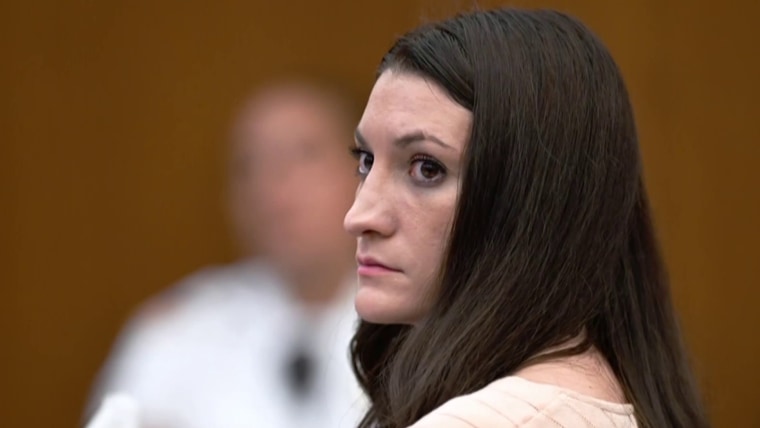
PLYMOUTH, Mass. — At Lindsay Clancy’s murder trial, psychologist Paul Zeizel provided testimony that highlighted Clancy’s inability to understand the wrongfulness of her actions due to mental health issues. Zeizel spoke in defense of Clancy, emphasizing that she should not be held legally responsible for the murder of her three children because of her bipolar disorder and a severe mental illness called postpartum psychosis.
Zeizel, who began treating Clancy at a hospital after the incident, stated, “She had no appreciation for the wrongfulness of her act.” He noted that Clancy was unable to comply with the law due to a mental disease or defect.
Clancy, aged 36, faces murder charges for the deaths of her children Callan, Dawson, and Cora Clancy, who were aged between 8 months to 5 years. Postpartum psychosis, linked to childbirth-related stress, sleep deprivation, and hormonal changes, is more severe and less frequent than postpartum depression, affecting 1 to 2 per 1,000 women after childbirth.
Prosecutors argue that the former labor and delivery nurse premeditated the January 2023 murders by sending her husband on an errand to retrieve medicine and dinner for the family.
Clancy’s Mental Health Struggles
Zeizel, having spent over 35 hours with Clancy through numerous visits, described her deteriorating condition. In December 2022, Clancy visited a perinatal clinic due to feeling as though her “brain was damaged.” She expressed thoughts of self-harm and a belief that recovery was impossible. She showed signs of paranoia, fearing loss of her children and that others could hear her thoughts.
Despite her psychotic state, Zeizel stated Clancy completed daily tasks, such as driving and searching online. On the day of the killings, she took her daughter to a doctor, played with her children, and searched for local services online.
Clancy’s attorney, Kevin Reddington, questioned whether her ability to perform routine activities undermined her psychotic state. Zeizel affirmed that it did not.
Prosecution’s Challenges
The prosecution questioned Zeizel’s objectivity, highlighting errors in his reports regarding Clancy. They noted the absence of records of Clancy hearing voices urging her to harm herself, despite her expressing a desire to die.
Her suicide attempt’s severity was scrutinized, as Clancy remains paralyzed from jumping from a second-story window after the killings.
Prosecution’s Evidence and Defense Response
Prosecutor Shanan Buckingham referenced reports from Tewksbury Hospital, where Clancy is currently, which mentioned family visits and interactions but omitted any acknowledgment of her children’s birthdays or death anniversaries. Reddington countered by asking whether Clancy exhibited any inappropriate behavior at the hospital.
Zeizel defended Clancy by stating, “Lindsay Clancy has bad days and worse days.” He acknowledged that Clancy frequently spoke about her children, countering the prosecution’s argument that she neglected to mention them. “She really loves them and misses them and thinks of them every single day,” Zeizel asserted.
If found guilty, Clancy could receive a life sentence without parole. Alternatively, a verdict of not guilty due to a lack of criminal responsibility would lead to her commitment to a state mental health facility.
If you or someone you know is experiencing a crisis, contact the 988 Suicide & Crisis Lifeline via call or text at 988, or visit 988lifeline.org. More resources are available at SpeakingOfSuicide.com/resources.
 Florida Man Indicted for Defrauding Clients Over Ransomware Recovery
  New Hampshire Man Pleads Guilty to Killing Father
  Archdiocese of New York Settles Abuse Claims for $800 Million
  Internal Reviews Highlight Failures in Detention Center Operations
  Federal Judge Engages in Fiery Exchanges Over Golf Course Case
  Husband Charged with Murder After Missing Wife’s Burned Remains Found