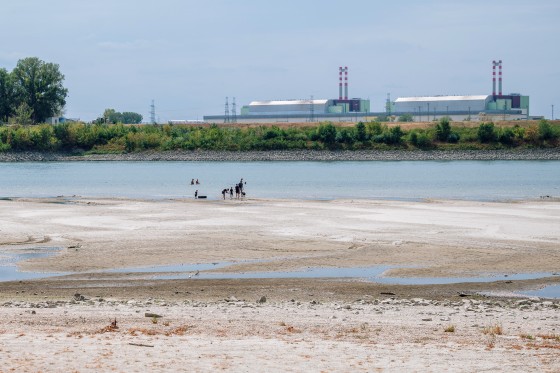
Prime Minister Péter Magyar announced urgent steps to raise the Danube River’s level this week to ensure Hungary’s sole nuclear power plant, Paks, remains operational. Recent droughts and heat waves have drastically reduced water levels in one of Europe’s largest rivers.
The Paks nuclear facility, crucial for supplying about one-third of Hungary’s electricity, currently operates at only 10% of its capacity. This facility relies on the Danube for cooling its reactors, and record lows in water levels now threaten its operation.
Magyar highlighted the emergency in a Facebook video, stating that the government would construct a bed sill—a low structure to elevate upstream water levels—beginning Thursday. This construction aims to raise the Danube by up to a meter near the plant.
To facilitate this, authorities will start delivering around 145,000 cubic meters of rocks on Wednesday evening. Additionally, two large barges may be submerged to further boost water levels by 20 centimeters near the plant’s cooling pumps, pending a decision on Friday.
Magyar stressed the urgency, noting that the situation can no longer be viewed as a one-time occurrence. The intervention seeks to prevent the drastic measure of shutting the facility completely, a scenario not seen in its 44-year history.
After a brief rise, water levels are predicted to fall again without intervention, risking a full shutdown. In comparison to the Paks plant’s current monthly economic drain of up to 50 billion forints ($158 million), the intervention costs are estimated at around 6 billion forints ($19 million).
Last week, Romania took similar measures by submerging barges into the Danube to aid the Cernavoda nuclear plant, which had already shut down one reactor due to low water levels.
 US Monitors Russian Pneumonic Plague Case
  Poland Prepares for Potential Conflict Amid NATO Concerns
  Drone Warfare Redefines Ukraine’s Frontline Conflict
  Key Developments in the Iran Conflict Affecting Global Oil Markets
  U.S. Military Strikes Vessel in Caribbean, Allegedly Involved in Drug Trafficking
  Australia Probes FlyDubai Co-Pilot’s Connections