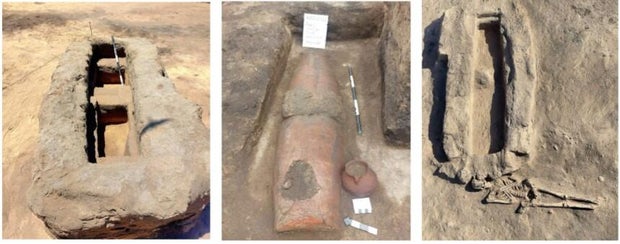
Cairo — Egyptian archaeologists have made significant discoveries in a Greco-Roman cemetery, revealing more about funerary practices over centuries. The site, located in Tell Kom Aziza in Egypt’s northern Beheira province, showcases burials from 332 B.C. to 395 A.D., highlighting the evolution of the site from a settlement to a burial ground.
According to Nevine El-Aref, media adviser to the Minister of Tourism and Antiquities, these findings are crucial for understanding the transformation from a community hub to an extensive cemetery encompassing different eras.
Variety in Burial Practices
The cemetery revealed diverse burial types. Simple pit burials, graves lined with mudbricks, and painted plaster coffins were found. There were both individual and collective burials, positioned along north-south and east-west axes. Dr. Hisham El-Leithy, Secretary General of the Supreme Council of Antiquities, noted varying hand positions, including hands folded over the pelvis or crossed on the chest, reflecting different burial traditions.
This diversity can be interpreted in several ways: It may reflect social differences among the individuals buried, variations in ritual practices, or a limited development within the same funerary tradition.
Unique Discoveries
Researchers found the complete skeletal remains of two wild boars, an uncommon discovery at Egyptian sites. Boars were associated with the deity Seth, linked to chaos and violence. Mohamed Abdel Badi, head of the Egyptian Antiquities Sector, mentioned ongoing analysis to determine whether these remains had ritual significance or were part of domestic activities.
Additionally, pottery fragments from the Egyptian Old Kingdom, around 2686 to 2181 B.C., through to the Greco-Roman period, highlight the site’s continued use. Items like amphorae, burial jars, and bread molds suggest long-term habitation and utilization.
Excavation continues as archaeologists seek to uncover more about the site’s history and patterns of human activity. El-Aref emphasized the ongoing effort to piece together the site’s complex history.
 Personal Journey in Understanding Neurodegenerative Diseases
  Great Lakes Face Beach Hazards Due to Dangerous Currents
  OpenAI’s Complex Solution to Navier-Stokes Equations Stirs Debate
  Reassessing the Central Role of Rome in the Roman Empire’s Road Network
  Fire Amoeba Discovery Challenges Limits of Complex Organisms
  Impact of Sleep Types on Disease Risk