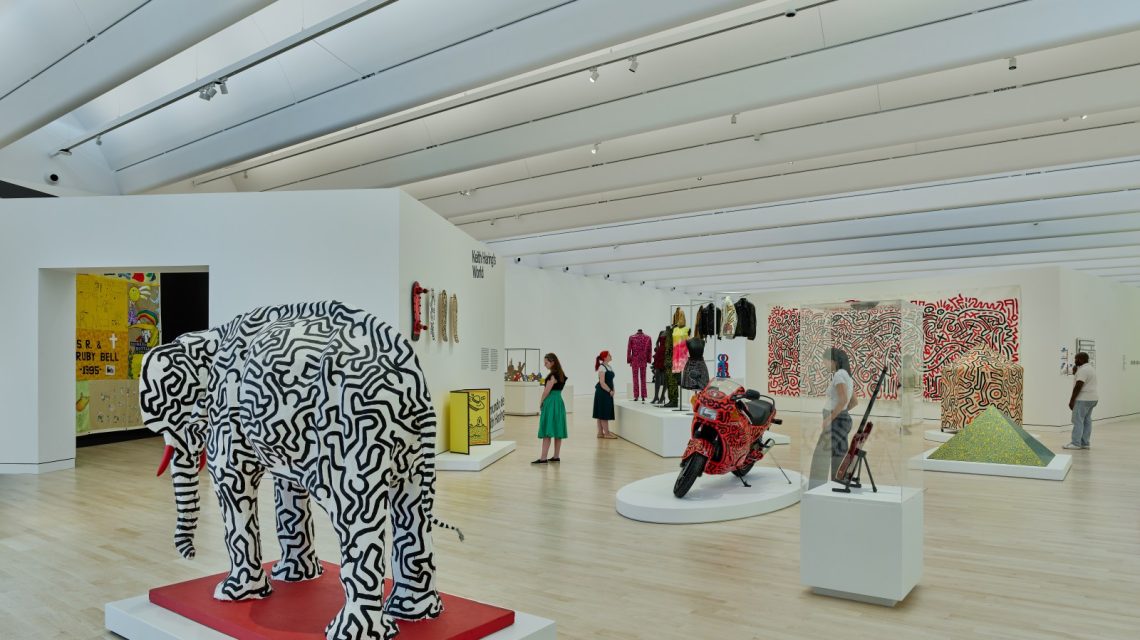
Larry Warsh’s journey as a collector began in his youth, evolving into a fascination with Keith Haring’s unique ability to transform line, object, and public space into a shared language. As co-editor of the art book Keith Haring in 3D, which complements the major exhibition at the Crystal Bridges Museum of American Art, Warsh argues that despite Haring’s popularity, his work is not fully understood. This exhibition, held in Bentonville, Arkansas, from June 6, 2026, to January 25, 2027, is the first major showcase of Haring’s three-dimensional pieces. It features sculptures, totems, masks, painted objects, clothing, boomboxes, and even a 1963 Buick Special, highlighting Haring’s expansive practice beyond the picture plane.
Finding a Way Into Art
Warsh describes his early connection to art through simple and tactile experiences. In a family filled with objects meant for close observation, an uncle broadened his perspective by introducing him to galleries and auction houses at the age of 12. This early exposure revealed to Warsh how objects could embody history, taste, and energy. His passion for collecting began early, encompassing antiques, silver, and baseball cards, fueled by a lifelong habit of keen observation.
Relocating near Astor Place expanded Warsh’s artistic interest. In the early 1980s, New York City provided proximity to artists and venues that would define an era, including Keith Haring, Jean-Michel Basquiat, and Kenny Scharf. This closeness informs why Warsh views the Crystal Bridges exhibition as significant; it repositions Haring’s object-based works within the downtown networks that shaped them, rather than sidelining them as lesser-known aspects of his portfolio.
The Downtown Triangle
Warsh recalls the vibrant and communal art scene that linked Haring, Basquiat, and Scharf within a wider downtown ecosystem composed of clubs, studios, sidewalks, and galleries. This scene, enriched by interactions with figures like Patti Astor, converted raw energy into cultural momentum. Artists such as Futura, Rammellzee, Tseng Kwong Chi, and Rene Ricard formed part of this dynamic network, while contributing to the cultural identity of downtown New York.
Art for Everyone
Warsh believes one of Haring’s enduring achievements was his understanding of scale, both visually and socially. Recognizing Haring’s broad appeal, Warsh highlights the artist’s desire to create images and objects encountered in motion, throughout daily life. The opening of the Pop Shop in 1986 exemplified this by extending the logic of the subway drawings into retail, without forsaking Haring’s public mission.
The exhibition at Crystal Bridges echoes this theme, demonstrating how Haring transformed his graphic language into three-dimensional objects, allowing viewers to interact more physically. Warsh likens Haring’s approach to those of Andy Warhol and Salvador Dalí, who understood how art could permeate popular culture. Haring’s words, “The Pop Shop makes my work accessible. It’s about participation on a big level,” reflect his intent to make art part of public life.
Generosity as Legacy
Warsh emphasizes Haring’s generosity, a key aspect of his legacy. Many pieces in exhibitions come from friends, gifted by Haring. His foundation supports AIDS care and children’s education, continuing his spirit of giving. Warsh remembers Haring as deeply engaged with people, painting in hospitals, supporting benefit auctions, and displaying notable openness.
The Crystal Bridges exhibit aims to redefine Haring’s legacy, focusing on sculpture and objects often overshadowed by his murals and paintings. By highlighting his three-dimensional works, the exhibition seeks to reveal the full scope of Haring’s artistic vision, which was as much about space as it was about line, expanding the narrative of his artistic journey beyond the widely recognized aspects.
 Colin Kaepernick’s Press Tour Raises Unasked Questions
  Controversial Claims in Charles Spencer’s Book about Princess Diana’s Divorce
  The Curious Case of Mark Jackson’s NBA Hoops Card
  Communities Continuing Recovery from Hurricane Helene Explored through Graphic Novel
  Art Institute of Chicago Returns Nazi-Looted Painting to Heirs
  Chicago History Museum Responds to Protest with Aquí en Chicago Exhibit