NASA is set to announce the four astronauts chosen for the upcoming Artemis III mission. This event, taking place at the Johnson Space Center in Houston, marks the beginning of extensive training for the crew. They will launch next year to test vital procedures necessary for future lunar landings. These include rendezvous and docking techniques utilizing moon landers from SpaceX and Blue Origin.
The Objectives of the Artemis III Mission
The Artemis III mission will focus on mastering operations needed for future lunar orbit missions. This crew will launch aboard an Orion capsule, propelled by NASA’s Space Launch System rocket. Their mission will echo NASA’s Apollo 9, where the lunar module was tested in Earth orbit. Following this, missions like Apollo 10 prepared for the final Apollo 11 moon landing.
Recently, the Artemis II mission successfully completed a lunar flyby, paving the way for Artemis III. Commanded by Reid Wiseman, with Victor Glover, Christina Koch, and Jeremy Hansen onboard, this mission demonstrated essential technologies and techniques.
Pathway to a Moon Landing
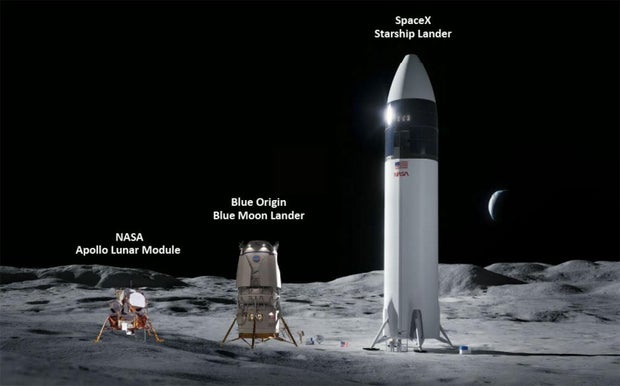
Artemis III is NASA’s sole test flight before a targeted moon landing in 2028. The mission’s success hinges on either SpaceX or Blue Origin completing an uncrewed moon landing. An artist’s rendering contrasts NASA’s Apollo lander with Blue Moon’s Mark II and SpaceX’s Starship landers on the lunar surface.
Recent challenges arose for Blue Origin when a New Glenn rocket exploded on May 28, damaging its Florida-based launch pad. Despite these setbacks, Blue Origin aims to resume flights by year-end. Meanwhile, SpaceX is advancing its Super Heavy-Starship rocket system.
If none of the lunar landers are available, NASA may alter the mission to maintain momentum. Completing Artemis III and future missions will establish NASA’s competitive position in the space race, notably with China.
Expanding Lunar Exploration
The Artemis program aims to reestablish astronauts on the moon, continuing the legacy of the Apollo missions. During the late 1960s and early 1970s, NASA sent 12 astronauts to the moon. Today, the focus extends to a lasting lunar presence.
Robotic landers and satellites will precede astronaut landings under Artemis IV and V. By the early 2030s, NASA plans to establish a base near the lunar south pole, capitalizing on resources like ice deposits potentially useful for water and fuel.
Infrastructure, including power stations and habitats, will support extended lunar stays, akin to current space station missions. Yet, obstacles persist, such as potential delays stemming from rocket and lander readiness. Future test flights might be necessary.
 NASA’s Challenges Amid Goddard Space Flight Center Relocations
  Lost City Linked to Jesus Discovered Near the Sea of Galilee
  NASA’s Launch of the Nancy Grace Roman Space Telescope
  NASA Launches Nancy Grace Roman Space Telescope to Explore Universe’s Mysteries
  Trump Engages with Astronauts and Honors Artemis II Crew
  NASA’s Nancy Grace Roman Telescope Prepares for Launch