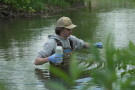
Hannah Ray J Childs loves whitewater kayaking on Iowa’s Maquoketa River, performing acrobatics that make her feel like she’s flying. She also found her community on the water, even meeting her husband through kayaking. Despite this passion, she faces challenges due to water pollution, now using nose and ear plugs to minimize health risks. Many people question her love for kayaking in such waters.
Iowa struggles with water pollution, a common problem in the Midwest. As a major corn, soybean, and hog producer, the state experiences runoff from fertilizers and manure, impacting the waterways. These pollutants make Iowa a significant contributor to the dead zone in the Gulf of Mexico. Last summer, the state’s largest city imposed water restrictions due to high nitrate levels.
Decades of water pollution affect public health and recreation. Many lakes and streams in Iowa fail to meet swimming and drinking standards. Algal blooms and bacteria from agricultural runoff create challenging conditions. Over half the monitored water bodies in 2024 did not meet essential state standards.
Iowa relies on voluntary measures to address nitrate and phosphorus runoff. Recent lawsuits targeted the Trump administration for reversing policies requiring the state to combat nitrate pollution. Investments include a new $320 million water infrastructure package, complementing the state’s annual $100 million allocation.
Iowa’s identity is linked to its waterways, like the Missouri and Mississippi rivers. Despite being surrounded by water, pollution hampers enjoyment. Childs, who grew up near the Maquoketa River, now volunteers to test water quality and promotes a whitewater park in her hometown of Manchester. She stresses the importance of local engagement with the river for long-term care.
“If we don’t get people invested in their local river, their local community, how are we ever going to ask them to take care of it?”
Mary Swander, a theater director who spent her childhood by Iowa’s waters, now avoids them due to negative experiences. Changing conditions at places like Lake Darling underscore the broad challenges. Last year, the lake faced the worst health advisories among state beaches due to E. Coli and algal blooms.
Nearby, efforts to conserve land and address runoff saw progress, yet new challenges emerged with increasing agricultural operations. The lake serves as a reminder of the difficulties in maintaining healthy waterways.
Drake University conducts research to track water quality issues. Though recent years saw improvements, pollution from manure and fertilizer continues. Bacterial contamination remains significant, caused by both animal and human waste.
The struggle with pollution extends beyond Lake Darling. After high-profile lawsuits and voluntary remediation efforts, the EPA collaborates with states to tackle nitrate and phosphorus pollution.
Aaron Lehman, representing Iowa Farmers Union, notes rising costs and the long-term nature of farming changes. Farmers need federal and state support, but demand often exceeds available resources. Yet, local successes inspire hope. Efforts to restore wetlands and improve treatment systems maintain some areas as viable recreational spots.
David Thoreson, inspired by his mother to sail on the Iowa Great Lakes, emphasizes local contributions to conservation. Restoring areas and understanding environmental importance bolster economies and communities.
 Trump’s Vision for Global Security: Iran, AI, and the Role of the U.S.
  Lawsuits Claim Vision Loss Risk from GLP-1 Medications
  Nevada Attorney General Faces Questions Over Clemency Bid
  Trump Administration’s Crackdown on ACA Coverage
  Shakeup in Mayor Johnson’s Administration with Key Retirements and Appointments
  States Tighten Regulations on Tianeptine, Known as ‘Gas Station Heroin’