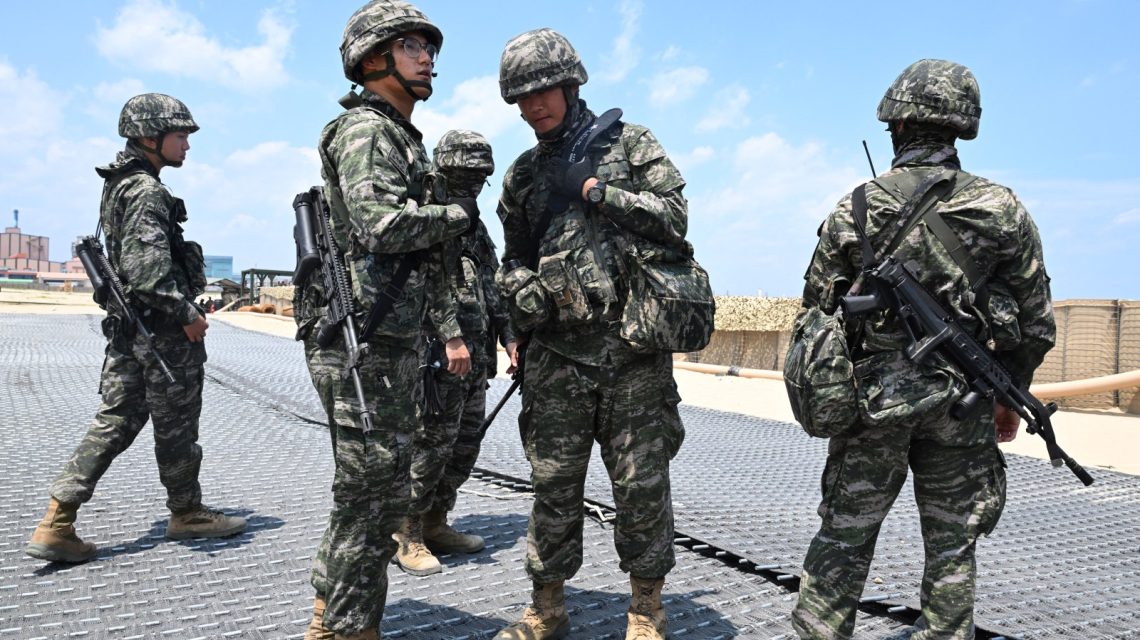
Donald Trump’s recent decision to scale back military drills with South Korea could create an opportunity for renewed discussion with North Korea. Analysts suggest this move might provide Washington a chance to negotiate control over Pyongyang’s expanding nuclear capabilities. The U.S. president announced his decision on Sunday, instructing Defense Secretary Pete Hegseth to reduce the annual exercises. Trump cited his positive relationship with North Korean leader Kim Jong Un and criticized Seoul for lacking support in the conflict with Iran.
This week saw the commencement of the planned military exercises.
Throughout his first term, Trump met three times with Kim to discuss denuclearization, but these talks failed to yield results. Pyongyang has since increased its nuclear arsenal. A June 2026 report from a Stockholm-based think tank noted North Korea had approximately 60 assembled nuclear weapons and could produce at least 30 more. Recently, Pyongyang conducted ballistic missile launches prohibited by United Nations regulations.
Trump’s announcement via Truth Social triggered concern among Democrats, Republicans, and South Korea. They fear that scaling back these drills may embolden Pyongyang and create doubts about the reliability of Washington as an ally, especially during a challenging geopolitical period. However, Evan Sankey, a policy analyst at the Cato Institute, mentioned that this decision might prompt new U.S.-North Korea discussions. He expressed skepticism about convincing Kim to entirely abandon his nuclear capabilities, but stated that talks might achieve limitations on his missile arsenal and fissile material stockpile.
Jennifer Kavanagh, director of military analysis at Defense Priorities, viewed Trump’s announcement as both necessary and strategically wise. Newsweek has reached out to the White House and the South Korean Ministry of Foreign Affairs for comments.
The U.S.’s Relationship with South Korea
South Korea hosts Camp Humphreys, the largest U.S. military base overseas, and frequently engages in joint military drills with the U.S. The annual Ulchi Freedom Shield exercises began as planned this week. Reuters reported that these drills will focus on addressing North Korea’s evolving capabilities, including training to counter drones, GPS disruptions, and cyber-attacks. Local authorities noted the participation of at least 18,000 South Korean troops.
North Korea has consistently criticized these exercises, labeling them last week as “a rehearsal for an aggressive war.” Trump’s posts on Truth Social conveyed that these drills represent hostility toward North Korea, which he described as having been “unthreatening and respectful.” These comments elicited strong reactions from various lawmakers.
Senator Jack Reed, the leading Democrat on the Senate Armed Services Committee, accused Trump of reducing military exercises to please a dictator. Republican Senator Thom Tillis remarked that Trump’s announcement to decrease drills merely frees North Korean troops to support Russia’s war efforts.
The South Korean publication Hankook Ilbo opined that Trump’s announcement highlights the reality of a weakened Korea-U.S. alliance. Sankey, from the CATO Institute, compared Trump’s announcement to his previous cancellation of exercises during negotiations with Kim in 2018 and 2019.
Sankey stated that while no current U.S.-DPRK talks are known, reducing exercises might indicate a U.S. diplomatic initiative. He welcomes this potential development, emphasizing that current U.S. policy towards DPRK is stagnant.
Kavanagh of Defense Priorities argues that there is minimal evidence that drills with South Korea deter aggression from North Korea and China or aid regional stability. She believes they might have the opposite effect.
“China and North Korea often respond by accelerating their military developments and regional activities, including holding their own exercises or launching new weapon tests,” Kavanagh stated.
South Korea’s Pursuit of Security Control
Kavanagh criticized the exercises, saying they drain U.S. resources and readiness during the Iran conflict. She advocated for Washington to fully transfer security responsibility to Seoul.
On Tuesday, South Korean President Lee Jae Myung reiterated his commitment to transition wartime control of South Korean forces from the U.S. to Seoul. He encouraged progress in acquiring nuclear-powered submarines. This issue dates back to the Korean War, which ended in 1953 without a formal peace agreement.
Sankey from CATO suggested that talks between Washington and Pyongyang might lead to a declaration ending the Korean War, emphasizing potential benefits to U.S. interests. Diplomatic efforts toward these goals were encouraged.
You may contact Newsweek editors Matthew Robinson and Cristina Diciu for further information on this story.
 Nationwide ‘No Kings’ Events Aim to Inspire Voter Turnout
  Senator Armstrong Advocates for Federal Permitting Overhaul Amid AI Expansion Challenges
  Democratic Incumbent and Republican Newcomer Vie for Lake County Clerk Position
  Senators Receive Suspicious Mail Amid Nationwide Investigation
  Trump Accuses Michigan Senate Candidate Abdul El-Sayed of Muslim Brotherhood Ties
  U.S. Army Prepares for New Threats on Domestic Soil