
Trump’s Approval Rating Falls to 30 Percent
President Donald Trump’s approval rating has dipped to 30 percent, marking the lowest level during his second term. This drop coincides with increased engagement and motivation among Democratic voters as the November midterm elections approach. A Pew Research Center survey highlights that Trump’s approval rating is now 8 percentage points lower than former President Joe Biden’s was at a similar juncture of the 2022 midterm campaign. During that period, 38 percent of Americans approved of Biden’s performance, while 59 percent disapproved.
Decline Among Trump’s 2024 Voters
The decline in Trump’s approval largely stems from his own 2024 voters. While approximately two-thirds still express approval of his job performance, this marks a substantial drop from the 95 percent approval he garnered at the start of his term. Notably, Hispanic and younger voters have shown some of the steepest declines in approval.
Polling and Voter Sentiments
The survey, conducted from September 28 to October 4, gathered responses from around 5,000 U.S. adults, including 3,917 registered voters. With 26 days left until the 2026 midterm election, Trump remains a significant factor in voters’ congressional choices. Sixty-three percent of registered voters indicate that Trump will influence their vote for Congress, with more than double expressing their vote as opposition to him rather than support.
Comparatively, an October 2022 Pew Research Center poll showed that 36 percent of voters opposed Biden with their congressional vote, while 19 percent supported him. Grant Davis Reeher, a professor of political science at Syracuse University, explained that voting against the president in midterms is common. He noted, “You’d probably also find that a lot of Republicans are voting against Democrats, rather than for the president or for the Republican candidates. ‘Versus’ seems more powerful than ‘for’ in recent years.”
GOP Campaign Focus and Democrat Motivation
These numbers surface as Trump emphasizes his role in the Republican congressional campaign. He urges voters to imagine his name on the ballot during rallies, such as the Republican National Committee’s midterm convention in Dallas.
Democrats are showing higher motivation and engagement as midterms approach, with 78 percent of Democratic supporters asserting that control of Congress matters compared to 69 percent of Republican supporters.
National Dissatisfaction and Midterm Uncertainty
The survey reveals widespread national dissatisfaction, with 77 percent of Americans reporting dissatisfaction and 22 percent satisfied. A Harvard CAPS/Harris poll conducted on September 26 found that 42 percent of voters had not settled on their midterm choice, a detail Reeher finds intriguing. He suggests that voters’ preferences would typically solidify by this point, given midterms often serve as a referendum on the president. Reeher mentioned, “I take the large number of votes still being in play as potential good news for the Republicans, especially in those close Senate races that Republicans have won more easily in the past. Those folks might ‘come home’ in the final week of the election.”
Other Polling Results
Other recent polls also indicate Trump’s approval rating well below 40 percent. An AP-NORC poll from September 24-28 found 31 percent approval, while a Quinnipiac University poll from September 24-27 showed 34 percent approval. A CBS News/YouGov poll conducted September 30-October 2 found 39 percent approval.
Trump has criticized these polls. On August 30, he commented on Truth Social, “THE FAKE POLLS USED BY OUR CROOKED MEDIA ARE OUT OF CONTROL, AND SOMETHING MUST BE DONE ABOUT IT. FCC TO THE RESCUE!”
 Chicago School Board President Election: Candidate Overview
  NYC Mayor Calls for End to ICE Enforcement After Shooting
  Collins and Jackson Clash in Maine Senate Debate
  Trump’s Nobel Peace Prize Aspirations and Current Contenders
 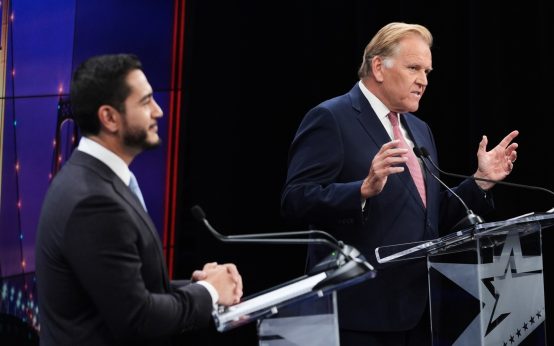 Contentious First Debate in Michigan Senate Race Highlights Divisions
  Senator Ossoff and Rep. Collins Clash Over White Nationalist Accusations