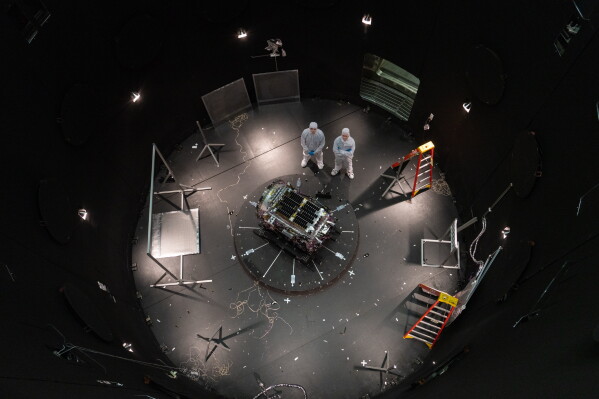
At Cape Canaveral, a spacecraft with three arms launched into orbit on a mission to rescue a NASA telescope. Northrop Grumman sent Katalyst Space Technologies’ Link spacecraft from the Marshall Islands. The Pegasus rocket, launching from a plane, is on a path to reach NASA’s Swift Observatory in about a month.
Swift, launched in 2004, is descending rapidly due to recent solar storms. NASA allocated $30 million to Katalyst to capture the telescope and elevate its orbit. This will allow it to continue observing large cosmic explosions like gamma-ray bursts.
If the mission succeeds, Swift might resume cosmic scans by September. Currently, all observations are paused to maintain the telescope’s orbit for as long as possible. A similar operation might occur for NASA’s Hubble Space Telescope in the near future, as it also faces altitude challenges due to solar activity.
Swift, weighing 1.6 tons, is orbiting 224 miles above Earth. Katalyst plans to increase its altitude by 150 miles, bringing it back to its original orbit. The ascent will be gradual to prevent abrupt movements.
The mission came together in nine months under NASA’s urgency, with Swift projected to fall by October without intervention. Weather and technical issues caused launch delays.
“This is a high-risk, high-reward mission,” said Katalyst Space CEO Ghonhee Lee, emphasizing the need to prevent Swift’s destruction in the atmosphere.
The Associated Press Health and Science Department benefits from the Howard Hughes Medical Institute’s Department of Science Education and the Robert Wood Johnson Foundation. The AP is fully responsible for its content.
 The Unique Challenges of the Pumpkin Toadlet
  Animal Self-Medication Insights
  Carlo Rovelli’s Perspective on Physics and Ultimate Reality
  Department of Defense Legal Waiver Promotes UAP Disclosure
  NASA’s Challenges Amid Goddard Space Flight Center Relocations
  Ancient Ring Offers New Insight on Pontius Pilate’s Authority