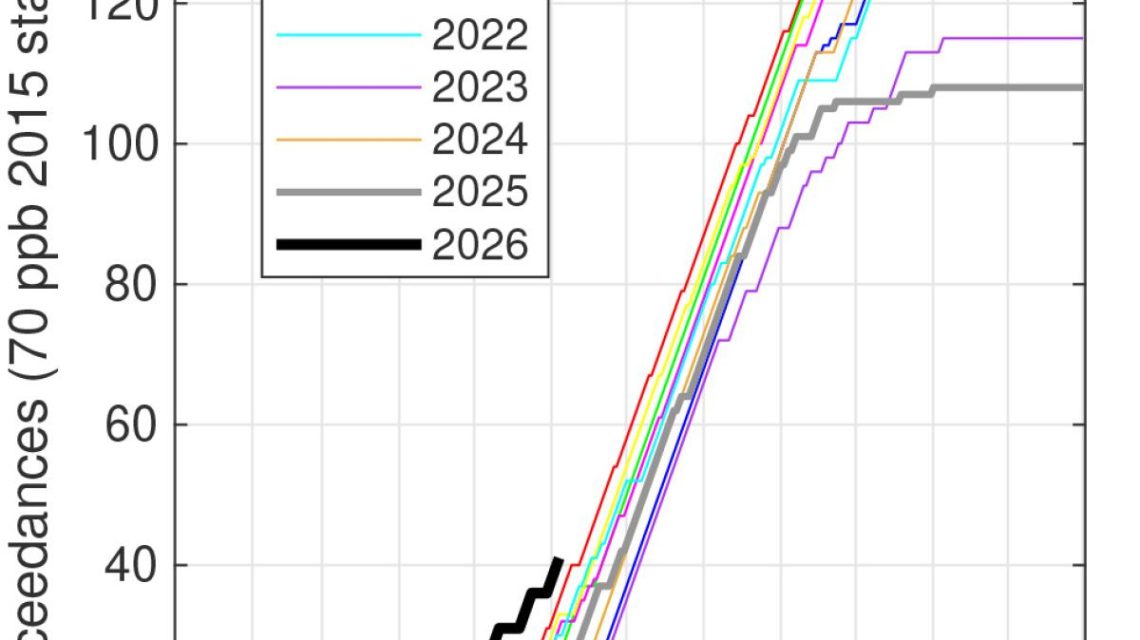
The first five months of 2026 have marked a significant rise in smog levels for Southern California, with the highest number of unhealthful air days seen in more than ten years, based on statewide air monitoring data.
The South Coast air basin, covering Los Angeles, Orange, Riverside, and San Bernardino counties, recorded 39 days of elevated lung-irritating ozone levels surpassing federal standards. This figure indicates a troubling trend, surpassing the well-known smog-filled year of 2017, which recorded 36 unhealthful days by early June and totaled 145 days by year’s end.
About 18 million inhabitants of the area have encountered unhealthy ozone levels. Ozone is a highly corrosive gas linked to asthma attacks and numerous respiratory issues. The current situation raises concern, as smog traditionally increases during summer months when heat and sunlight convert pollution into ozone. Adrian Martinez, director of Earthjustice’s Right to Zero campaign, stated, “If we have this many violations by this time, this could be a really awful year for air quality.” Southern California already grapples with the nation’s worst summertime smog pollution.
Notably, smog has intensified in valleys. On April 18, Reseda in the San Fernando Valley recorded the second-highest spike in hourly ozone levels in a decade. The South Coast Air Quality Management District attributes high ozone levels to early heat waves, as no increase in pollution types contributing to ozone formation has been identified. Local temperatures have exceeded norms, hitting mid-80s to high 90s from January to April, as per the National Weather Service. March was the warmest recorded, with Riverside experiencing 13 days of temperatures above 90 degrees.
Sarah Rees, deputy executive officer of the air district, highlighted the unusual early heat conditions typically seen in July or August occurring in March, which accelerated ozone levels. Officials urge residents to check pollution levels on the air district’s website and limit outdoor activities when smog is significant.
Southern California’s smog issue stems from millions of gas-powered vehicles releasing emissions where sunlight acts as a catalyst. Mountains trap this pollution over densely populated areas. Despite significant reductions in smog-forming pollution in the last two decades due to regulatory efforts, the region still falls short of federal ozone standards.
During an air district meeting in Diamond Bar, the governing board paused to honor William Burke, a former longtime chair, who led the agency to enact nearly 270 rules reducing smog-forming pollution significantly. Burke passed away in May at 87. Chair Michael Cacciotti noted that while emission reductions are evident, the health impact, like reduced hospital visits for asthma, isn’t as visible.
Residents from the heavily polluted Inland Empire acknowledged the district’s efforts but underlined the necessity for further improvements. “I know things have improved, but there’s a lot of invisible stuff that you don’t see, that’s still out there,” said Erik Morden, a meeting attendee.
Martinez, from Earthjustice, emphasized the smog’s early emergence as a call to action for regulators. He advocated for more incentives for zero-emission appliances, stating, “Our contention is, this agency can’t control the weather. But the one thing it can control is the pollution.”
 Potential Impact of Tropical Storm Polo on Southern California
  Communities Continuing Recovery from Hurricane Helene Explored through Graphic Novel
  Fat Bear Week 2026 Highlights: Meet the Competitors
  Annual Fat Bear Week Begins at Katmai National Park
  Understanding Hurricane Development
  California Prepares for El Niño-Fueled Storms with Emergency Declaration