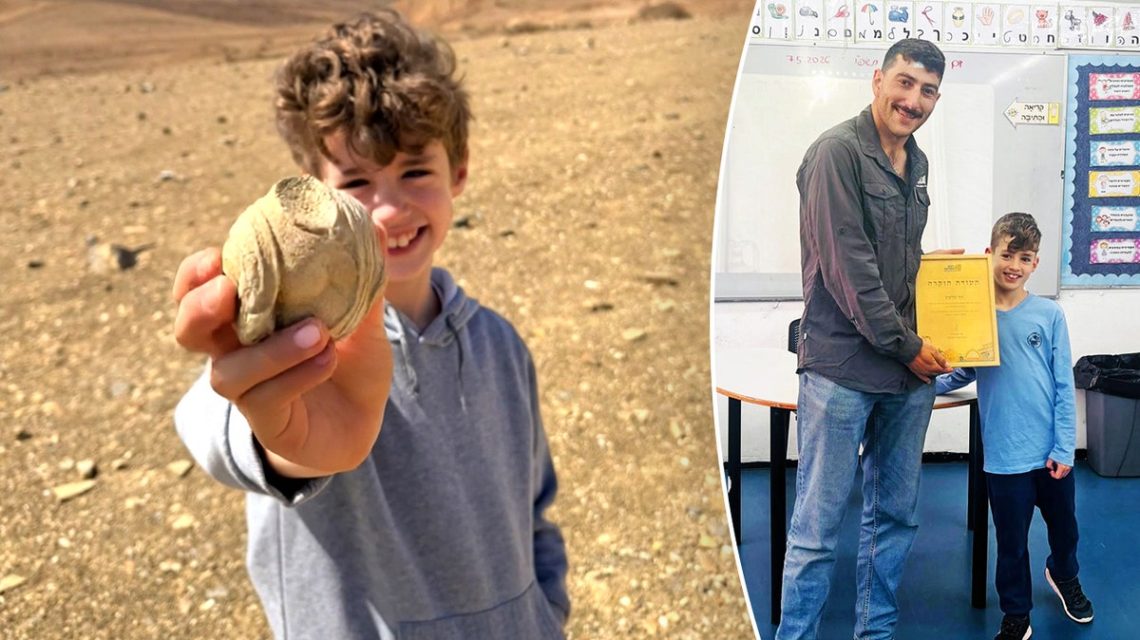
An 8-year-old child in Israel stumbled upon a remarkable find during a family trip: a fragment of a Roman statuette thought to be 1,700 years old. The discovery took place at the Ramon Crater in the Negev Desert of southern Israel, according to a release from the Israel Antiquities Authority (IAA) on May 11.
The child, Dor Wolynitz, was participating in a family weekend retreat organized by a paratrooper reserve unit when he found the fourth-century A.D. artifact.
The boy shared with the IAA his motivation. He said, “I was looking for special things on the ground that I could show in class.” He continued, saying, “Suddenly, I noticed an interesting stone with stripes lying on the ground and picked it up.”
The discovery caught the attention of Akiva Goldenhersh, an archaeologist and family friend who was on the trip. Goldenhersh noted the artifact’s features: “It seemed like an unusual object to me, so I showed it to Akiva.” The fragment measures six by six centimeters, depicting part of a human figure with carefully sculpted folds of fabric.
Initially, Goldenhersh mistook the object for a fossil. He said, “I thought it was a fossil. But then I noticed the sculpted folds of the garment — and I was very excited.” This artifact is believed to date back to the fourth century A.D.
Made from a mineral native to the Negev, the statuette’s material suggests local production rather than importation. Goldenhersh highlighted the attire depicted: “The figure is depicted wearing a type of heavy mantle called a himation, with no visible chiton, or undergarment.” The craftsmanship indicates a high skill level from the artist.
The statuette possibly represents the Roman god Jupiter or the Nabatean god Zeus-Dushara. The artifact’s surface discovery, instead of via controlled excavation, is particularly noteworthy.
The Ramon Crater region lies along the ancient spice route, a key artery during the Roman and Nabatean periods. It reflects a blend of local traditions with influences from the classical world, as cultures intersected there.
Goldenhersh told Fox News Digital that such Roman-era stone figurines in this style are “relatively rare.” A surface find makes this discovery even more unusual.
The small stone piece, only a fragment today, likely moved from its original position due to erosion or natural shifts. The Negev’s desert conditions can preserve artifacts, occasionally exposing them.
Wolynitz handed the find over to Israel’s National Treasures Department and earned a certificate for “good citizenship.” The family recognized the artifact’s significance and reported it to the relevant authority.
Goldenhersh commended the family’s actions. He said, “The responsible conduct of Dor and his family is an example of proper civic responsibility and the preservation of our country’s cultural assets.” He praised the child as a “role model for us all.”
 Colin Kaepernick’s Press Tour Raises Unasked Questions
  Controversial Claims in Charles Spencer’s Book about Princess Diana’s Divorce
  The Curious Case of Mark Jackson’s NBA Hoops Card
  Communities Continuing Recovery from Hurricane Helene Explored through Graphic Novel
  Art Institute of Chicago Returns Nazi-Looted Painting to Heirs
  Chicago History Museum Responds to Protest with Aquí en Chicago Exhibit