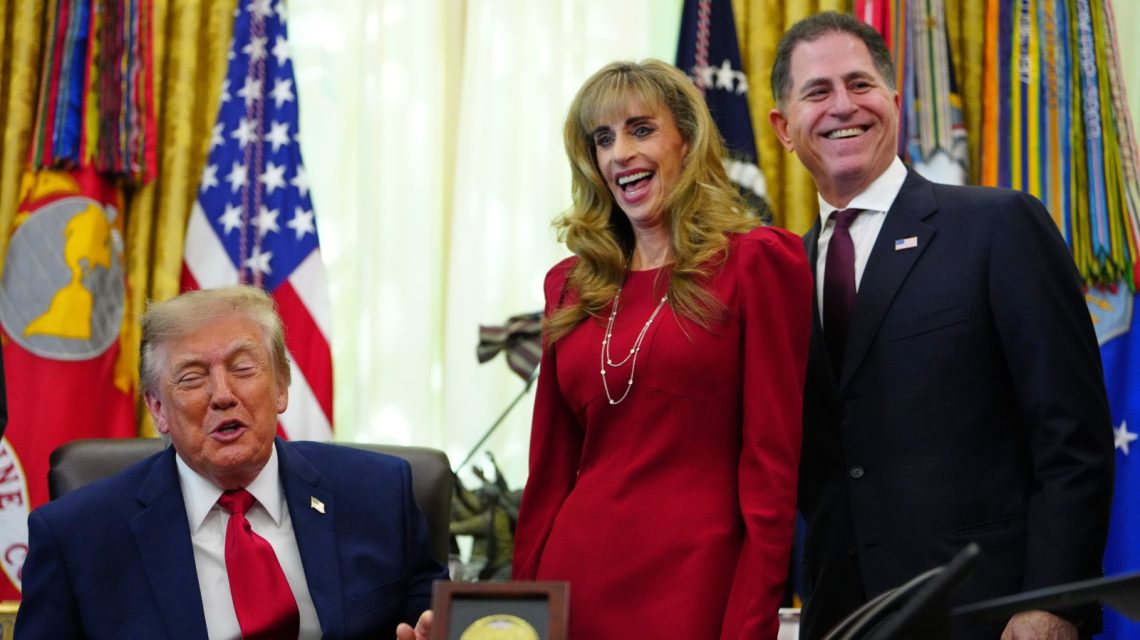
The administration announced modifications to Trump Accounts, permitting donations of individual company stocks. While officials argue this change will enhance wealth-building opportunities, it has generated concern among critics.
The White House reported that 70 million Trump Accounts are now established for American children, a significant increase from under 10 million, primarily due to automatic enrollment. This milestone was celebrated at a White House event, where it was stated these accounts are “already investing billions of dollars for American children.”
“Since their launch on July 4th, more than $4.5 billion has been deposited into Trump Accounts,” said the press release. “This includes $1.3 billion in $1,000 seed contributions, over $600 million from family and friends, and $2.6 billion in philanthropic gifts.”
Besides auto-enrollment, the government is expanding funding methods by allowing stock donations.
Billionaire Michael Dell, a strong supporter of the accounts, attended the event with his wife, Susan. In an interview with Yahoo Finance, Dell dismissed criticisms of the policy as “nonsense,” asserting it would attract more wealthy donors to contribute to children’s accounts. His net worth, according to Forbes, is approximately $280 billion.
Understanding Trump Accounts
Trump Accounts, created via the One Big Beautiful Bill Act, are a tax-advantaged savings platform for American children. They allow up to $5,000 in annual contributions, with tax-deferred growth until withdrawals are made after the account holder turns 18. Children born between January 2025 and December 2028 receive a $1,000 initial deposit from the Treasury Department, and many companies have promised to match this contribution or that of their employees.
In July, the administration sought methods to automatically enroll all children in these accounts. According to a government official, the ultimate aim is universal ownership of Trump Accounts by American children.
President Trump acknowledged the development, labeling it a “historic” achievement, and supported the auto-enrollment’s role in ensuring “every American child has a fair shot at the American Dream.”
Elaine Maag, co-director at the Urban-Brookings Tax Policy Center, noted that auto-enrollment would aid children from lower-income backgrounds in accessing the program, as many traditionally have lower sign-up rates.
Details of the New Rule
The Treasury proposed in July that philanthropic stock donations would be accepted into Trump Accounts. SpaceX President Gwynne Shotwell pledged to give company stock to over two million children from lower-income areas.
The recent Federal Register publication outlined that publicly traded companies can now donate stock directly to these accounts, deviating from past rules requiring investments in mutual or exchange-traded funds. Stocks must generally be held for five years, and donations cannot be declined, although feedback is being considered on this holding period.
Treasury officials suggest stock donations could foster a sense of corporate ownership among beneficiaries. Nonetheless, Adam Bergman of IRA Financial cautioned that a market downturn could negatively impact the account value over the holding period, as selling is not permitted.
The Role of Susan and Michael Dell
Michael Dell described Shotwell’s substantial stock donation as positive, potentially sparking interest in space and capitalist markets among young beneficiaries.
The Dells remain key advocates for Trump Accounts, pledging $6.25 billion to provide $250 to accounts of children under ten in qualifying zip codes, who are otherwise ineligible for the federal contribution.
During the White House event, Susan Dell emphasized the need for parents to claim their child’s account, highlighting the financial readiness and opportunity these accounts offer.
For further information, Newsweek reporters and editors can be contacted via John Fitzpatrick and Gray R. Thomas.