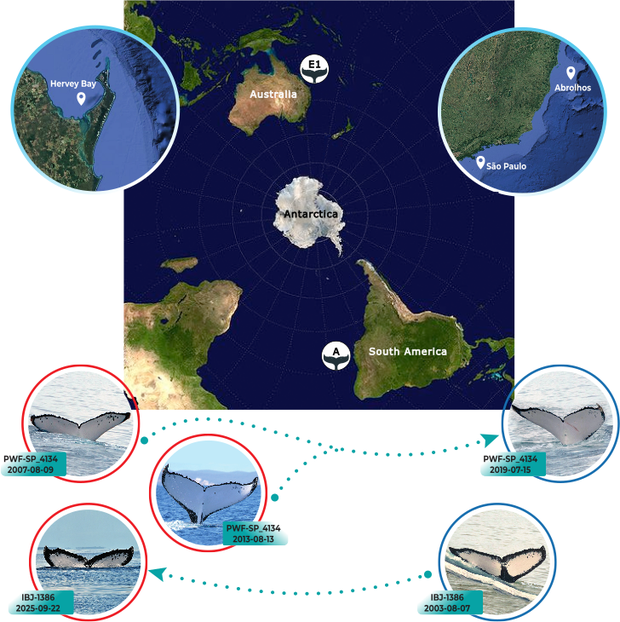
A pair of humpback whales have been discovered undertaking record journeys between the eastern shores of Australia and breeding grounds in Brazil. Research published on Wednesday showcases the longest distances ever recorded for these sea mammals.
Using tens of thousands of images of whale tails, international scientists identified the vast travels of these whales. One was first spotted in Queensland in 2007 and later appeared near Sao Paulo, Brazil, in 2019, covering a tremendous 8,823 miles. Another was seen off Bahia in Brazil before surfacing 22 years later in Hervey Bay, Australia, about 9,383 miles away. These pictures mark the longest distances documented between sightings of the same humpback whale.
The journeys are rare yet significant for maintaining genetic diversity in whale populations. Griffith University PhD researcher Stephanie Stack emphasizes that occasional movements between distant breeding grounds help preserve this diversity. The whales may even transfer new song styles across regions, akin to cultural music trends among humans.
The study analyzed nearly 20,000 photographs gathered between 1984 and 2025 from eastern Australia and Latin America by scientists and citizen scientists alike. An automated image-recognition algorithm facilitated the identification of two humpback whales photographed in both locations.
“This kind of research highlights the value of citizen science,” Dr. Cristina Castro of Pacific Whale Foundation stated. “Every photo deepens our understanding of whale biology.”
This discovery also supports the “Southern Ocean Exchange” theory, suggesting whales might travel to Antarctic feeding grounds and take alternative routes home, leading to entirely new breeding areas. Climate-driven changes, such as sea ice shifts and krill distribution, may encourage these crossings.
Due to commercial whaling, humpback whales were declared endangered in the U.S. in the 1970s, with a final whaling moratorium established in 1985. Currently, four of the 14 distinct population segments remain protected as endangered, while one is listed as threatened.
These findings underline the extraordinary movements of humpback whales and their possible implications for conservation strategies.
 Santa Ana Winds Threaten Southern California with High Fire Risk and Power Outages
  Hurricane Trudy Advances Toward Mexico
  Name the New Red Panda Cub at the National Zoo
  Toxic Metal Exposure in Maui Fire Survivors
  Big Bear’s Celebrity Eagle Jackie Dies from Bird Flu
  Search for Amelia Earhart’s Missing Plane Nears Possible Discovery