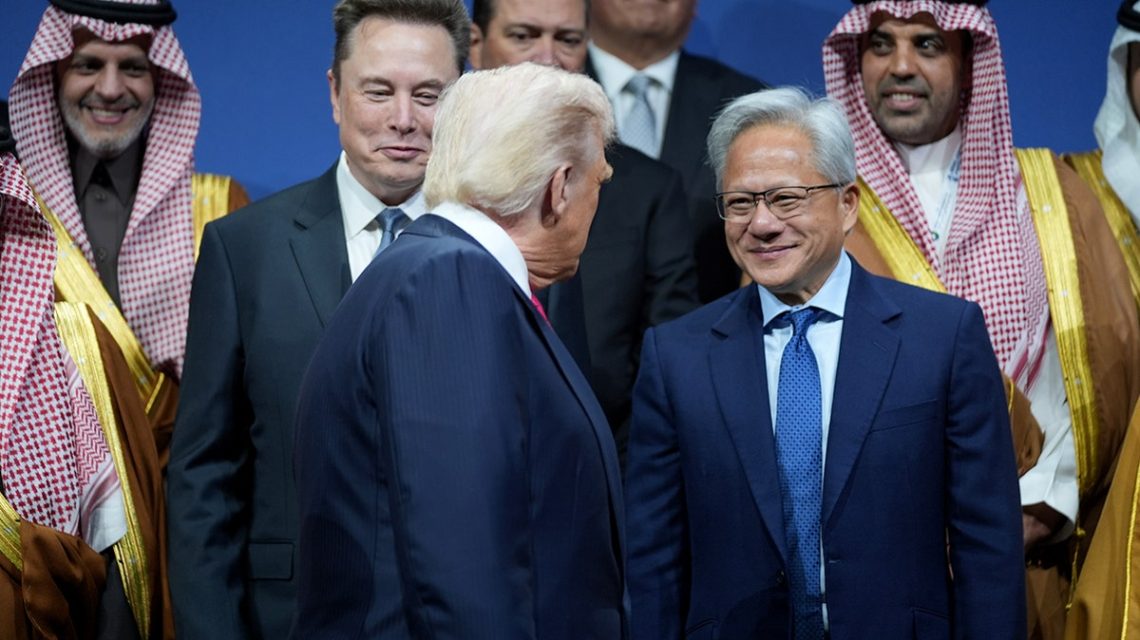
Nvidia CEO Jensen Huang discussed the transformative impact of artificial intelligence on the workforce during his appearance on The Will Cain Show. He likened AI’s effect to that of the Industrial Revolution, predicting it would generate new jobs and change how Americans work.
Huang encouraged young individuals to embrace AI. Rather than fearing it, he said it would enhance workers’ abilities in nearly all fields. The Nvidia co-founder highlighted the swift growth of AI infrastructure, which is already driving demand for skilled labor like electricians, welders, and construction workers as companies establish chip manufacturing facilities, computer plants, and data centers nationwide.
“We’ve created about half a million of them,” Huang stated. “We’re probably going to create a lot more.”
Earlier this week, Huang toured a manufacturing facility in Sherman, Texas, partnering with software firm Coherent, guided by Fox News host Will Cain. Nvidia recently invested $2 billion in Coherent, which specializes in producing lasers and optics crucial for advanced technologies. Coherent CEO Jim Anderson announced that production at the Sherman facility is expected to increase fourfold within the next 12 to 18 months.
Huang emphasized that productivity leads to more employment, urging people to reflect on historical trends.
“It is the case that productivity creates more jobs,” Huang expressed.
AI differs from previous technological strides because it allows interaction with complex systems using natural language, even by those with minimal technical expertise. Huang sees AI as a tool to improve skills rather than replace them, encouraging students and young workers to explore their interests while incorporating AI.
“If you’re into culinary arts, study it with AI. If you’re into philosophy, study it with AI,” he suggested.
He compared AI to the calculator, asserting that technological tools modify the nature of work rather than eliminate skilled workers.
“We don’t have to do algebra anymore, we don’t do surface integrals, we don’t do calculus,” he noted. “All of those things are now done by computers.”
Huang believes the purpose of work will remain unchanged as AI alters its performance. He argues that AI will enhance U.S. productivity, bolster the economy, and elevate energy demand as the AI infrastructure expands.
“It’s going to be largely optimistic, largely wonderful,” Huang predicted. “There are some use cases that we have to be extremely careful about.”
Despite AI-related job loss concerns, the federal government remains cautious regarding some advanced models’ national security threats. Recently, the Trump administration prohibited Anthropic’s Fable 5 and Mythos 5 models from foreign quốc gia usage, following Amazon AI experts’ discovery of their cyber capabilities.
Huang dismisses the notion of AI as a competitive race between the U.S. and China.
“AI is going to last a long time, and there’s no end,” he stated.
Nonetheless, he underlined the importance of the U.S. leading in technology.
“We should absolutely lead.”
 Challenges Revealed in Drone Deliveries: Conor McGregor’s Experience
  Efforts to Limit AI Content Gaining Momentum on Popular Platforms
  Challenges and Opportunities: The Illinois Quantum and Microelectronics Park Development
  Closed-door AI Framework Surprises Tech Policy Sector
  FAA Orders Inspections for Boeing 737 Max Planes Over Structural Concerns
  AI Stethoscope and Innovative Toilet Seat Transform Heart Condition Diagnostics