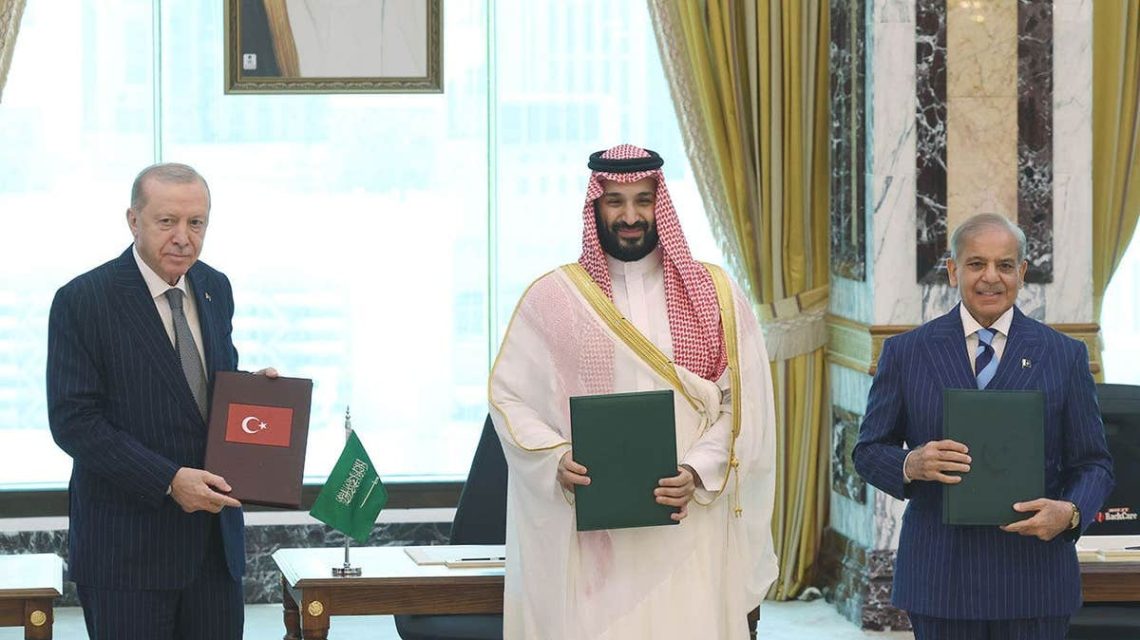
A new defense pact involving Saudi Arabia, Turkey, and Pakistan sparks debate on whether the trio aims to challenge the U.S.-backed regional structure centered around Israel and the Abraham Accords. Alternatively, it might represent a model of shared responsibilities among these nations.
Each country has distinct motivations for joining. Saudi Arabia, after signing a Strategic Defense Agreement with the U.S. in 2025, sought stronger U.S. security assurances. This pact potentially hedges against uncertainty about future U.S. commitments. Saudi Arabia enhances its security framework without fully relying on Washington.
Pakistan, a nuclear power, benefits through energy security, Saudi investment, and increased regional influence. However, it remains unclear if Pakistan’s nuclear deterrent will extend to its new allies.
Turkey, a NATO member, finds an expanded market for its defense products and strengthens its strategic position. This comes as tensions with Israel rise.
“The agreement could change the regional balance,” analysts say, noting it offers these nations more independence from U.S. security commitments.
On August 7, 2026, Saudi Crown Prince Mohammed bin Salman, Turkish President Recep Tayyip Erdoğan, and Pakistani Prime Minister Shehbaz Sharif signed the Mecca Joint Defence Agreement. It emphasizes collective deterrence against aggression. An attack on one country equates to an attack on all three.
Turkish Foreign Minister Hakan Fidan likened the agreement to NATO’s Article 5 provision. However, specifics of assistance following an attack remain under discussion by a new ministerial committee. The alliance will establish a secretariat based in Saudi Arabia.
Saudi Deputy Minister for Public Diplomacy Rayed Krimly and Turkish officials assert the agreement is defensive, not aimed at Iran or any nation. Iran downplays the threat, viewing it as a regional shift to self-reliance.
Experts like Sinan Ciddi express skepticism. The pact may not resemble a NATO-type alliance yet. Ciddi suggests it emphasizes economic ties over security commitments, serving as a hedge against doubts about U.S. assurances.
“While closer economic and commercial ties are evident, substantive NATO-like security links remain unrealized,” Ciddi explains.
Saudi Arabia denies the pact implies a pivot from the U.S., with a Saudi source affirming the U.S. as a primary strategic partner. The agreement is not targeting any specific country.
Analyst Aziz Alghashian supports this view, suggesting the pact complements U.S. relations. Greater regional cooperation may relieve some of Washington’s security burdens.
From Pakistan’s angle, Raza Rumi sees military and political benefits. Nevertheless, he advises caution in interpreting mutual-defense language literally without established joint planning and crisis response frameworks.
India watches the alignment closely, evaluating its implications for regional stability. New Delhi commits to protecting its interests in response to this evolving dynamic.
Despite the pact, foreign policy experts warn against assuming rigid regional divisions. The Middle East is seen as a region hedging its bets, not committing to permanent blocs.
Senior fellow Sinan Ciddi highlights the opportunity for opposing groups to harden. A militarily weak pact might still provoke reactions from nations like Israel, Greece, and potentially India.
Efrat Lachter, a Fox News Digital reporter, provides insightful coverage of regional developments with a seasoned perspective.
 Shifting Dynamics in U.S.-Iran Relations Amid Leadership Changes
  NATO Weapon Deployment in the Pacific Raises Concerns
  Russia Responds to Ukraine’s Attack on Black Sea Hub
  Hungary Takes Action to Preserve Paks Nuclear Power Plant
  Robert Gilman’s Release from Russia: A Successful Outcome Without a Prisoner Swap
  Secretary of State Rubio Discusses Unidentified Anomalous Phenomena