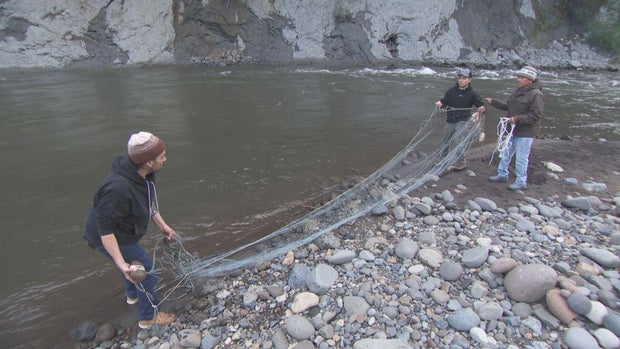
The Muckleshoot tribe considers salmon more than just food. For the tribe, safeguarding the fish is a way to keep alive a deep-rooted culture and tradition. Descendants of the Duwamish and Upper Puyallup peoples, the Muckleshoot have lived in the Seattle area for thousands of years and continue to be known as the Salmon People.
Generational Fishing Traditions
“We have a connection with the fish and the water, and you feel that in your body when you fish or swim,” stated Mike Jerry Jr., a 21-year-old tribe member. One morning, Michael Jerry Sr. and his brother Cory taught Jerry Jr. the custom of using a small net to catch spring salmon. This traditional method aims to catch a single salmon, reinforcing lessons in patience and skill.
“It’s all a process… preservation, drying, smoking,” Cory Jerry explained. “That’s how we grew up, and it’s crucial to pass it on.”
Michael Jerry Sr. emphasized that fishing this way since childhood embeds the next generation in their past. “Passing it to the next generation is vital for our people,” he noted.
Spiritual and Historical Significance
Traditional fishing holds spiritual value for the Muckleshoot. According to oral historian Warren King George, salmon are viewed as relatives, visiting yearly. The legend of Salmon Boy highlights the deep connection and promises maintained by ceremonies such as the First Salmon Ceremony, a tribute to the season’s first catch.
“We thank that relative for returning to feed us,” King George conveyed.
Challenges and Legal Battles
Obtaining fishing rights was a struggle for Native American tribes in the Pacific Northwest. In 1892, tribal member Big John received a citation, fined for fishing off-reservation, an event marking early tensions.
The 1960s Fish Wars saw large protests for rights extending beyond reservation limits, leading to the Boldt Decision of 1974. This landmark ruling allocated tribes half of the harvestable salmon, demonstrating their dedication to resource protection.
Facing New Environmental Challenges
Today, Muckleshoot fishers contribute 2% of the global wild salmon supply. Phil Hamilton from the Muckleshoot Fish Commission stresses the need for strong salmon populations for economic prospects.
“We must sustain salmon life,” Hamilton emphasized.
Environmental degradation threatens salmon habitats. The tribe invests in habitat restoration, necessary to hinder declines noted in the 1990s. Despite these efforts, 5% of habitats are lost annually.
“It’s about water,” Hamilton pointed out. “Without it, fish can’t survive.” Through significant settlements, the tribe ensured water availability for salmon.
Efforts have restored salmon populations sufficiently to support 500 fishers and over 200 boats today. Hamilton reflects, “Seeing our fishers succeed brings me the most joy,” articulating the tribe’s pride in their cultural and environmental endeavors.
 Communities Continuing Recovery from Hurricane Helene Explored through Graphic Novel
  Art Institute of Chicago Returns Nazi-Looted Painting to Heirs
  Chicago History Museum Responds to Protest with Aquí en Chicago Exhibit
  Ari Emanuel’s Memoir Explored
  Benito Juarez Community Academy Students Celebrate Día de los Muertos Through Art
  Celebrating Diversity at Valparaiso’s World Cultural Festival