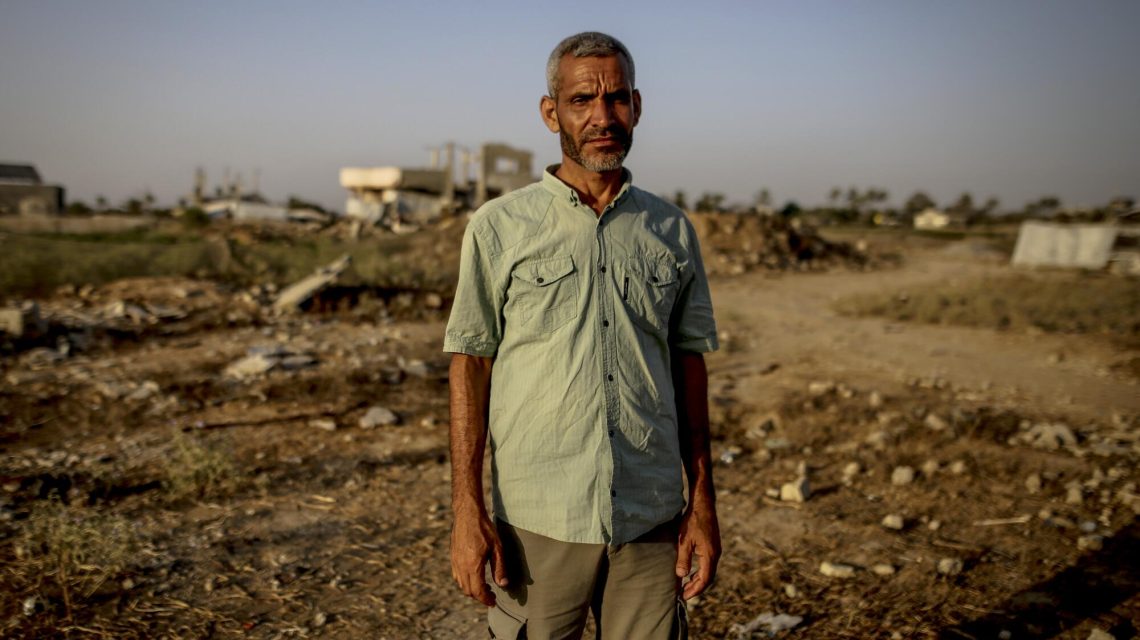
In the city of Deir al Balah in the Gaza Strip, the Yellow Line, marking the boundary of Israel’s military zone, looms large. Ashraf Al-Louh, living just 100 yards from this line, understands this presence well. For three months, he ignored it. Now, the advancing line forces him to consider leaving.
Every day, more residents join the growing exodus from war-torn neighborhoods. These areas are marked by large yellow-painted cement blocks, signifying the Yellow Line as it moves westward. A donkey cart carrying elderly individuals and their scant belongings, wrapped in mattress covers, passes by, leaving behind countless memories as people flee the approaching boundary.
“We’re exhausted. We’ve already been displaced seven times,” says Al-Louh, 45, casting a glance at the yellow blocks. His farm faces a real threat from the line’s encroachment, pushing him to contemplate relocation.
Created in October 2025, the Yellow Line emerged following a U.S.-brokered truce between Israel and Hamas. Initially, it was meant to withdraw Israeli troops from some territories, though never recognized as a legal border by the U.N. or other organizations. The line effectively bisects Gaza, creating eastern zones under Israeli military control and western areas under Palestinian oversight.
Since the ceasefire began, the line has shifted westward, intensifying displacement among Gazans. The confined space has forced many into dire conditions.
The Yellow Line is a quiet thief. It stole my land, my work and everything I spent my life building. — Abu Miri, Gaza resident
Initially, Israel controlled 53% of Gaza. That percentage has now expanded to about 64%, excluding a newly designated Orange Zone where aid deliveries require coordination through Israeli military restrictions.
For Al-Louh and his family of eight, life beneath a partially destroyed building feels precarious. “About a month ago, the line was a kilometer away. We felt some safety then,” he recounts, gesturing towards his makeshift shelter, a fragile amalgamation of tarpaulin and debris. With every passing week, the line advanced, ignoring hopes held by locals that it might stop.
Proximity to the Yellow Line remains dangerous. Since the ceasefire, 196 Palestinians, including women and children, have perished in the region due to Israeli military actions. The Israeli Defense Ministry maintains that such responses were defensive measures against perceived threats.
A short distance from Al-Louh, farmers harvest eggplants before it becomes impossible to access their fields. “I’m working all day to get it all out of the ground,” says Ahmed Al-Louh, a relative, working tirelessly to secure his crops.
With belongings moved, the family waits for the inevitable. “I’m just waiting for the moment we have to run,” Ahmed admits as gunfire echoes in the background. A military drone monitors their actions before retreating.
Recent attempts for a compromise introduced by Hamas and the Board of Peace proposed conditional disarmament contingent on Israeli withdrawal. However, Israeli Prime Minister Benjamin Netanyahu rebuffed these conditions, demanding complete disarmament from Hamas first.
The Palestinian death toll continues to climb, with over 1,230 killed since the ceasefire began. Israel, escalating its actions, aims to prevent Hamas’s resurgence. Evidence suggests that the Yellow Line might evolve into a permanent barrier as Israel expands its control.
Netanyahu’s statements about expanding territory emphasize continued pressure on Hamas. His aspirations are clear, with local reports quoting him on incremental territorial gains soon aspiring to control 70% of Gaza.
Displaced residents like Jamal Abu Miri painfully witness their hard-earned life’s work dissolve as the line advances. After decades of investment, his land has been overtaken.
Abu Miri, once a successful land surveyor in Saudi Arabia, battles the sense of loss and helplessness. “Everything I owned was supposed to support my sons and grandchildren. Now it’s beyond the line; it’s gone forever,” he laments.
The advance of the Yellow Line signals uncertainty and peril for many, including Al-Louh. With prepared belongings and a makeshift shelter vulnerable to the next move, the prospect of displacement remains an ever-present reality.
“It could happen tonight. It could happen in a few days,” Al-Louh says, eyes fixated on the yellow blocks now defining his world. The wait continues.
 Trump’s Remarks on Ukraine-Russia War Casualties and Peace Efforts
  Tony Blair Warns Europe to Maintain U.S. Alliance
  Trump Rejects Iranian Proposal on Strait of Hormuz
  Tensions Rise as Russia Accuses Europe of Blocking Ukraine Peace Efforts
  Erdogan Challenges Israel’s Rhetoric and Strengthens Alliances
  Court Rules Against Third-Country Deportation Policy