Lex Marie, a multidisciplinary artist, has become a viral sensation on TikTok and Instagram, drawing attention to her artwork that challenges traditional discipline within Black households.
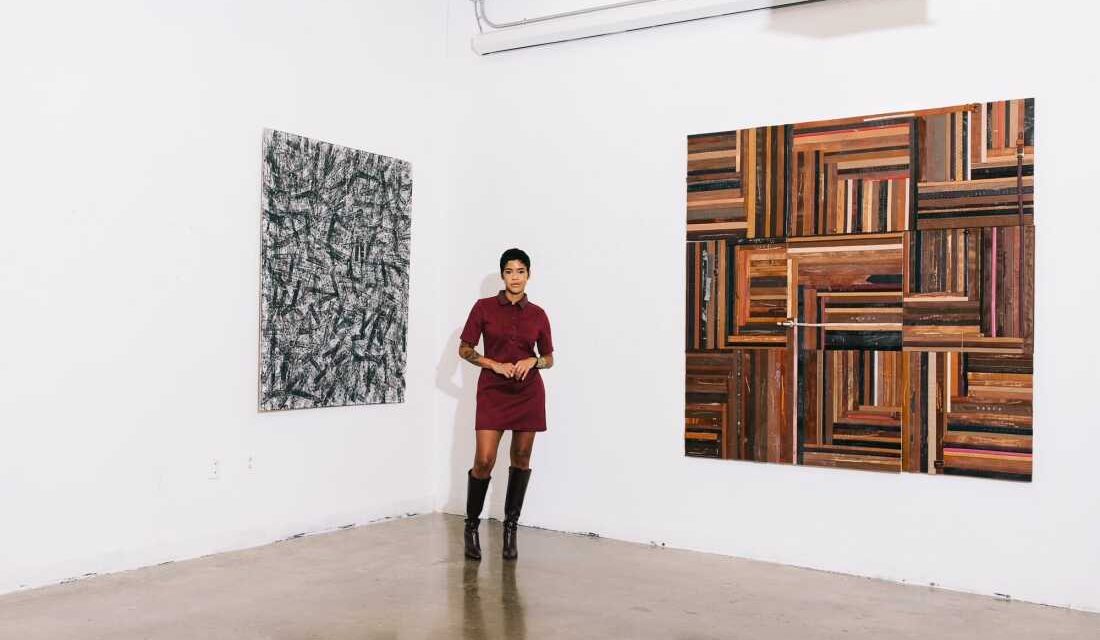
In Marie’s studio at the Katzen Arts Center of American University in Washington, D.C., belts take on new meanings. Some are stretched carefully across a canvas, forming organized patterns, while others serve as creative tools. Dipped in paint, these belts become brushes, creating expressive marks on the canvas. Every piece tells a tale, exploring themes of childhood, discipline, survival, and the complex nature of love.
I’m critiquing discipline in Black households, specifically,
says Marie. Her work digs into the history of corporal punishment in Black families and examines how millennials are parenting differently. Being a mother to an eight-year-old boy, Marie’s artistic questions often arise from her experiences in parenting.
One of Marie’s larger artworks is titled Watch Your Tone. Measuring six-by-six feet, this piece is entirely composed of belts arranged in shades representing flesh tones. The title echoes phrases commonly heard in youth, such as Watch your tone when talking to me
. Marie explains that the belts symbolize the ties between punishment practices and American history.
Historians argue that the discussion of corporal punishment in Black American families is inextricably linked to the legacy of slavery. Enslavement involved physical violence, such as whipping, to control Black bodies, influencing modern parenting practices. Yohuru Williams, director of the Racial Justice Initiative at the University of St. Thomas, emphasizes this historical connection.
This idea that Black bodies require extreme punishment extends beyond slavery but was reinforced by enslavement, continuing into post-slavery parenting practices.
Another striking piece, Because I Love You, highlights the physical enforcement of punishment. Marie’s process involved repeatedly striking a white wooden panel with a paint-dipped belt, leaving marks akin to scars. The title refers to phrases like This hurts me more than it hurts you
or I’m doing this because I love you
, reflecting common justifications for punitive actions.
Marie found creating this piece both cathartic and physically taxing. Her art has sparked conversations online, with reactions ranging from painful to grateful, revealing shared childhood experiences.
The goal isn’t to shame but to create space for dialogue, she notes. Williams calls for reimagining how Black families perceive discipline, seeking honest conversations about its historical implications. He stresses the importance of affirming human dignity and the dignity of Black life.
Marie views her art as a means to address difficult discussions about childhood trauma, especially for those struggling to articulate similar experiences. Her series, planned for exhibition in the fall, will feature nearly 20 pieces. Two have already been acquired by filmmaker Spike Lee.
Lex Marie’s upcoming solo show at The Bishop gallery in Brooklyn, New York will feature this compelling series. The art is about recognition, not necessarily agreement, she concludes.
 Colin Kaepernick’s Press Tour Raises Unasked Questions
  Controversial Claims in Charles Spencer’s Book about Princess Diana’s Divorce
  The Curious Case of Mark Jackson’s NBA Hoops Card
  Communities Continuing Recovery from Hurricane Helene Explored through Graphic Novel
  Art Institute of Chicago Returns Nazi-Looted Painting to Heirs
  Chicago History Museum Responds to Protest with Aquí en Chicago Exhibit