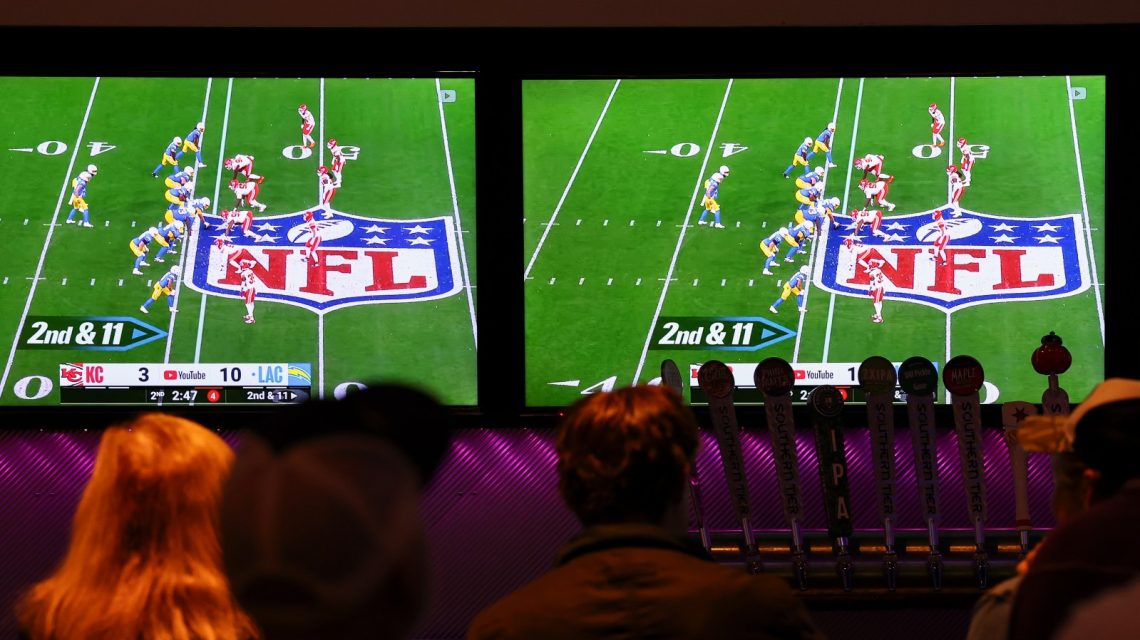
Bipartisan support for Israel once united lawmakers on Capitol Hill, but now a different issue has caught their attention: the cost of watching NFL games due to streaming services. House Judiciary Committee Chairman Jim Jordan (R-Ohio) and Congressman Jamie Raskin (D-Md) are focused on this, although they usually disagree on most matters.
Both accuse the NFL of increasing costs for viewers, claiming that streaming services have made watching football more expensive. Their concerns center around whether the NFL’s marketing practices violate antitrust laws, as the Judiciary Committee’s report, “The Sports Broadcasting Act: A Special-Interest Antitrust Exemption Gone Awry,” suggests.
The Federal Communications Commission (FCC) and the Justice Department are also involved. Yet, professional football remains more accessible and affordable compared to other sports leagues. Streaming services have indeed lowered access costs for fans.
“Every NFL team’s games are available on free broadcast TV in their home market.”
NFL’s current agreements with ABC, CBS, FOX, and NBC remain effective until 2033, maintaining game availability on broadcast TV. Though games are also on streaming platforms like ESPN Unlimited, Paramount+, Fox One, and Peacock, offering viewers cheaper alternatives to traditional cable.
Streaming has made it easier for cord cutters to watch games affordably. Most games are still broadcast and simulcast on streaming services. For example, Christmas Day doubleheaders on Netflix will still be accessible locally via broadcast TV.
Rich Greenfield of Lightshed Partners emphasizes that streaming has reduced football access costs, contrary to congressional critics who argue differently. For instance, accessing all games previously available via broadcast and cable now costs an estimated $218 for a six-month season if subscribing selectively to Amazon Prime Video, Netflix, Peacock, and ESPN Unlimited.
Subscribers benefiting from Amazon Prime’s free shipping or Twitch Prime Video channel can access Prime Video services without additional costs. Adding services such as Fox One raises the total to $387.
Alternatively, a mix of sports streaming services, including YouTube TV and DirecTV Stream, costs around $428, compared to over $600 for a traditional cable package.
Congressional concerns extend to the NFL’s Sunday Ticket, previously exclusive to DirecTV and requiring a satellite dish, now available through YouTube without a dish. Its annual cost of $378 has not had widespread adoption, indicating sufficient televised coverage elsewhere.
NFL games offer more cost-effective access compared to basketball, baseball, and hockey, which typically demand both cable subscriptions and regional sports network payments.
While the process of finding games has become more complicated due to multiple streaming options, modern TV interfaces are improving game scheduling processes, enhancing user access.
The Judiciary Committee’s report aims to support upcoming legislation addressing the NFL’s transition to streaming. A potential outcome might be flexible subscription options for Sunday Ticket games, similar to YouTubeTV’s approach.
Ultimately, streaming has rendered watching NFL games cheaper than during the cable era. A focus on genuinely impactful bipartisan issues could be beneficial.
Tom Rogers, executive chairman of AI companies DO0 and Claigrid Inc., founder of CNBC, and a CNBC contributor, expresses his views. Rogers also founded MSNBC and serves as an adviser to Versant, CNBC’s parent.
 Adam Brody’s Discussion on Political Activism and Israel-Palestine Conflict
  Senator Collins Unfazed by Vandalism Incident Amidst Senate Race
  Controversy Surrounds Huckabee Sanders’ Welfare Ad
  Mamdani’s Child Care Plans: A Model for Policymakers
  U.S. Senate Advances Protect College Sports Act Amidst Debate
  A Test of Leadership in Global Crises