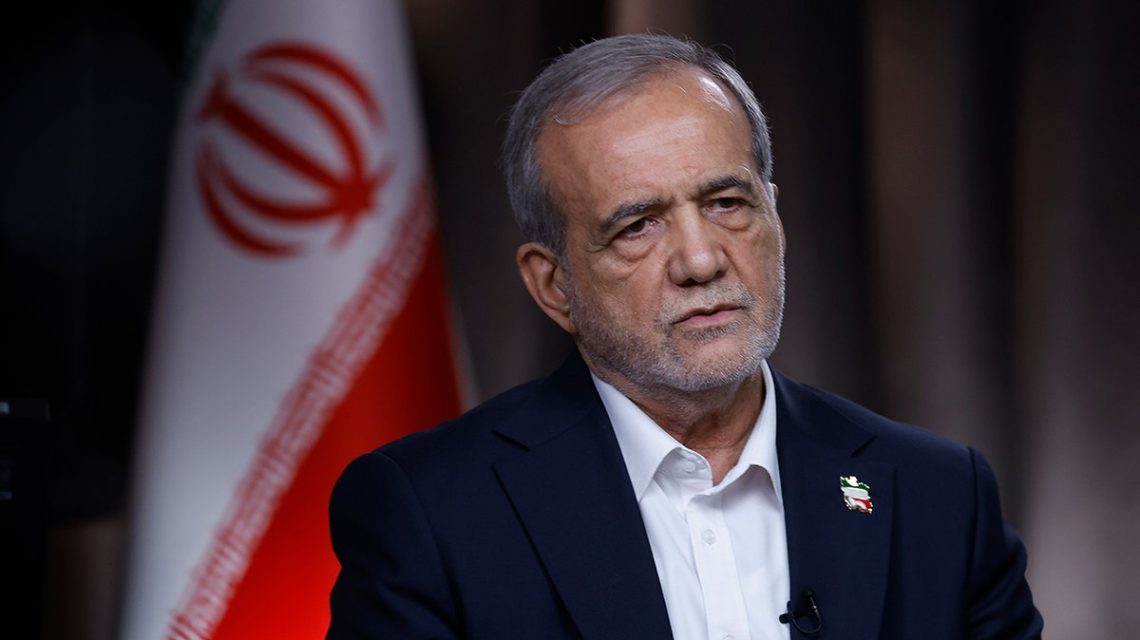
Iran’s political factions are using the authority of Supreme Leader Mojtaba Khamenei to bolster their positions and undermine rivals. Questions linger about whether Khamenei is actively governing, according to experts on Iran.
Recent reports from Iran International shed light on the tensions. They focus on President Masoud Pezeshkian’s ties with the supreme leader. In one report, senior cleric Mohammad-Bagher Kharrazi claimed Pezeshkian threatened to resign multiple times. Kharrazi warned that another resignation would be accepted.
Kharrazi quoted Khamenei as saying, “If he resigns one more time, I will approve it.”
Pezeshkian’s office rejected the claim. Mehdi Tabatabaei, the president’s deputy for communications, labeled it a “baseless and an outright lie.” A presidential advisor added that Kharrazi had no direct contact with Khamenei.
A second report alleged Pezeshkian had a brief encounter with Mojtaba Khamenei in a car in Tehran. Sources claimed the meeting lasted a few minutes and Pezeshkian could not see or shake hands with Khamenei. Pezeshkian reportedly questioned afterward if he had heard the supreme leader’s voice.
Kasra Aarabi, director of IRGC research at United Against Nuclear Iran, described these events as a reflection of a “mafia system.” Under Ali Khamenei, the supreme leader acted as a mediator among factions. His absence left a vacuum, which Mojtaba’s role needs to fill, but his lack of public presence causes uncertainty.
Aarabi noted, “The very essence of this mafia system is built on a godfather. If the godfather is absent, a vacuum re-emerges between the oligarchic clans.”
The factions vie for power and economic resources, using Mojtaba Khamenei’s name for political leverage. Each faction invokes his authority to legitimize themselves and weaken opponents.
Exiled journalist Mehdi Ghadimi described resignation rumors as a strategy by reformists. Previously, such rumors surrounded former Presidents Mohammad Khatami and Hassan Rouhani, helping build public sympathy before potential ousting.
Ghadimi expressed skepticism about Mojtaba Khamenei’s status, claiming he might be incapacitated or deceased. Aarabi noted that using Khamenei’s name as an authority source will become tougher without proof of life.
Ghadimi said, “Either he is dead, or he is being kept alive in an extremely unstable condition.”
Overall, the political struggle in Iran highlights a system built on personal power, with factions using Supreme Leader Mojtaba Khamenei’s name amid an undefined leadership presence.
 The Cost of Challenging Beijing
  Analyzing Midterm Elections and Party Dynamics
  Allan Lichtman’s Framework for Assessing Presidential Greatness
  Florida Senate Race Tightens as Recent Polls Show Dead Heat
  Ethics Complaint Targets Colorado Representative Lauren Boebert
  Ken Paxton’s Campaign Funding and Polls