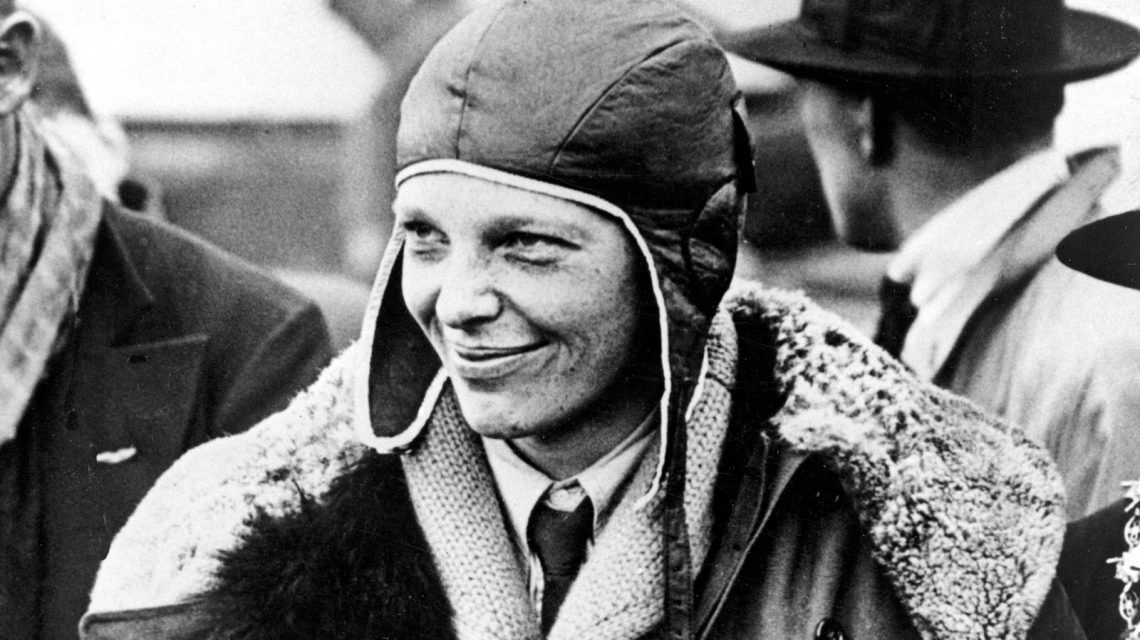
A map has highlighted the remote Pacific island where Amelia Earhart is believed to have terminated her ill-fated attempt to fly around the world almost 90 years ago. Researchers have arrived on the island to investigate a suspected wreck that could provide new insights into the fate of the pioneering aviator and her missing plane.
Expedition on Nikumaroro
A team of 17 researchers backed by Purdue University is currently at Nikumaroro, an uninhabited coral atoll in the Republic of Kiribati. They are focusing on a submerged object believed to be part of Earhart’s Lockheed Electra 10E aircraft. The object, known as the ‘Taraia Object,’ has been identified through satellite imagery within the island’s lagoon. The elongated shape of the object has led researchers to suspect it might be the fuselage and tail of Earhart’s missing plane.
The expedition team from Purdue University and the Archaeological Legacy Institute reached their destination after a five-day, 830-nautical-mile journey across the South Pacific. Researchers are employing sonar, magnetometers, and various archaeological techniques to thoroughly examine the object beneath the sediment. If confirmed as part of Earhart’s aircraft, it could offer crucial evidence of what transpired during her final flight in July 1937.
On Tuesday, the team cleared an overgrown path to the lagoon using chainsaws and machetes, established staging areas, and began evaluating the research site. They encountered at least four of the island’s giant, meat-eating coconut crabs but reported these posed no threat to their operation. Additionally, team members explored the sandspit on the Taraia Peninsula in search of artifacts, while the maritime archaeology team assessed conditions on the lagoon floor before commencing fieldwork on Wednesday.
‘This case has taken a long time,’ remarked Dr. Richard Pettigrew, Executive Director of ALI, in an exclusive interview. ‘However, we have some new evidence. There’s an object visible in the Nikumaroro lagoon. Everything we see suggests that it could possibly be what remains of Amelia Earhart’s aircraft.’
Amelia Earhart’s Final Flight Route
Earhart vanished on July 2, 1937, during her attempt to become the first woman to fly around the world along the equator. Her journey commenced in Oakland, California, in May 1937 with navigator Fred Noonan. The pair traveled eastward across the United States before proceeding through the Caribbean, South America, Africa, the Middle East, South Asia, Southeast Asia, and Australia.
By late June, Earhart and Noonan had arrived at Lae, New Guinea, now Papua New Guinea. Their intended destination was Howland Island, a small remote Pacific island for refueling before continuing their journey. The flight from Lae to Howland was one of the most challenging segments, spanning roughly 2,550 miles over open ocean.
Departing from Lae on July 2, they received support from the U.S. Coast Guard cutter Itasca stationed near Howland Island to assist with radio communications and navigation. Nevertheless, the plane never arrived. Earhart had reported communication difficulties and low fuel levels. Her final known transmission to the Itasca described a navigational line but failed to pinpoint her exact location. Earhart, Noonan, and the aircraft were never found.
The prevailing official theory suggests the plane ran out of fuel and crashed near Howland Island. The Nikumaroro theory proposes a different scenario, where the pair missed their destination, continued searching for land, and eventually made an emergency landing on the atoll. Located about 400 miles southeast of Howland Island, the investigation of the Taraia Object could help ascertain whether Earhart and Noonan reached Nikumaroro.
Details About Nikumaroro Island
Nikumaroro, formerly known as Gardner Island, is a secluded coral atoll within Kiribati’s Phoenix Islands group in the central Pacific Ocean. Encircled by a coral reef, the island contains a lagoon at its core. Today, Nikumaroro remains uninhabited and distant from major population centers, posing logistical challenges for archaeological investigations.
Earhart researchers have long been interested in Nikumaroro because of the possibility that she and Noonan survived after an emergency landing. Historical reports imply human remains and artifacts potentially linked to a castaway were discovered on the island in 1940. However, this evidence has not conclusively proven the remains belonged to Earhart or Noonan.
The current expedition concentrates primarily on a specific underwater target rather than exploring the entire island or surrounding ocean. The Taraia Object was first noted by researcher Michael Ashmore based on satellite imagery in 2020. Potential changes in lagoon sediment are believed to have exposed parts of the object, simplifying its identification.
Researchers plan a systematic survey using magnetometers to detect metal components and sonar to analyze objects beneath the lagoon floor. A hydroprobe offers insights into the object’s depth, orientation, and surface characteristics, while a water-induction dredge could help with sediment removal for visual inspection.
Purdue University supports the expedition, having funded the aircraft Earhart used for her final flight. Earhart’s role as a career counselor and aviation adviser at Purdue from 1935 to 1937 connects the university with the ongoing search.
‘Our intent is to explore bringing it back to Purdue,’ notes Kelly Hiller, Purdue’s chief marketing officer, emphasizing plans for further research and teaching. Both Amelia and her husband had always intended for the plane’s return.’
Presently, the operation is investigatory rather than focused on recovery. Even if aircraft wreckage is identified, further permissions and efforts would be necessary before bringing remains to the surface.
Nikumaroro’s Giant Meat-Eating Coconut Crabs
Nikumaroro hosts large coconut crabs, also known as robber crabs, which rank among the largest land-dwelling arthropods globally. These omnivorous scavengers are capable of consuming a range of plant and animal materials. Coconut crabs are known for scavenging carcasses, using their powerful claws to access food sources typically unavailable to other animals.
The expedition team has mentioned their preference for sleeping aboard their support vessel due to the size and nocturnal habits of the crabs. Questions have arisen regarding whether the crabs could have consumed the remains of Earhart or Noonan. No conclusive evidence supports this theory.
Reported human bones discovered on Nikumaroro in 1940 were examined, but later lost. While their identity remains debated, some researchers argue the skeletal measurements might align with Earhart, whereas others underscore the limitations of the existing evidence. No definitive identification has been confirmed.
Amelia Earhart’s Distress Calls
The final radio transmissions from Earhart are critical in the search for her missing aircraft. On July 2, 1937, Earhart confronted difficulties establishing radio contact with the Itasca while nearing Howland Island. Despite attempts to guide her, communication and navigation were problematic.
Historically, at approximately 7:42 a.m., Earhart stated her belief in proximity to the ship but was unable to see it, along with concerns of low fuel and a flying altitude around 1,000 feet. The Itasca’s response seemed not to be received.
Shortly before 8:00 a.m., Earhart circled and requested bearings. Attempts to establish their position continued. At roughly 8:43 a.m., Earhart’s last transmission to the Itasca was logged. The navigational line described as 157-337 ran north and south but lacked concrete location details, challenging rescue efforts.
The U.S. Navy and Coast Guard initiated a major search effort, but neither Earhart nor her aircraft was discovered. The radio transcript has since been integral to differing theories on their disappearance. Conventional views suggest a crash; however, Nikumaroro proponents contend the pair might have reached the atoll. Confirming the Taraia Object as aircraft wreckage could clarify the debate.
 Tropical Storm Rachel and Coastal Hazards for Southern California
  Exploring Spider Webs, TV Pixels, and Storytelling in Science
  Henri Kagan and Kenso Soai Win 2026 Nobel Prize in Chemistry
  How Little Brown Bat Genes Are Outsmarting a Fungal Killer
  The Impact of Generative AI on Critical Thinking Among Knowledge Workers
  New Insights from Research on Ancient Ethiopian Palace