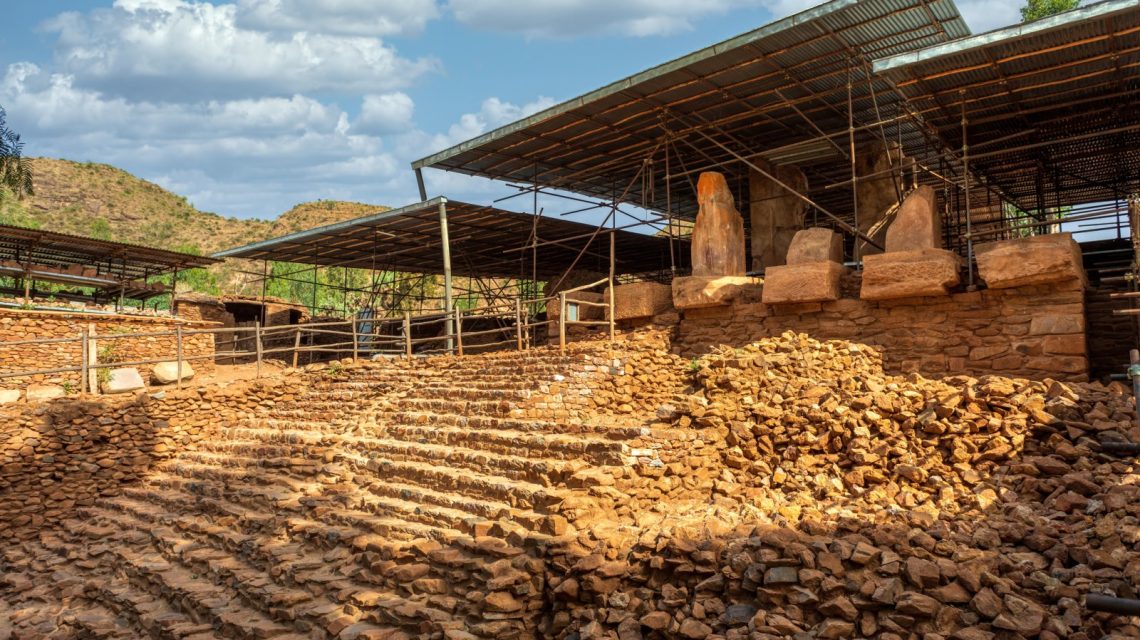
Recent research on an ancient Ethiopian palace, believed to be about 2,800 years old, suggests that the structure might have reached great heights, comparable to modern skyscrapers. This study, conducted collaboratively by the German Archaeological Institute (DAI) and Brandenburg University of Technology Cottbus-Senftenberg (BTU), focused on the Grat Be’al Gibri palace located in Yeha, within the Ethiopian-Eritrean highlands.
The Grat Be’al Gibri palace is significant for its time, representing the largest known palace complex in both South Arabia and East Africa. The palace had a floor area measuring approximately 60 meters by 60 meters, which translates to over 196 feet.
Dated back to around 800 B.C., the palace was reportedly destroyed by fire in antiquity, leaving only portions of the ground floor and the podium. The construction utilized rubble masonry with clay mortar, strengthened by horizontal timber beams, as described by Professor Davide Tanasi, a classical archaeologist from the University of South Florida.
In this study, scientists used a virtual 3D model to reconstruct sections of the palace walls, particularly a wall corner and a doorway, to evaluate their load-bearing capabilities using the finite element method (FEM).
The research demonstrated that clay walls, in conjunction with timber and stone supported by wooden beams in a horizontal grid, were a well-developed technique in Yeha and surrounding regions. Historian Kwasi Konadu explained that the findings reflect an architectural system more robust than suggested by the remaining ground floor.
Before this study, ancient records mentioned structures with up to 20 floors, supported by South Arabian rock carvings and wall paintings. However, no engineering proof existed until now. Tanasi emphasized the significance of these new findings, which offer quantitative evaluation of a recognized architectural system.
The research concluded that the wall system could have supported at least 19 floors, implying the palace could have grown to skyscraper-like proportions. However, Kwasi Konadu clarified that having a wall capable of bearing 19 floors isn’t the same as having an actual building of 19 floors, indicating it referred to the load capacity rather than physical height.
Tanasi and Konadu urged caution in labeling the Grat Be’al Gibri palace as a “skyscraper” in a contemporary context. Nonetheless, they acknowledged that the research challenges conventional assumptions about the sophistication of ancient large-scale construction techniques.
Konadu remarked that this study questions past narratives that positioned Arabia as the sole source of such architectural systems in the northern Horn of Africa. It highlights the presence of local traditions in monumental construction and engineering evident in multistory structures in the region.
The findings underscore the expertise of African builders in calculating height, material, and load capacities nearly three millennia ago.
Tanasi noted that discussions of advanced ancient engineering often centered on Egypt, Mesopotamia, Greece, and Rome. However, the study of Yeha reveals equally advanced traditions that evolved in the Ethio-Sabaean world, where African and South Arabian techniques merged.
Martin Drieschner, chair of structural analysis at BTU and lead researcher, highlighted the utility of modern engineering methods, like FEM and fuzzy material parameter modeling, in analyzing ancient structures. These tools prove powerful in understanding historical civil engineering practices beyond their usual applications.
 Moose Street Brawl in Colorado Captured on Video
  Abraham Lincoln’s Pocket Watch: A Piece of History
  Why Animal Scavengers Protect Your Health
  Gene Editing and Ethical Debates at Origin Genomics
  Possible Shipwreck Exposed After Nor’easter in Nantucket
  The Endangered American Red Wolf: A Conservation Story