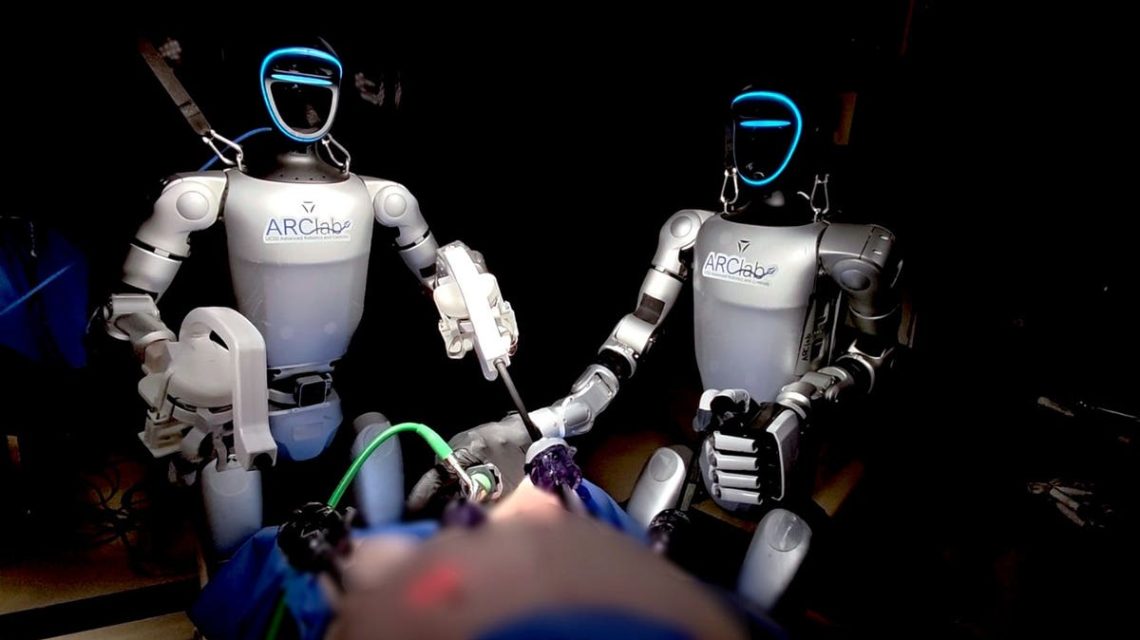
A groundbreaking success in the medical field occurred as doctors from UC San Diego used humanoid robots, priced at $20,000, for remote gallbladder surgeries on pigs. This advancement highlights artificial intelligence’s potential to mitigate surgeon shortages and enhance global healthcare access. However, it also raises privacy concerns about AI, including new household robots for chores.
Humanoid robots have begun performing surgical tasks, completing two remote surgeries for the first time. Surgeons guided these robots through gallbladder removal procedures during preclinical trials. The robots mimicked surgeons’ movements without making any medical decisions, and human patients were not involved. Unlike fixed robotic systems, these five-foot humanoid robots utilized standard surgical tools within an operating room designed for humans. This experiment serves as early evidence of how specialists might operate through mobile robots in places where surgical care is scarce.
Researchers from UC San Diego detailed their findings in Nature after two laparoscopic gallbladder surgeries on pigs. In one procedure, a humanoid robot handled tools with a human surgeon assisting, while two robots worked together in the other. Surgeons remotely controlled each robot, executing delicate tasks like tissue manipulation and clip placement to remove the gallbladder. The trial aimed to test whether a humanoid robot could sufficiently handle surgical tools, which it did, though researchers identified areas needing improvement before human testing.
This trial marked the first teleoperated humanoid robots to successfully complete live surgeries. Previously performed robotic gallbladder surgeries did not use general-purpose humanoid machines. UC San Diego’s earlier robot research laid the foundation for this achievement. These humanoids were part of modified models designed for medical use.
Researchers modified Unitree G1 humanoid robots to create Surgie, which stands around 5 feet tall and weighs 60 pounds. These features offer advantages over existing surgical systems that might weigh about 1,800 pounds, requiring extensive setup and space. Surgie’s human-like design is suitable for existing hospital operating rooms, enabling it to move between locations or smaller facilities.
Unitree lists the base G1 at $13,500, excluding surgical adapters, instruments, or remote-control equipment utilized in the study. A significant price difference arises compared to specialized surgical systems, such as the Da Vinci robots, which are priced between $700,000 and $3 million based on model and configuration.
Why employ humanoids instead of standard surgical robots? Current surgical robots assist in precise operations but often remain stationary, tied to specialized equipment. Humanoid robots offer greater flexibility and compatibility with standard medical tools. They may also assist in managing room resources during surgery. Crucially, they could bring expert skills to underserved areas.
Professor Michael Yip from UC San Diego envisions humanoid robots expanding access to crucial operations. Researchers aim to provide robotic solutions for communities with medical staffing shortages or field hospitals. Surgeons control robots from afar, carrying out techniques where patients might lack access to specialist care. The technology’s potential application includes future space missions where access to medical expertise is limited.
This technology’s development is gradual, with its present stage limited to preclinical trials on animals. Researchers have yet to prove humanoid robots’ ability to perform consistently in human trials. Hospitals will require strict safety protocols and skilled teams prepared to intervene if needed.
Challenges include latency, or the delay between remote command and robot response. Minimized latency is necessary for precision, particularly during surgery. Enhanced reliability and responsiveness are vital for future applications. Backup plans are critical for failure scenarios when connections are interrupted.
The next research phase would involve autonomous surgical assistance capabilities. Such robots could eventually determine tool necessities or complete tasks under supervision. An autonomous approach requires innovation in managing surgical complications and ensuring medical staff can swiftly regain control.
Remote surgical operations pose cybersecurity threats requiring stringent measures to protect software and information. Hospitals must ensure safe operation despite connection issues.
This robot-assisted medicine experiment reflects possible future benefits but also raises security and ethical concerns. As technological research continues, public acceptance relies heavily on safety and accountability.
 Lymphatic Drainage and Ice Sculpting: Emerging Wellness Trends
  The Rising Trend of GLP-1 Medications Among College Students
  The Challenges and Opportunities of Testosterone Therapy for Menopausal Women
  Long-Term Health Impacts of 9/11 and the Continuing Response
  Mental Health Challenges for Women with Type 2 Diabetes
  Debate on Integrating Race into BMI Guidelines Among Doctors