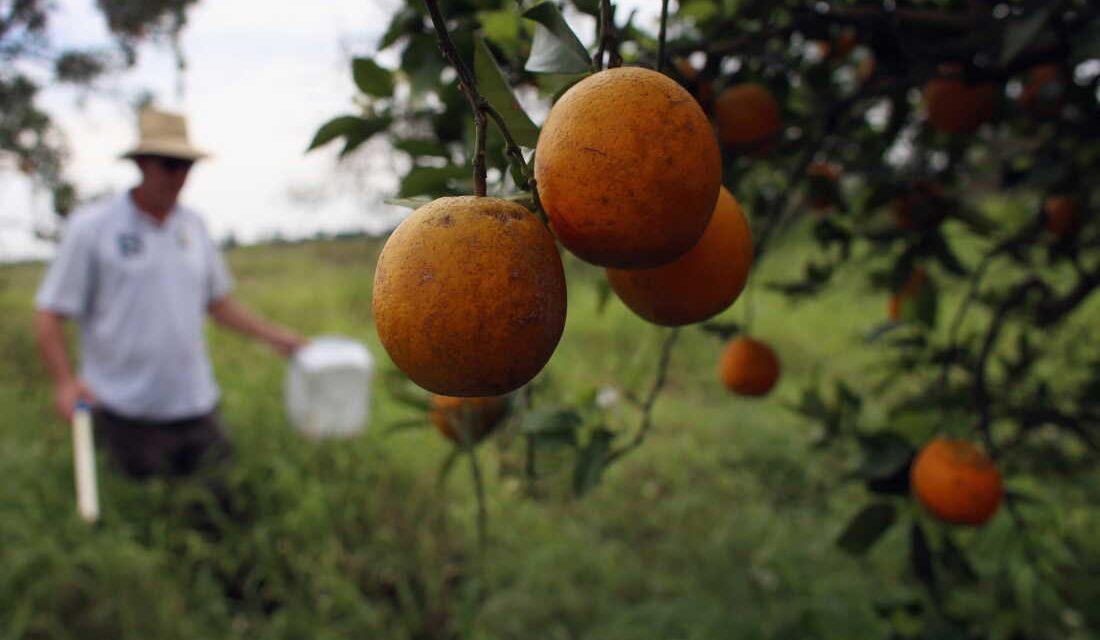
Guy Davies, an inspector for the Florida Division of Plant Industry, recently examined an orange tree in Fort Pierce, Florida, for the presence of the Asian citrus psyllid. This insect carries the bacterium responsible for the disease known as citrus greening, which spreads from tree to tree. The inspection took place on May 13, 2013, amid efforts to combat this significant threat to Florida’s citrus industry.
Citrus growers in Florida are adopting gene-editing technology to fight citrus greening, aiming to protect their crops from this lethal infection. In the past, they tried various methods such as tents and sprays without success. The disease has devastated many citrus trees and caused a substantial drop in citrus production in the state. Now, growers await the outcome of recent genetic modifications, approved by the Environmental Protection Agency earlier this year, hoping these will preserve their trees.
Citrus greening first appeared in Florida in 2005, spread by the tiny winged Asian citrus psyllid. The disease weakens the trees’ immune systems, preventing them from combating the infection. Infected trees produce bitter, discolored fruit and usually die within a few years. Unfortunately, there is no known cure.
Ron English, whose family operated a citrus business in Valrico, Florida, shared his experience. Their groves, once some of the finest, succumbed to greening, forcing them to close in 2015.
In the late 1990s, Florida citrus growers shipped around 300 million boxes of fruit each season. However, according to Matt Joyner, CEO of Florida Citrus Mutual, only slightly more than 15 million boxes were shipped during the current season ending in June.
Soilcea, a company based in Tampa, has utilized CRISPR gene-editing technology to develop a rootstock called CarriCea T1 that resists the greening disease. This innovation helps maintain the immune system of citrus trees, reducing the dependency on insecticides. Yianni Lagos, CEO of Soilcea, emphasized the importance of targeting the rootstock to fight the bacteria. He noted that symptoms like yellowing leaves appear when half of the root system is already compromised.
The grafting of the CarriCea T1 rootstock onto trees is underway. Results in a Soilcea test field are encouraging, showing trees with the modified rootstock growing taller and greener than those without it. Ron English supervises these test trees, planted alongside unmodified ones.
The true test will come when the fruit from these newly grafted trees appears, a process taking years. Lagos pointed out that while initial data is promising, only time will reveal how a 10-year-old tree will perform.