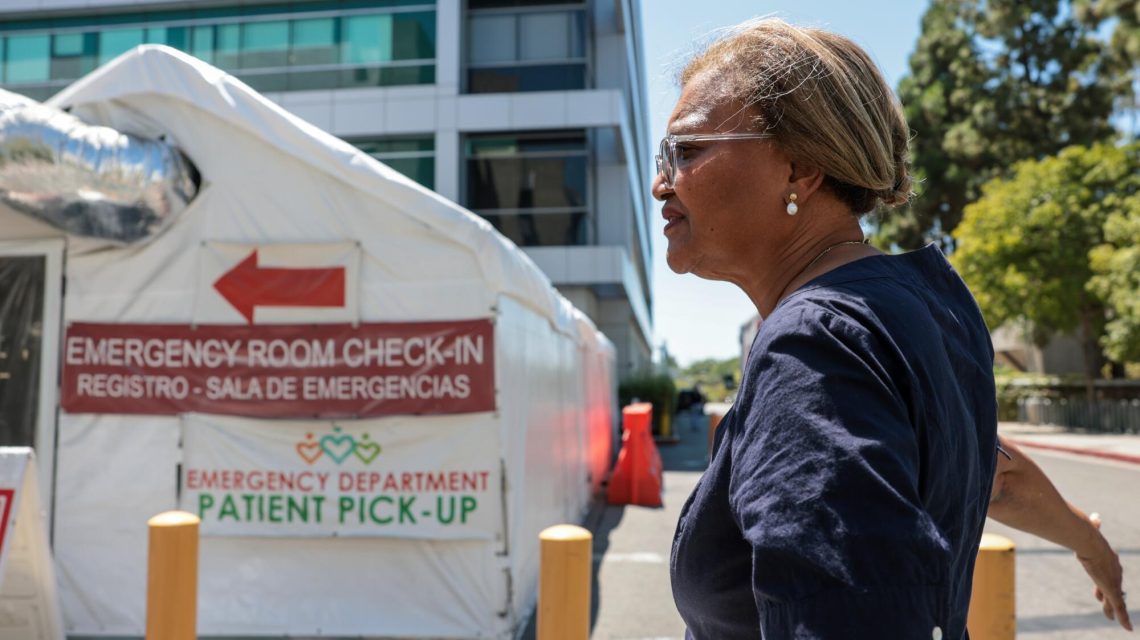
Martin Luther King Jr. Community Hospital in Willowbrook is a crucial emergency medical care facility for hundreds of thousands in South Los Angeles. Yet, the increasing demand for its services has led to an unusual situation. Due to inadequate space, patients often receive treatment in large metal-frame tents outside the hospital. This situation echoes the makeshift medical settings from the early COVID-19 pandemic.
The tents underscore the hospital’s severe financial situation. Leaders warn that without increased funding, the hospital may need to shut down. Despite reporting $14 million in net income recently, the hospital experienced financial losses over the past three years. Moreover, the One Big Beautiful Bill Act, or HR1, poses significant financial challenges by changing Medicaid eligibility and financing, potentially resulting in a loss of $80 to $100 million annually by 2025.
Tony Weiss, director of media relations at MLK Community Healthcare, highlighted the contrast between Los Angeles’s wealth and the hospital’s dire conditions. He criticized the need to treat patients in tents in one of the wealthiest areas worldwide.
Amid these challenges, hospital leaders are urging a reevaluation of the funds it receives from Measure B, a property tax that supports trauma centers and emergency medical services. Los Angeles County collected approximately $427 million via Measure B during the fiscal year 2025. However, ongoing funds prioritize county and private hospitals with trauma centers, excluding hospitals like MLK without trauma centers from consistent funding.
Between 2023 and 2025, MLK hospital received $68 million in bailouts from the state and county. Yet, it did not receive ongoing Measure B funds. Additionally, $126 million was awarded to 13 private hospitals with trauma centers, including Cedars-Sinai Medical Center.
Cedars-Sinai, a major hospital with substantial resources, opposed changes to Measure B funding allocations. Stephanie Cohen, vice president of government and industry relations at Cedars-Sinai, stated that reallocating these funds could undermine existing systems. Sally Stewart, a spokeswoman for Cedars-Sinai, reiterated the risk of changing the allocation formula.
MLK hospital’s CEO Dr. Elaine Batchlor pointed out the disparity in funding between hospitals like theirs and others better equipped financially. The hospital faces overcrowding and has been forced to adapt by doubling hospital room occupancy and converting spaces like the gift shop into medical areas.
Batchlor emphasized the need for reassessment of Measure B funds to support hospitals serving financially needy communities with limited healthcare options. She advocated for changes to ensure sufficient funding for their survival.
Changing the allocation formula risks undermining the system that Measure B was designed to protect and sustain.
Dr. Naman Shah of the L.A. County Department of Public Health voiced concerns about the current distribution of Measure B funds. If MLK hospital closed, it would severely impact access to care for the community.
In 2023, MLK hospital saw nearly 85,000 Medicaid/Medi-Cal patient visits in its emergency department, significantly higher than Cedars-Sinai’s 17,000 visits. Most visits involved uninsured or Medicaid/Medi-Cal patients, relying heavily on state and county funding.
Local leader Pastor Robert Taylor emphasized the importance of redistributing Measure B funds to meet community needs, warning that the hospital’s closure could lead to dire consequences.
Los Angeles County Supervisor Holly Mitchell is exploring how Measure B funds are allocated. She plans to propose hiring a consultant to assess and recommend optimal fund distribution strategies. Mitchell underscored the need for all hospitals, regardless of financial stability, to play essential roles in the county’s emergency care system.
 Understanding School Shooting Preparedness Drills
  The War on Poverty: A Lesson on Intentions and Outcomes
  Florida Reports First Dengue Fever Death as Outbreak Expands
  Federal Relief Funds Used for Anti-Racism Training in Albuquerque Schools
  Florida Man Claims ‘Lion Diet’ Transformed Health and Life
  Concerns Over Food Safety and Its Impact on Families