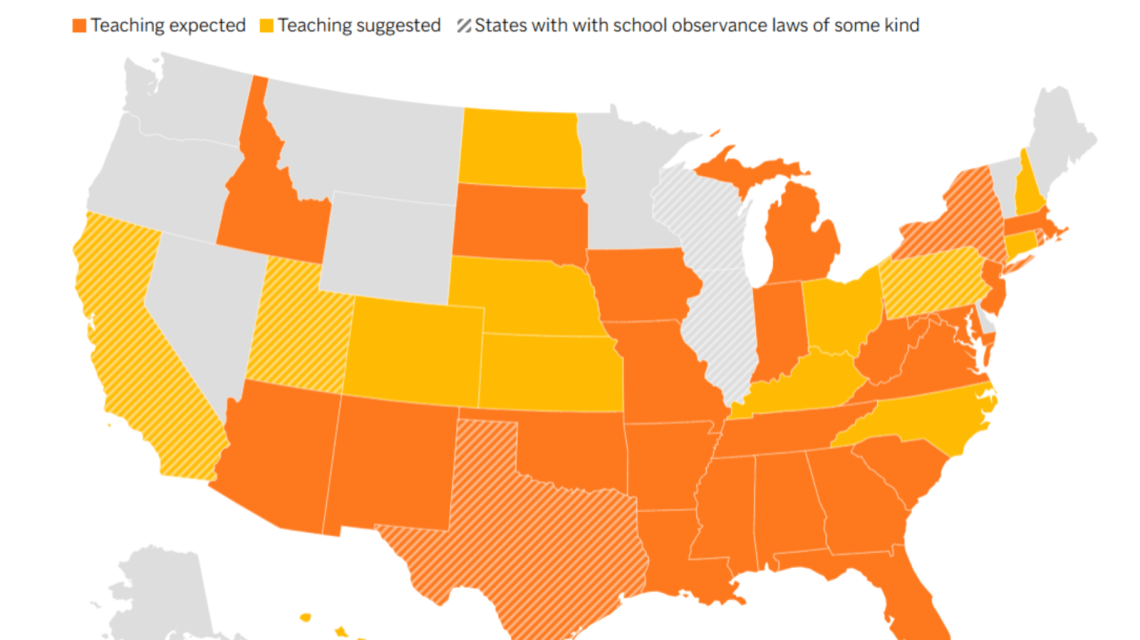
As the United States approaches the 25th anniversary of the September 11 terrorist attacks, many states are implementing policies that require or encourage schools to teach students about this significant event. According to The Associated Press, 40 states expect or suggest public schools to address 9/11 in some way. Of these, 25 states have laws or education standards specifically requiring instruction on the attacks. An additional 13 states include optional references to 9/11 in educational guidance, while several others recommend observances such as moments of silence.
Approximately one-third of Americans were born after the attacks, meaning current students are distant from the events of September 11, 2001. Jeremy Stoddard, an education professor at the University of Wisconsin, indicated that teachers increasingly view the attacks as historical events instead of personal experiences. Today, educators emphasize how policies following 9/11 continue to affect students.
States have varied approaches to teaching 9/11. Some require dedicated instruction on the attacks and their aftermath, while others incorporate the topic into broader U.S. history, civics, or discussions about terrorism and foreign policy. For example, Alabama mandates the study of U.S. military actions post-attacks and evaluates the effectiveness of the response, including the creation of Homeland Security and the Patriot Act. Arizona enacted a statewide requirement for age-appropriate education on 9/11 annually, later narrowed to grades seven through 12.
Why Teaching 9/11 Matters
With fewer students connected personally to the attacks, teaching about 9/11 becomes increasingly crucial. Educators face challenges because many students, and more teachers, lack direct memories of the events. Stoddard notes that students do not share the same emotional connection or collective memory.
Gordon Felt, whose brother Edward Felt died aboard United Airlines Flight 93, highlighted the importance of educating about 9/11. He considers the total omission of the story worse than incorrect or inappropriate language. Teachers gathered at the memorial in Pennsylvania to discuss educating a generation born long after the attacks. Stoddard observed that classroom approaches have evolved, with educators now focusing more on the lasting impact of post-9/11 policies.
Following the attacks, roughly 60% of states did not mention 9/11 in their education standards. Curriculum requirements have expanded significantly over the past decades. States that include it in educational content appear to delve deeper into the subject than before.
A Diverse Approach to Teaching 9/11
The national picture of how states teach 9/11 varies. Key categories include:
- Dedicated Instruction: States like Arizona and Florida require explicit instruction on the attacks.
- Curriculum Standards: Alabama, Arkansas, Georgia, Idaho, and several other states incorporate 9/11 into social studies content.
- Commemoration: States such as California, New York, and Pennsylvania have laws on moments of silence or observances.
Another group, including Alaska, Colorado, and Connecticut, suggests content without mandating specific instruction. Minnesota, Montana, and other states have no identified statewide 9/11 policy. Stoddard’s analysis noted that differing methodologies often lead to varying totals of state standards. An earlier University of Wisconsin study identified fewer states with explicit 9/11 requirements due to its focus on official standards and legislation.
 Independence of Research from Political Agendas
  Unsupervised Play: The Benefits Over Commercialized Youth Sports
  Colleges Should Handle Tuition with Care
  Federal Relief Funds Used for Anti-Racism Training in Albuquerque Schools
  The Importance of Financial Responsibility in Higher Education
  The Financial Expectations on Universities: A Parental Perspective