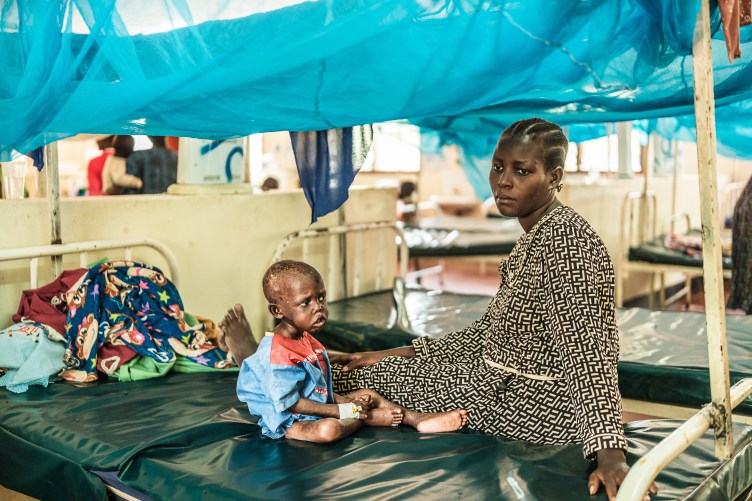
Rose Natabo faces a heart-wrenching choice. At dawn, she bids farewell to her firstborn, leaving him behind as she hurries away with her youngest son, Santo, and middle child, James. They are seeking help, her pink sandals clapping against the dry earth. Hours later, they arrive at the only hospital in Kakuma, Kenya’s third-largest refugee camp, after a harrowing journey past soccer fields and slums.
This camp, housing those fleeing wars and disasters, offers little solace. Rose joined a throng of mothers at the pediatric malnutrition ward, only to discover that food rations were slashed. The reason? The World Food Program (WFP) lost its primary funding source—the United States. Despite pleas from aid workers and government officials, the Trump administration’s funding cuts remained, leaving families like Rose’s to watch their children starve.
Trump’s team claims reforming the foreign aid system required such disruptions, a senior State Department official states.
For the WFP, this meant informing 300,000 refugees that fewer than half would receive a modest food portion in August. Rose doesn’t know if her family is among the lucky ones or if her sons can make it until then, especially two-year-old Santo. Nurses struggle to insert an IV into his swollen body, a result of severe protein deficiency, forcing them to resort to the veins on his head.
Under the harsh hospital lights, Santo receives careful feeds as his body adapts to starvation. By July 16, Rose’s five-year-old James is discharged, having survived malaria—a deadly risk for malnourished children. Rose stays with Santo, aware her other sons might be suffering without her.
As August arrives, Rose becomes a constant presence in the clinic. She sees mothers arrive with sick children, many leaving empty-handed. Some mothers, desperate for information, leave their hospital beds to check on their children. Rose wrestles with the temptation to do the same, fearing for her children’s wellbeing.
“I don’t want my kids to suffer alone,” Rose says, crafting a necklace for Santo, channeling her anxiety.
As a South Sudanese refugee, Rose copes with the trauma of fleeing civil war to Kakuma. She contemplates joining those returning to South Sudan despite the hardships. Her situation became more precarious when it’s revealed that she’s pregnant, adding to her health concerns. Anemia threatens her and her unborn child, as nutrition counselor Jane Atim advises on the importance of a balanced diet—a nearly impossible task given their circumstances.
Rose decides to leave the hospital with Santo, ignoring the doctor’s advice due to her inability to leave her other children alone. She gathers her modest belongings and embarks on the journey back to her sister’s home.
At home, her sons Lino and James eagerly greet Santo, but their conditions worry Rose deeply. Their malnutrition is evident as Rose strives to maintain hope. The Red Cross conducts malnutrition checks, but supplies are limited due to disrupted funding. As a result, Rose receives only minimal nutritional supplements for her children.
On October 5, Rose gives birth to a daughter she names Sunday. But their struggle for food continues, even if recent WFP rations have improved slightly. Still, her sons’ health deteriorates, and Santo’s condition worsens, leading to another hospitalization.
Despite efforts, Santo’s frail body cannot recover. He passes away two weeks after his November admission, underscoring the precarious conditions faced by many in Kakuma.
 Escalating Conflicts and Diplomatic Efforts in the Middle East
  Iran’s Struggles in the Strait of Hormuz
  Navi Pillay Awarded Nobel Peace Prize for 2026
  Jimmy Kimmel Jokes About Trump Ahead of Nobel Peace Prize Announcement
  China’s Espionage Activities in the U.S.
  Controversial Rap Song Sparks Investigation Amid French Protests