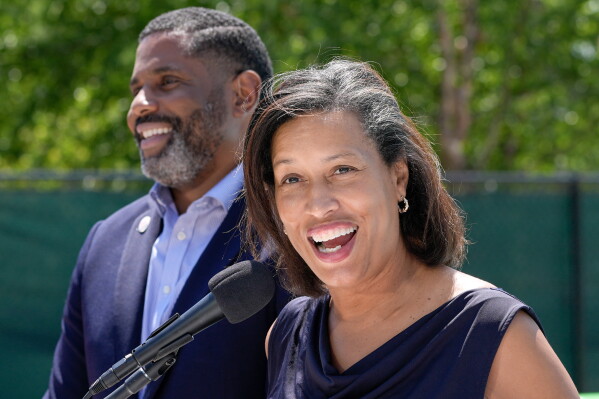
A year ago, President Donald Trump declared a crime emergency in Washington D.C., deploying the National Guard with promises to make the city “safe and beautiful.” Initially perceived as a short-term measure, this deployment has now been extended through January 2029. Local officials and residents view this as an intrusion on the city’s autonomy, especially in the heavily Democratic capital.
Scott Michelman from the ACLU of the District of Columbia articulated the irony of this situation, questioning the need for what seems akin to a police state in a city known as the capital of the free world. Residents have observed National Guard troops in their communities for a year, challenging what they see as a lack of a genuine need for such measures.
“There’s a deep irony that here we are in the capital of the free world, and our president is treating it like a police state,” Michelman stated.
Trump’s strategy, announced on August 11, 2025, included a federal law enforcement surge aimed at crime reduction. As of August 4, over 4,600 military personnel remain deployed in D.C. Their presence is visible in both police operations and tourist areas. While some residents appreciate assistance with medical emergencies and beautification efforts, others question the necessity and financial implications of the $1.4 billion extended deployment.
Despite these measures, crime statistics have shown a notable decline. The Metropolitan Police Department reported a 20% reduction in overall crime compared to 2025, with homicides down by 32%. Nonetheless, debate persists on whether these reductions result more from local efforts than the federal intervention.
Autonomy remains a vital issue for newly elected officials in Washington. The city’s unique status as a federal district under the Home Rule Act of 1973 gives the president considerable control over D.C.’s police and National Guard. This political landscape facilitated the deployment and restricts local leaders’ capacity to counter it.
Democratic primary elections in June emphasized D.C.’s autonomy and statehood. Janeese Lewis George, expected to become the next mayor, and Robert White Jr., the Democratic nominee for D.C.’s congressional seat, have focused on these priorities. They aim to rally residents and allies to influence congressional elections, drawing inspiration from past political strategies.
Muriel Bowser, D.C.’s outgoing mayor, has avoided aggressive rhetoric against Trump, focusing instead on maintaining the city’s limited independence. Her office emphasized safety and home rule as top priorities in an email statement.
Concerns arise about National Guard presence during future elections. Activists like Alex Dodds worry about the implications of having troops on the streets during potentially volatile political transitions.
Resident Donna Powell expressed a desire for funds to be redirected to healthcare and food assistance, underscoring a sentiment shared by many that the deployment is unnecessary.
 Controversy Surrounds Abdul El-Sayed’s Senate Candidacy
  Chuck Edwards Exits Re-Election Race Amid Ethics Controversy
  South Carolina Republicans Face Uncertain Senate Primary
  Darline Graham Continues Late Brother’s Legacy in Senate Campaign
  State Department Revokes Over 175,000 Visas Under Trump Administration
  Bipartisan Effort Brings Wildfire Relief to California Residents